Tuesday night, A and I rounded up some friends for a little "tee time" at the 4th Annual Holocene Minigolf Art Invitational. Each year, the organizers enlist a roster of artists, designers, galleries, and stores to build out their dream putt-putt holes. In past years, there have been 3-D fun houses, giant labyrinths, life-size atari games, and a whale with an air-jet blowhole that ejected your golf ball. People get seriously ambitious - it almost puts the Adult Soapbox Derby to shame.
This year, I'd say the course was even stronger and the holes were definitely more playable. One green was populated with fey garden creatures and over-sized, candy-colored radish flowers. Another was a modeled critique of our crazy car-culture and freeway system. Free pancakes (and self-esteem boosts) were served for every hole-in-one. And overtop of it all, they projected Caddyshack on the walls and hosted club-circuit regulars to DJ the festivities. It's that classic love-it or hate-it Portland event. You either embrace the self-aware, irony-laden quirkiness or end up muttering bitter things about the "creative class."
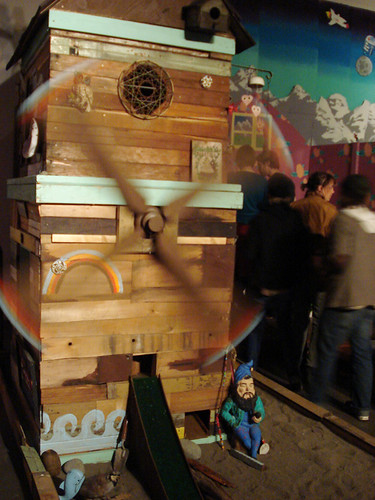
But if you're too busy wandering around sulking over hipsters, you might get nailed by a vicious windmill with its fast-moving ceiling fan blades!
And wouldn't that just be a horrible way to go? Getting a concussion from a salvaged-wood cabin covered in dream catchers and garden gnomes. Ha!
Even though most of my photos were drunkenly blurry (the tournament is held at a bar, afterall), I did manage to find one of my favorite holes online:
Everyone else was really into the mustachioed bunny, but I would have taken home that little Indian headdress bird in a heartbeat. He's like a lazy-eyed neo-hippie. Priceless!
You can see more (re: less blurry) photos on the Portland Mercury's website.
Thursday, February 26, 2009
putt putt putt


Thursday, February 19, 2009
pok pok express, now servicing new stops
I think people are generally surprised at our answer when they ask A and me to name our favorite restaurant in Portland. The quizzical looks on their faces always betray that they were expecting a refined, European-inflected restaurant or a rustic, farm-to-table bistro in the vein of Chez Panisse. Sure, there are plenty of both in our top 10 list, but no, our favorite is a Thai place. Granted, this certain Thai place happens to be Pok Pok, so anybody who's surprised at out choice must never have been there.
I'm not quite sure how to write about Pok Pok without embarrassing myself (or A). Whenever I tell people about this place, I tend to get a little worked up, mixing up my words and talking a bit too loudly. But seriously, the food is un-damn-believable. Unless you've been to Thailand, it's probably completely unlike anything you've ever tasted; Pad thai is absent, as are all other Americanized dishes. In their place, Pok Pok serves Southeast Asian drinking food with a nose for authentic (and esoteric) flavors. Fiery hot barbecued boar collar with iced mustard greens, turmeric-hued catfish stew, salads with sawtooth and betel leaf, and addictive fish-sauce wings. Every dish is mouth-wateringly spicy and alluringly aromatic. As proven by this review, owner Andy Ricker is devoted to his ingredients. This is a man to be trusted when it comes to Asian food.
When we moved into our current apartment, it only took one ride on our nearest bus line to realize that, if we took it all the way through downtown and back over the river into Southeast, that it would be deliver us on Pok Pok's front lawn. We christened it the "Pok Pok Express." Since we moved in, we've been 2 (3?) times and still haven't used the bus to get there. But each day, as we commute to and from work, it's a struggle not to just keep on riding in the direction of Pok Pok's heavenly khao soi. Now, the temptation has become even worse.
For months, Portland food writers have been frantically swapping gossip about Pok Pok's rumored expansion into Chinatown. Now, Ping has finally opened. And it is right at our downtown bus stop. As a partnership between Ricker and John C. Jay of Wieden + Kennedy, this place has quite the pedigree of cooking chops and hip branding. The future is bright.
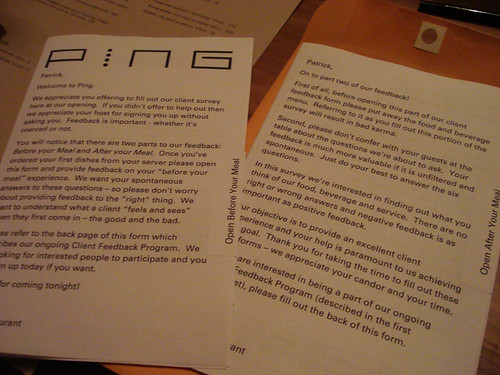
Now, you can chalk it up to being a superfan, but as soon as their placeholder website went live, I'd already signed up for their mailing list. As one of the overeager first, A and I were invited to a preview night for the restaurant last Saturday. The look on A's face was priceless - it was like getting asked to head backstage with her favorite band. Sometimes, there's a payoff for being obsessive.
Right when you step inside, it's got that same kind of cool as Clyde Common, another favorite of ours. The kind of cool where you feel hipper for being there, instead of thinking you're not up to par with the other patrons. Let's call it "inclusive cool." But even more than being hip, it feels established, like an old and weathered noodle house. From the wall of antique radios to the vintage tin advertisements, every detail is carefully considered and well-placed. It's how I imagine I'd style a restaurant were I to open up shop.
I can already tell Ping is going to enter our "heavy rotation," mainly because nothing on the menu would have seemed out-of-step at Pok Pok. Even though Ping expands the scope to include dishes from Japan, Korea, China, Macau, Singapore, Malaysia and India, everything is prepared with the same attention to native detail and eye-opening flavor. What I can confidently report from our representative "smattering" of their dishes is that the food is Good and Unique. So what did we try? Chicken heart skewers, fish balls, kopitiam toast (coconut egg jam), steamed gai lan, salted duck egg salad, ju pa bao (Macanese pork bun), and pet pha lo (aromatic duck leg stew). Every one a winner.
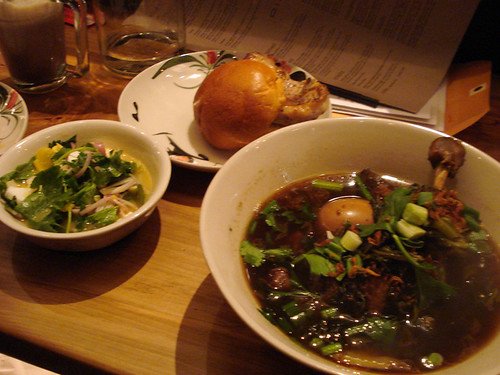
The chicken hearts had a rich, irony, and essential flavor, while the grilled kopitiam toast made for an unusually sweet and nice starter. We ordered the gai lan (Chinese broccoli) half-accidentally, but ended up pleasantly surprised by how light and flavorful this dim sum staple was prepared. Ping's pork bun was the end-all-be-all of literal interpretation: a whole pork-fried pork chop nestled into a halved, sweet, brioche bun. Pork + bun. Very satisfying. Of everything we tasted, I think the pet pha lo stood out the most. Rich with star anise, the brothy stew played really well off of the pickled mustard greens and chili vinegar accompaniments. My mouth is watering just to write about it.
Well, A and I can safely add Ping to that growing list of crave-worthy Asian restaurants we daydream about. If it weren't for a prior commitment on Tuesday night, we might have already headed back for their official opening, and a for a bowl of the ramen we missed. It may just be that I'm starting to feel a bit of Euro-pub burnout, but 2009 is shaping up to be a year of Asian food. Welcome to the 21st century, right? Still, I'm starting to worry that it might be a tad geeky to get this excited about Asian food. We'll see what my co-workers say when I start bringing in kimchi for lunch...

Monday, February 9, 2009
infographics
Recently, I read my first book by Edward Tufte, Visual Explanations. Brilliant! Tufte's obsession is with improving how we share and use ideas and, to that end, he's written a series of books examining and critiquing the information design of charts, graphs, tables and diagrams. This may sound like I'm starting off a really dry post here, but his book was unbelievably fasciating and really beautiful. Since he couldn't find a publisher who would produce the books to his standards (and that means full-color photos, annotations and moving flaps), Tufte has committed himself to self-publishing. The results are like pop-up books for designers! Just look at this page from the book that explains the importance of scale:
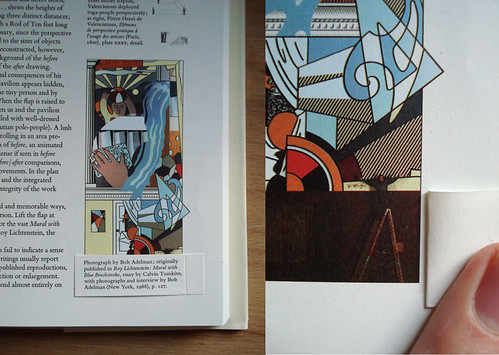 The Lichtenstein mural looks small as it's printed on the left
(until you see the artist standing next to it). It's all relative.
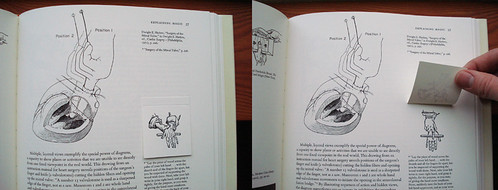
Basically, Tufte shows that the same rules apply to visual information design no matter the subject and, at the base of all of these examples, everything is subjective. Just by omitting certain details or changing the color-coding or scale, Tufte points out how the same data can be used to reach drastically different conclusions. I never thought I'd be particularly interested in the the first epidemiological study of a cholera outbreak, but with the right design, I was enthralled.
Ever since reading Tufte's book, I feel like I've been on the patrol for well-designed charts and diagrams. If you spend enough hours on the internets, you're bound to find something worthwhile.
GOOD magazine has, across the board, pretty exceptional design. I guess that it's what happens when a bunch of design-savvy, future-obsessed progressives found a magazine. Good stuff. As part of their work, they produce really engaging videos for their Transparency series that detail hidden costs and overlooked facts about the world we live in. Just take a look at this sharp clip about water resources:
Hot. Last year, they also launched a brief series of broadsheet-style charts that gave a sort of "state of the union" in the months surrounding the election. Their GOOD sheets applied beautiful design to explaining historically slim election margins, immigration rules in the US, the "first 100 days" of a Presidency, and holiday-season shopping.
While the graphs and charts that GOOD produces tend towards the macro, a new website, called Daytum, gives a stylish way to track the highly idiosyncratic details of your personal life. In early December, I set up my own tracking and have been trying to diligently record some of the mundane things I think and do. In my mind, this is what Twitter and Facebook and all of those social networking sites should have been - just the facts, well-designed, and slightly comical. The holidays lent themselves perfectly to quantification - now I know exactly how frequently I hummed "Little Drummer Boy" to myself (9):

I have to say that after two months of following a few statistics, it can be tricky to keep it spontaneous. When I log in to record one change, it's hard not to end up thinking, "Do I have anything to change on these other charts?" Then it becomes an issue of influencing the results of the "study." Did something actually change, or am I making up a reason to adjust the numbers to keep things interesting? I should ask my sociologist wife about this.
Given the slick design and tip-top usability, it shouldn't be surprising that Daytum is the brainchild of Nicholas Felton, a shockingly obsessive and talented designer who's best known for his Annual Reports. No, not like "really well-done reports for major companies" - more like "really hyper-detailed reports for the minutae of his daily life." Just look at this spread from the 2008 report:

If that seems detailed, you should know that the maps included in the printed version of this year's report can be assembled into an icosahedron globe of his movement patterns. I absolutely love this guy and I'm amazed by how his brain works.
But Felton's definitely not alone in his rigorous self-observation. He was invited by PRINT magazine, along with a few other diligent data recorders, to follow a single week using a medium of their choice. The results, captured in photos, drawings and charts, show everything they consumed. While I found this project clever, the neurotic tracking of certain others can begin to give me the jeeblies. The Quantified Self is a new movement for greater understanding of our lives, beginning with more detailed recording. As you can read in this article from GOOD, its adherents chart their pains, sleep cycles, sex, calories and mood. As much as this stuff fascinates me, I have no interest in weighing my food and counting my breaths. For now, you'll just have to put up with my tracking the foods I wish I were eating. Not that you probably want to know any more than that.
Sorry if this is falling into a bit of rambling, but there is really just so much of this stuff out there to enjoy. If you want - no - if you need more charts, Visual Complexity provides a clearinghouse for visual data mapping. Some of them are just pretty to look at.
There is also this taxonomy of heavy metal band names.
In a long string of web-recorded personal geekery, let's just look at this post as keeping up with tradition.
Monday, February 2, 2009
six more weeks...
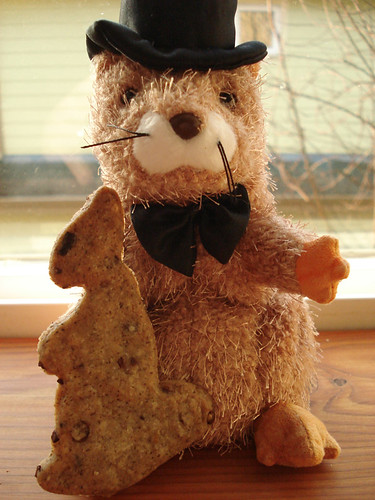
Yes, we made cookies.
Yes, that is my very own groundhog-shaped cookie cutter and top-hatted rodent. I also have a mug.
Growing up, my family celebrated Groundhog Day each year as diligently as any church holiday and I could never figure out why my peers didn't mark the day with cookies and cards like we did at home. I'm not sure if any of us can remember how the festivities began, but they certainly haven't let up over the years. Maybe it had something do with my dad being a librarian; after all, Punxsutawney Phil spends the other 364 days of his year in the Groundhog Zoo at the Punxsutaweny Memorial Library.
Yes, I've proudly visited him there. (We always did a lot of library tourism on our vacations.)
For those of you who don't mark rodent-centric holidays on your calendar (February 2 - remember it for next year!), here's a little run-down: based on German superstition, if a groundhog sees his shadow on Candlemas, then it bodes 6 more weeks of winter. Sure, Spring is technically in about 6 weeks anyway, but this holiday gives the folks of Punxsutawney, Pennsylvania an excuse for lots of top-hats, braggadocio and some pretty epic mustaches. A lot of other cities (all with equally baffling names) boast their own groundhogs and their predictions can vary wildly. I would recommend that they all band together to form some sort of unionized weather service, except that I know the rest of them are impostors. Shubenacadie Sam? Staten Island Chuck? Bah.
If (for some reason) you didn't get up at daybreak to watch Phil's prediction live this year, you can still see it on groundhog.org. The fact that Phil snagged that URL is enough for me to legitimize his prognosticating primacy.
My favorite part of this year's holiday coverage was that GOOD magazine compared him to a soused gambler:
"Phil has a motley track record. At 30% accuracy, he doesn’t even beat the flip of coin; he’s more like a drunk at a poker table: You could make money simply by betting against him."
And yes, that was part of an article using the movie, Groundhog Day, to illustrate complex ideas in economics, physics and theology. Who could blame theorists for trying? That film is fantastic. Last week, I came across an artist online who was illustrating a book of famous Bills and Williams in mock masonic garb called the Billuminati.
Yes, the Bill Murray spread was the best.
And yes, Punxsutawney Phil saw his shadow this morning, predicting six more weeks of winter.
Tuesday, January 27, 2009
year of living awesomely

I can not think of a year in recent memory that has begun with such a glum national mood as 2009. It was as if everyone collectively decided that the end of 2008 was so disheartening (I'm looking at you, economy) that we might as well resign ourselves to this year being even worse. Time to hunker down, hole up, and stick it out. Let's call it the "Year of the Fallout Shelter."
Now, what surprised me was that a lot of writers didn't necessarily take the same tack. While there have certainly been a fair amount of dire predictions for restaurants and shops closing in the coming year, a lot of critics seem like they took it upon themselves to argue against their own apocalyptic visions and implore readers to think about the impact of their dollars.
Portland Mercury's Not Invited Back 2009 list featured a rant against "status dressing" that offered this positive upswing:
Taking its cue from a time when purchases were made bearing the long term in mind, and quality took precedence over mass-marketing and instant gratification, even the fashion world is adopting a more serious approach. And with manufacturing jobs in your country, and your city, directly affecting the quality of your own life, you might find yourself more inclined, when you do spend, to put your money back into the hands of your neighbors.That same issue interviewed local designers on their advice for the new year, to which Moth Love owner Gretchen Jones responded that 2009 should focus on:
Simplicity in design/function/production. Inflated outsourcing of overly available goods versus handmade, independent, and SLOW (made-to-order) fashion. Approach design uniquely. Be savvy in your selections and who you support. Yours is mine, is ours, is mine. This is the time to refine.There it was - another plea for carefully-considered shopping. Over the next few days, I caught notice of similar sentiments in a lot of New Year's articles and not just on fashion. Food critics implored their readers to patronize local restaurants more in the coming year and Carrie Brownstein, over on Monitor Mix, resolved to better her concert-going, paying more money for worthwhile bands and avoiding free shows.
But of all the articles and ideas I've collected, the one that keeps resonating for me comes from last November, though it perfectly primed me for everything I later read. Bruce Sterling, on the Worldchanging blog, called for a dramatically redefined relationship with our stuff. (To really get into it, read past some of his first thoughts on global living to the second-half, when he starts talking about the "hairshirt green" mentality.) Sure, there is some geeky multi-tool evangelism in there, but these ideas are really rich:
You need to re-think your relationship to material possessions in terms of things that occupy your time. The things that are physically closest to you. Time and space.Read the whole damn thing. Seriously. It's simple and encouraging advice:
Do not "economize." Please. That is not the point. The economy is clearly insane. Even its champions are terrified by it now. It's melting the North Pole. So "economization" is not your friend. Cheapness can be value-less. Voluntary simplicity is, furthermore, boring. Less can become too much work.
-Only own things that improve your life in some way (you can set those terms).
-Buy fewer, nicer items from which you'll get more use.
-Live better.
Even though his general idea is familiar, Sterling brings to it a new emphasis on quality of life. Women's magazines have been preaching a similar ethos for years (how to style one dress for five looks), but always with the focus being on frugality. The "voluntary simplicity" movement has also argued a related concept, but all too often, as Sterling points out, it's quickly been pushed to the extremes of "buy nothing" day, which doesn't work towards any improvement of a system, just its refutation. Where, then, is the room for deliberate, positive action?
So, before this post becomes a bibliography of all of the things that have been bouncing around my brain recently, I'm going to (try to) lay out my own little synthesis of all of these New Year's predictions and exhortations: the P & A economic stimulus plan!
It comes down to this: take Sterling's idea, but extend the quality of life concept to your community. Make your purchases from businesses that make good neighbors. Choose products that contribute to a better world. Easy.
Really, this shouldn't be difficult to adapt to this idea. You already make these decisions about the kind of world you want to live in all the time when you make purchases. For example - do you want to live in the kind of world where you don't stink? Then you buy deodorant. See how simple this will be?
First off, this is going to mean some serious spring (February?) cleaning and editing. We'll clear out the things we never use and put them under the scrutiny of a 17-year old at Buffalo Exchange to see if we can make a few bucks back on them. Anything we can't sell is going to Goodwill.
Now I'm not advocating for going on a shopping spree to single-handedly kick-start the economy, but I am saying that purchases are inevitable and they need to be considered. For us, this might mean that when we replace our computer, we do it at a local shop. If we're needing new threads? We'll make fewer, smarter purchases from better boutiques and stop wasting our time with places that sell serialized fashion. And when we're hungry (which we'll inevitably and frequently be), we'll make sure we're eating at restaurants we love and continuing our farmer's market boosterism. Skip IKEA. Forget Target. Go vintage and handmade and locally-owned. The trouble will surely come with the basics - how many small office supply stores are in business any longer; is there even a place to buy socks and underwear that isn't in a mall? It will be a year of searching these places out.
2008 shaped up to be the "year of doing it for ourselves" - preserving, baking, stitching, cooking, and making of all sorts. Now, those practices have become so ingrained in our routine that it's difficult to remember how we passed our time before them. They certainly won't be going anywhere, but for 2009, let's get over the worn-out idea of a "year of living simply" and make this fun: a year of living awesomely.
Wednesday, January 21, 2009
feel those tingles?
If that photo doesn't make you well up with tears of pride, then take a look at the newly polished Whitehouse.gov and this video:
It's official.
Welcome to the "Goosebumps Presidency."

Tuesday, January 20, 2009
the alaska of the tropics, part two (big island)
P:
So, Alaska. I mean, Hawaii. I mean ... We (inevitably) got a little long-winded in our post about the first island we visited, which meant that I didn't get to explaining the title. Well, guess what? The title only gains more clarity on the Big Island.
As we drove along the edge of Kailua on our last day on Oahu, I suddenly had an insight (!) that Hawaii was a lot like somewhere I'd been before: Alaska. Maybe it's their isolation from the continental 48. Maybe it's that both states tendered prominent political candidates this year. Maybe it's their similar climates. Wait, scratch that - it's actually hard to put my finger on what exactly gave me that idea. But there are some similarities between the two states that are worth pointing out:
-a disenfranchised native population that's a tourist-draw (totem poles and luaus)
-incredible natural beauty
-rich and hearty local cuisine (moose? plate lunch?)
-senior citizens on tour buses (and cruise ships)
-blue tarps (seven out of ten homes in both states have a plastic tarp covering some sort of junk in the front yard - it's an empirical fact)
Granted, a place like Waikiki is a far cry from "The Last Frontier" to the North, but we did an admirable job of avoiding the touristy resorts and sticking to a little more of an off-the-beaten-path trip, making my comparison a bit more understandable. In the end, Alaska and Hawaii boast their own quirky cultures, where people lead lives unique from anywhere else in the states. I mean, where else would A have run off first thing in the morning in her pajamas to pick giant, tropical fruit from the top of a fence off of a neighbor's tree? Yeah, it probably wouldn't have been Alaska, but my point remains: Alaska = Hawaii.
A:
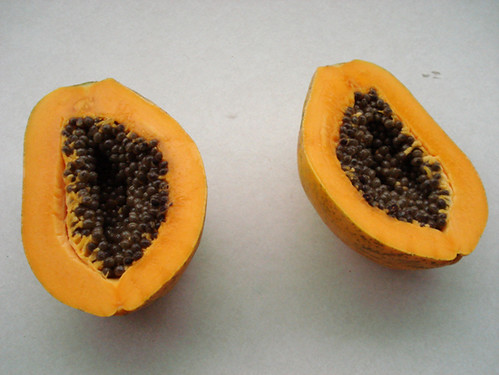
We had papaya trees in our front yard. Having arrived at our rental in the middle of the night, I first glimpsed the trees when I awoke the next morning. I picked the first papaya right off of our back lanai, but it was a small, under-ripe specimen and I knew it must be only the beginning. Thus, I set off to explore the rest of our acreage, and came back with two enormous, deliciously ripe papaya.
I don't know what came over me, really - it was as if my true, animal nature came bursting out of me and I had to hunt and gather. So, I hunted the best papayas (which just so happened to be right beyond our fence on neighboring land)...and once I found them, I gathered. Below, you will see the fruits of my labor.
Papaya is particularly good eaten cold, but we were so excited to try the fresh-picked fruit that we sliced one right open. The perfume was intoxicating, almost overwhelming.
Perfectly ripe and seductively sweet, I can safely say that I have never in my life tasted a better papaya. We devoured the fruit in a matter of minutes, and I was hungry for more.
As we drove into Kona later that morning, I noticed a sign for the South Kona Fruit Stand and immediately requested a detour. Though the smoothie bar and cafe were closed, the stand had plenty of exotic fruits for sale, most grown organically next door. Struck with the idea that I probably would not return to a tropical island in the forseeable future, I loaded up on everything in sight - local Ka'u oranges, Rangpur limes, butter pear avocados, mangos, organic estate-grown coffee, abiu, and haupia/lilikoi (coconut pudding with passionfruit). The pudding was a nice, mid-morning snack, as all of the fruit was a day or two from ripeness. The abiu - small, yellow fruit with a translucent flesh that has the texture of lychee and the sweet, rich flavor of vanilla pudding - were the most unlike any other fruit I've tried. Our bags bulging with treats, we trekked off to find snorkeling gear for P's introduction to the sport.
P:
As the storm clouds gathered closer to shore, we suited up for my inaugural foray out snorkeling. Even though it may make me a weenie, I'm not a big fan of swimming in lakes - the feeling of plants and fish brushing past me in the murky waters just gives me the jeeblies. So, to put it mildly, I was withholding judgment on snorkeling. It remained to be seen whether I'd be better with non-pool swimming if I could see with whom I was sharing the waters, or if it was best left to my imagination.
We'd been steered towards a sheltered bay that boasted a lava rock shoreline and a historic park: Pu'uhonua o Honaunau. The waves slapped me against rocks as I fumbled with my flippers, before I made an ungainly plunge out into the waters. Holy. Crap. That is one strange, claustrophobic feeling to be breathing underwater, through a tube, with your eyes wide open. But wow, did I see some cool fish: puffer fish, trumpetfish and too many butterfly fish to count. At about the same time as I reached my limit for swimming with the fishes, a torrential thunderstorm broke over the coast. I'd just climbed out of the waters, but A (a true lover of the sort of quiet time that snorkeling affords) was drifting further and further out, oblivious to the weather. She did eventually look up from her aquatic reverie to realize we were calling her back to shore.
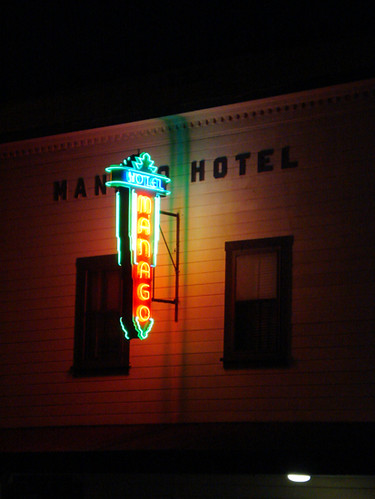
In October, we read a feature in Gourmet magazine about 20 great American restaurants from when the magazine was founded that are still going strong. Among them was the Manago Hotel, in Captain Cook, Hawaii, not far from where we'd been snorkeling. We'd called ahead that day to make a reservation, since the place still operates on plantation hours, meaning you need to be in by 7:30 pm to be served. The hotel dining room was not nearly as stately as that phrase makes it sound, but it was awesomely kitschy and probably hasn't changed since the day it opened. On the wood-paneled walls, a felt letter board menu listed the entrees and while almost everyone at the table ordered some local fish, I took the article advice and ordered the house special: a gravy-drenched pork chop.
Everyone at a table shared the family-style side sides, which came out with a pot of genmaicha tea before the rest of the meal. Sugary-sweet black-eyed peas, pasta salad, steamed vegetables and lots of white rice - island food circa 1950. With liberal dosings of soy sauce, we devoured most of the plates before our main courses even arrived. My pork chop was pretty delicious, covered as it was with a brown gravy and pan-seared on the bone, but A's choice of opelu, a less-fishy mackerel, caught all of our notice as the best-tasting fish at the table.
On our way back to our house that evening, we made a short detour to the southernmost bar in the US, Shaka Restaurant in Na'alehu. I don't mean to be a spoil sport, but they are resting on a tenuous claim - they're at least a few miles from the very southern tip of Hawaii. If someone wanted to be a huge jerk, that crown is there for the taking. Other than that, there's not much else to say on that front other than that my beer did taste very southern.
A:
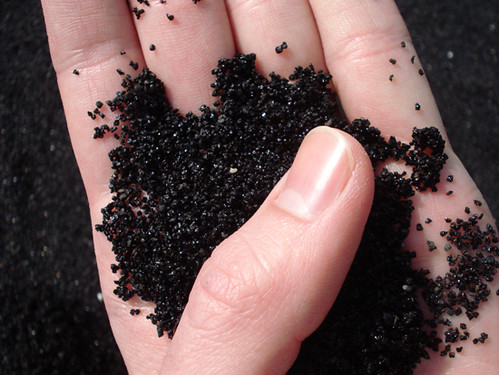
Our third and final day on the Big Island was volcano day. After a breakfast of cold papaya, linguisa, and toast with jaboticaba jam (grapes that grow out of the trunks of trees - my brother's find at the fruit stand), we set out for a black sand beach. Punalu'u beach is known for the presence of endangered sea turtles, that often drift onto dry land to sunbathe on the warm sand. We were lucky enough to see three while we were there - surrounded, of course, by tourists trying to get there picture taken with the turtles. It always astounds me when people blatantly ignore both posted rules and common sense, standing within inches rather than the suggested fifteen feet from the basking animals. I'll admit that I am particularly attentive to rules - perhaps I should be an officer of the law when I grow up? - but, seriously, regardless of regulations, is it that difficult to understand that standing nearly on top of living creatures might distress them in some way? And that maybe if you distress these turtles too much, you might not have a turtle to take your picture with next time around?
Off of my soapbox, and onto lunch. On our way into Volcano National Park, we stopped to grab food in a small town that was rumored to have outstanding malasadas. Unfortunately, the donuts were only available on the weekends, but the rest of the food at the unassuming cafe was surprisingly tasty. I briefly contemplated a hamburger made with local, grass fed beef, but eventually settled on the loco moco with fish. Traditionally consisting of white rice topped with a hamburger patty, a fried egg and brown gravy, ours replaced the patty with a cut of fish. Looking back, I wish I'd gotten the patty, but the meal was still a satisfying way to prepare for a hike through a lava crater.
Kilauae Ika erupted in 1959 and formed a lava pool at the base of the crater. The cooled lava now provides a short, scenic hike that begins and ends in rainforest and allows you to trek across the floor of the crater. We had lots of fun muttering from above about stupid tourists getting too close to the steam vents in the crater, only to head straight for them once we reached the floor. We even took a family photo next to one of them. It's always particularly touching when a family risks severe burns while posing for next year's Christmas photo.
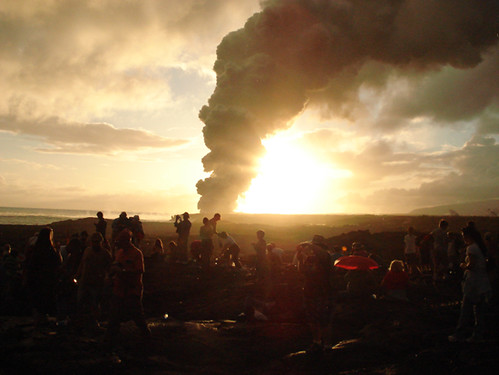
As late afternoon wore on, we drove out to the edge of the park where you could watch eruption meet ocean. Before dusk, the site is impressive enough - as you drive up through the lava fields and hike over cooled lava coils toward the viewing area, a HUGE, billowing steam cloud looms ahead. Every so often, a spray of rocks shoots into the air and the crowd collectively "ooohs". As dusk settles and the sun sets, however, the real show begins. The base of the steam cloud begins to glow red, and the shooting rocks become red sparks that burst into the sky. These were far and away the best New Year's fireworks I have yet to see.
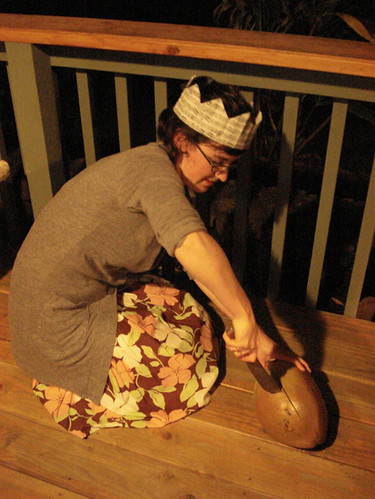
P: That night, with the spoils of a surprisingly good local grocery store and farmer's market, we made up a hodge-podge dinner to celebrate New Year's Eve. Thai fish curry to take advantage of the local produce; hoppin' john for some New Year's fortune. After a long day of volcano hikes, everyone began to crash by 10:30, but not before A could run outside with a coconut, a dull machete and a few glasses of wine in her. Looking back, I can not believe I let her tippsily hack at coconut in the dark, but then again, I was distracted by the sparklers. Between her efforts and her mom's even-more-nerve-wracking chopping, they split the outer husk and set to work boring out a hole for the juice. With the help of a lava rock, they split the fruit for everyone to taste and I remembered that I don't really like fresh coconut all that much. Thanks for your hard work, sweetie! It probably wouldn't have been a good end to the trip to lose her finger in Hawaii.