

I've often lamented the snarky tone and ADD brevity of the web, but I've also scorned the resistance of mainstream printed media to intelligently and unflinchingly re-assess their ailing industry. I'm speaking in broad strokes here, but where one medium has written itself into irrelevance by reporting staid news to an ever-shrinking audience (newspapers), the other medium has established an overly-democratic overabundance of shallow content (the internet). If you stop and look at the two outlets, then you come to realize that both in fact suffer from a similar flaw: a lack of well-considered news.
Now, that's not to say that you can't find good writing in both. Old standards like the New York Times continue to support incisive editorial writing and good columnists, and some blogs and websites offer analysis and reporting to rival the best of the traditional media. But part of the appeal (and shortcoming) of the internet is the openness; anyone can post their own take on the news without the oversight of fact checkers or editors. Sometimes this works, and sometimes this devolves into self-indulgence.
The issue (in my mind) is that as the internet has courted the market share traditionally held by newspapers, those papers have frantically tried to ape the qualities of the web - namely short, quick stories with little shelf life and a casual tone. Very infrequently has the internet tried to mimic newspapers. And why should they? They seem to be doing just fine as they are. But this begs the question: if the internet focuses mainly on up-to-the-second news and personal opinion - and newspapers try to follow this lead - then who is left to cover long-lead stories and in-depth investigative reporting? I have a hard time seeing the internet stepping up to fill this role.
I've spoken a few times with people about whether or not blogging encourages sloppy writing. The counterargument runs that the text is what matters, the rest is just container. To them, you could write a novel on a stack of post-it notes. But I think if you set out to write on post-it notes, you'd simply end up jotting down reminders. Humans suffer from a bias of "functional fixedness" - we're not, as a species, particularly good at imagining new uses for old tools. Once something works for a particular problem, what's the sense in shaking things up? There are many great writers throughout the span of the internet, but most people have trouble seeing the point in using the tool for anything other than gossip, banter, and infotainment. And even those who do see the point will have trouble finding any way to generate an income to fund good writing, good reporting, and investment in a news story.
But these are just musings. I don't have any answers about just how exactly newspapers will continue, or whether the internet will assume the many abandoned posts of traditional journalism. I think there is a great potential in both forms and have an unabashed love of each (for different reasons). But lingering on print for a moment, I have some hope for the future thanks to inspiring experiments like the McSweeney's Panorama.
I received a copy in the mail back in December and just finished reading it (all of it) last week. I can honestly say that I've never read that much of any single newspaper. I read the cover, the op-eds, the Book Review, the sports section, the arts coverage, the Sunday Magazine, the comics, and the food section. And I read a whole lot more that wouldn't easily fit into any previous newspaper I've ever seen.
But it wasn't a real newspaper; it was a one-off conceit of a literary magazine, an attractive daydream of what a newspaper could be. This is not to fault McSweeney's, just to acknowledge that the medium hasn't yet been revived. In truth, McSweeney's was probably the best possible outfit to attempt a project of this scope (320 pages! 150 contributors!). They have a breathless enthusiasm apparent in all of their ventures. Their approach is certainly infectious.
As I paged through each section on my first time looking at the paper, I kept interrupting A to exclaim at whatever new spread I held up in wonder. The whole experience felt like revisiting a childhood tradition. Lingering over a newspaper is one of those experiences that we sadly reserve today for those rare, lazy Sunday mornings. In reality, the experience of delving headlong into a newspaper should happen much more frequently.
The diversity of subjects is amazing. In the course of reading The Panorama, I read about DVD cover art, the environmental impact of Mendocino County marijuana operations, the 49ers, the Bay Bridge, lamb butchering, an out-of-print novel by an Irish author, and the reasons behind choosing public education for your child. Say what you will about the glories of the internet, but it strikes me that newspapers were the original form of rhizomatic learning, weaving an ever-deepening web of relationships, new leads, and wide-ranging (but interconnected) ideas.
Oh, and the design. What design! A large part of the pleasure of skimming the Panorama is sensory - 15 x 22" broadsheet pages with full-color, full-spread images. There are simply some things the internet (or, more accurately, a computer screen) can't approximate, and that is exactly the strength of McSweeney's newspaper gambit: to highlight the unique strengths of printed media. In-depth, lengthy stories; gorgeous design; immersive imagery. It would be a shame to lose these things to text-heavy, design-ignorant websites, but they already happen to be rare in newspapers. Perhaps this will serve as a wake-up call for newspapermen to embrace the limitations (and glories) of their medium.
I have a real fetish for printed objects: books, magazines, journals, daily and weekly newspapers. Let's hope The Panorama wasn't a last hurrah, but a rallying cry for creative explorations of the form.
Monday, February 15, 2010
the newspaper is dead, long live the newspaper.

Wednesday, October 7, 2009
ps

Through a summer of job transitions, art festivals, and over-extending ourselves with Slow Food, this blog has been pretty quiet. To get back into a rhythm, it's probably a good idea to look back, but, since I'm not overly ambitious, I won't be looking back very far.
Earlier this week, I walked over with a few of my co-workers to visit a pop-up publishing house. Publication Studio, the brainchild of Matthew Stadler and Patricia No, has squatted in the Ace Hotel Cleaners, where they are cranking out small-run novels and books. So far, they've published a catalog for a local gallery show, two short debut novels, and an annotated urban planning reader. When my work descended on the studio en masse, we bought them out of their day's printing of Lawerence Rinder's thinly-veiled fiction about his time as a curator at the Whitney. I guess working at an arts organization has made us predictable
It's true that I love a good book project, but I also love a good machine. To publish their on-demand books, the PS team has a high-speed duplex printer, a paper trimmer, and - to seal the deal - a perfect binder. I could watch this dreamy little video all day:
Publication Studio Makes A Book from Mike Merrill on Vimeo.
So far, I've been really impressed by what PS has released, and they already have exciting projects lined up through fall. In late October, they'll be participating in the 2009 Amsterdam Biennale, a decentralized art fair with satellite pavilions operating around the world. Portland's contingent will print a collection of single-run artist books, including some by two of my friends and co-workers. I'll certainly try to attend kick-off party on the 24th, with on-the-spot collaborative writing and early-morning gin. It's good to know that some (more creative) parts of the publishing industry still have a reason to celebrate.Friday, April 4, 2008
the godfather
We all have certain books sitting on our shelves that we know we ought to read, but always postpone. They frequently are books lent by friends or classics that we've been shamed into adding to our list. My own guilty example is Swann's Way by Proust. It is not something of which I'm proud - I picked it up when I was still taking French and because it struck teenage-me as a book that broadcasts intelligence - but when I notice it on our bookcase, it weighs on me with a heavy feeling of obligation. I've tried to read that book so many damn times and I just have to say: when a book begins with a discussion of sleeping habits, I'm probably not going to last.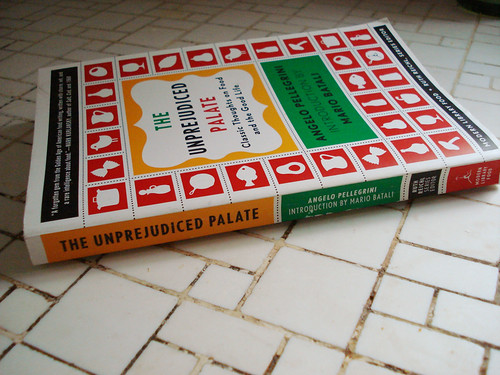
Do not mistake Pellegrini for some over-privileged epicure - all of his statements are firmly rooted in the value he places in honest labor and cultural knowledge. He advocates humility and tradition over decadence and indulgence and, because of this, sounds as though he is writing from the middle of the current dialogue over the politics of sustainable food. Over the last week since I read his book, I have come across numerous articles that show just how contemporary The Unprejudiced Palate is for having been written in 1948.
Last week in the New York Times, Eric Asimov offered his opinion on how parents should introduce their kids to alcohol, which brought to mind one of my favorite passages from the book:
"One summer morning several years ago, I was having an early breakfast with my three-year-old daughter in a small hotel in Utah. When the waitress asked what I wished to drink, the little girl announced to the bleary-eyed salesmen and the shocked grandmothers in the dining room that she would take coffee if they put a little rum in it. Since I had anticipated the possibility of frustration en route, I drew a little flask from my brief case and obliged the infant toper with a spoonful of rum in her coffee and milk. When we left the dining room, I felt certain that in the opinion of my fellow guests I hadn't scored much higher than an old soak and a corrupter of youth.
If, however, there was any wise among them, they must have seen in the incident a practical lesson in temperance. My daughter is now twelve. She still takes a teaspoonful of rum in her coffee and milk every morning. To date she has consumed approximately four thousand teaspoonfuls, or enough, say, to kill a whole circus of elephants."
This glib tone paired with common sense is absolutely classic Pellegrini. From the immigrant's point of view (Pellegrini came to the States shortly before the Depression), all of the brouhaha surrounding booze in the US is patently absurd and fully the result of a skewed relationship with food. "The self-appointed arbiters of the American's liquid diet," he writes, "have perverted that Hellenic virtue into a Puritan vice." Precisely by removing wine and drink from everyday conviviality and relegating it to bars, Pellegrini believes that Americans created their own drinking problem. Simply put: if you raise someone to appreciate the craft involved in alcohol and its place in a culture, they'll grow up to respect it.
Pellegrini argues that this embrace of excess in things that should be appreciated in their rarity is at the heart of America's distorted notions about food and health. One of the most interesting aspects of The Unprejudiced Palate is the abundance that Pellegrini finds in even the leanest of times and with the humblest of ingredients.
"A bunch of green onions, a few herbs, a handful of spinach, a little grated cheese and six eggs, can be fused into a delicious main course for the average family. The possibilities for going somewhere from nowhere are literally unlimited. They cannot be learned, of course, by those who persist in going to the grave on meat, potatoes, and gravy."
Because Americans have latched onto a handful of foods and consumed them in epic proportions, they have not only sacrificed their health, but also a lot of their ability to cook and even appreciate the value in alternatives to their current ways. By letting go of the myriad edible joys in the world and forgetting what they tasted like, it was a short step before stores were filled with imitation foods - the block cheddar "cheese" and bologna "salamis" that so perplexed the young, newly arrived Pellegrini. To me, this sounds a lot like Michael Pollan's recent talk in Portland in which he discussed the inviolable position of meat in the American diet:
But truly, the greatest argument Pellegrini makes for switching your diet towards more whole foods and vegetables is that, when freshly picked, there is simply nothing better:
"But above all else, they [two sewer-worker (and Italian) friends of Pellegrini] take great delight in eating what they produce in their gardens. While they argue about anything under the sun, and even about some things above the sun, they can never find reason to quarrel about this: that you can't beat what you grow in your own garden."
Across the country, growing numbers of people are currently seeing the value in replanting portions of their lawns or ornamental gardens with edible crops. In a sense, it is a return to the victory gardens that were so successful when Pellegrini was writing. Between a recent CHOW article on urban vegetable gardening, Fritz Haeg's Edible Estates, businesses like Your Backyard Farmer, and the "Food Not Lawns" movement, it is clear that people agree with Pellegrini on the importance of connecting with your food from soil to table.
"If you like your fruit ripened on the tree, bathed with the early morning dew or warmed to it very core by the midday sun, you must grow it on your little plot of earth. If you live in a climate where that is not possible, or if you are among the unfortunate millions caged in dainty little flats, I weep for you a brother's tears of compassion while I pray for your early release from bondage. But if you have the necessary facilities and still prefer the shade of the willow to the taste of a ripe peach, well, who am I that I should intrude upon your eccentricities?"
What struck me about the people's stories in the CHOW article were the vehemently negative reactions some of these gardeners received. It never ceases to amaze me how angry people can get when others strive to do better (or even just do "different"). Take for example this recent lambasting of Slow Food from Metropolis. I fail to understand where the author's apparent anger comes from - is he honestly defending McDonald's? Even if he is, how is it a problem for him that Slow Food hopes to preserve food traditions from being lost to the advance of narrowing, standardized food choices? And you don't have to read the well-written rebuttal (but you still should) to understand just how poorly Sterling understands what Slow Food does. All of his loaded language (ignore all of the word choices like "infiltrate" and just try looking up "myrmidon" in a dictionary) makes it seem as though Slow Food is a conspiracy to secure luxury comestibles for the super-wealthy. In fact, what Slow Food does is work to increase access for everyone to a diversity of foods - the very foods that used to (and, in many parts of the world, still do) sustain cultures that are the very opposite of privileged. And, I hate to have to explain it this simply, but food cannot exist in a vacuum - there need to be consumers in order for producers to have an outlet for their work.
So what really irritates me (& I believe would vex Pellegrini as well) is this tired and unfounded critique of enjoying good food as being elitist. As Pellegrini wrote (and he heaps just as much blame on chefs as on "gourmets"):
"They have broadcast a dastardly falsehood, perhaps to give a certain status to their labor of love - that cooking is an art. The implication of all their dithyrambic spewings on culinary matters, despite their protestations to the contrary, is that excellent food and drink are achievements in refinement beyond the attainment of ordinary mortals. [...]
The prevailing view seems to be that the preparation of a dinner in any way out of the ordinary means hours and hours in the kitchen and "an artist's touch" in the transmutation of ingredients. This notion, for which the precious cookery books are responsible, is as erroneous as it is widespread."
"...are sufficiently urbane and metropolitan to enjoy heartily a good dinner when it is served to them, but their gastronomic self has remained immature out of sheer neglect. [...] The difference between a gourmet and one who eats macaroni salad is precisely the difference between one who enjoys turnip greens and will bestir himself to satisfy a desire, and one who enjoys them but will do nothing about it."
To help restore the lost dignity of simple foods and cultural traditions, Pellegrini argues, we need to be willing to try our hand at tending our own gardens, stirring pots, and crushing grapes. We simply must reconnect with the labor and craft of eating. I can not imagine a better duty.


