Showing posts with label food. Show all posts

Friday, August 7, 2009

foragers

Couple a nationwide recession with a burgeoning food movement and you're bound to wind up with some foraging. Stylish foraging. News outlets have picked up on the trend (right behind the urban chicken coops craze), and they've raised its caché, even labeling it "the underground fruit economy." But these make-do tendencies have been around for a long time. Just think of old-school gleaners. Hell, foraging has even had indie cred for a long time.

Take LA's radical artist collective Fallen Fruit and their anarcho-ecological, Marxist guerrilla gardening. They started out by collecting the ignored produce of Los Angelenos' yards on nocturnal fruit walks, which have in turn become popular art scene happenings. The group recognized unused fruits and unplanted lots across the city, and have set out to expose the urban potential for food sovereignty.

Closer to home, Portland boasts the less-radical, but still exceptional Portland Fruit Tree Project and the community-generated wiki, Urban Edibles. The former is practically a fresh-fruit food bank, while the latter is much more DIY and under-the-radar. A and I have long thought about joining up on a Fruit Tree Project picking party or skipping the u-pick farm and gathering cherries on the streets. And yet, apart from some furtive handfuls of blackberries as we walk down an alley, we've always copped out.

-

I remember when we lived in Northwest Portland, I'd pass a Chinese couple in the mornings on my way to work. Both elderly, they'd be bent over collecting gigko nuts from the sidewalk. Others would pass by holding their noses against the sour odor of the trees, but the two people would stay crouched to the pavement with their bulging plastic bags. It was always jarring to see the two of them actually putting the wasted bounty to use.

-

Each year, A and I talk about all of the foods we'd like to experiment with preserving, usually after their seasons have passed. This summer, however, we had a seredipitous chance to both cross a new recipe off of our list and to scout out some neighborhood edibles. I can't remember when I'd first read about nocino, the Italian walnut liqueur, but something about it stuck with me. Ever since then, I've talked wistfully about tracking down green walnuts, but have never followed through. I'd thought this year's season had passed me by again, only to see a macerating jar of walnut fruits on the bar counter at Laurelhurst Market. While the tight-lipped bartender wouldn't reveal his walnut source, he did let us know that we probably had a few remaining days when the walnuts would still be soft enough to use.

That weekend, A and I fired up the Urban Edibles database and found a few clusters of trees in our neighborhood. On an early Saturday morning, we went out with grocery bags in hand and managed (after a lot of leaping and stretching) to knock down enough pounds of the hard green fruits to steep. We even found a few nut-bearing trees that we later added to the map.


At home, we chopped the nuts (which leak a thin liquid that stains everything it touches golden to green to inky black) and mixed them with a liter of cheap vodka according to David Lebovitz' simple recipe. The stuff smells high-test, and it's beginning to look potent; we have a few weeks left, and the brew already resembles motor oil. I suppose that's a fitting use for some walnuts we picked above our neighbor's parked cars.

Thursday, July 16, 2009

cherry-pickin'

Last Saturday we woke up way-too-early for a way-too-cold-for-July morning adventure. Yet, in spite of our groggy protestations, we knew we'd made a good decision as soon as we arrived at Sherwood Orchards. We discovered the farm in mid-October of last year when I got an itch to make quince paste, but refused to pay the premium at the markets in-town. After a little research, we found this farm just down highway 99 that had a few rows of quince trees, along with dozens of varieties of heirloom apples. We picked boxes worth of fruit and went home happy, redolent of quince's potent and flowery aroma.

Following a few months off, Sherwood Orchards opened for this year's season at the beginning of July. And with that announcement, we returned in search of another hard-to-find fruit: pie cherries. Luckily, the fiery older couple that runs the farm have sour montmorency cherries in spades. Pie cherries are almost comically perfect in their appearance, resembling a child's drawing of a cherry: plump, glossy red, and paired off on dangling stems. They also happen to be bracingly tart, which makes them perfect for sour jams and well-balanced pies. We picked 9 pounds for canning and freezing.

But we didn't leave before gathering 11 more pounds of Sherwood's sweet varieties. While the richly-colored, inky Vans were few-and-far between, we managed to find a few dozen of the grape-flavored fruits. We had much better luck with the Royal Annes, which also happen to be one of my favorite varieties. They usually have a blushing hue and marvelous sweetness, but these particular Royal Annes also gave off the strongest almond scent I've ever smelled in a cherry. I finally understood the French tradition of including stone fruit pits in desserts for their almond-like flavor. A and I were so taken by the heady perfume of the cherries that we had to stop ourselves from eating more fruits than we put in our buckets.


Last year, we ended up making far too many jars of each jam that we tried, which meant we didn't try as many varieties as we would have liked. To spread out the enjoyment and expand our options, we're trying to make smaller batches this year and try new recipes like fig preserves or plum jam. We're already planning on returning to Sherwood Orchards for some August peaches.

You can view more of our photos from last fall's visit to Sherwood Orchards here.

Monday, July 13, 2009

city-slicker campfire gourmet


Temperatures were pushing the mid-nineties and A and I were tiring of the nightly, clockwork, 10pm report of our neighbor's pre-4th fireworks. When our friends Kate and Kalin invited us along for a last minute holiday weekend camp-out, we jumped at the chance to skip town. It sounded like fun, until we dug out our tent and camp stove from the crawlspace to find a heavy layer of dust. I guess it's been a while since we've been camping.

In reality, we had little to worry about, since Kalin served as the quartermaster for our college's Semester in the West program. If he could handle two dozen co-eds for 4 months in the rural West, he could probably keep A and I out of trouble for one night in the woods. That is, if we were even able to find a spot to sleep. Most seasoned campers would probably scoff at the 4th of July weekend as a foolhardy time to go camping, but with Kalin's re-assurance, we let go of our anxieties and trusted that if worse came to worse, he would hack through the underbrush to clear us a site.

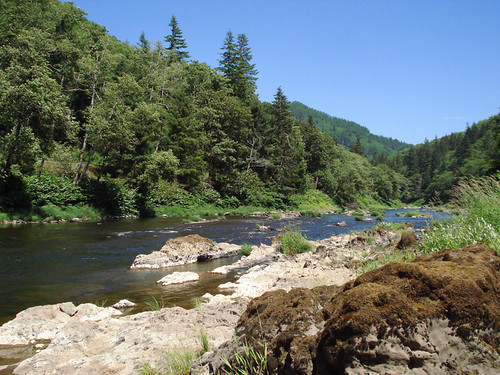
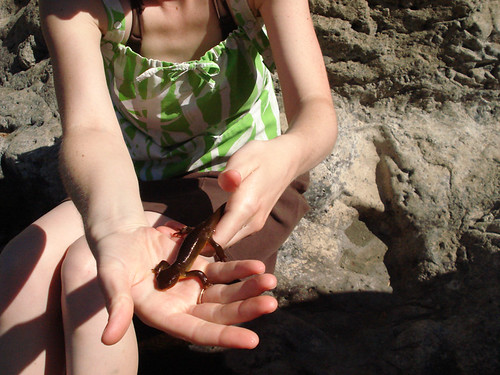
We drove toward the coast to stop at Nehalem Falls, where we completely lucked out by finding what well may have been the last remaining camp site in all of Oregon. It was small, but totally serviceable, and within earshot and a short walk of the nearby water. We spent a lazy afternoon along the river, counting salamanders, drinking beers, and by turns paddling against and floating with the current. But eventually, we had to eat.


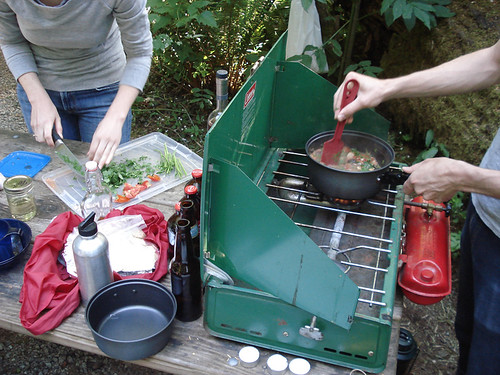
Our friends, wisely assessing the range of our outdoor survival skills, put us in charge of dinner. To prepare, A and I spent a few nights weighing out the merits and challenges of an ongoing list of "simple" foods. Unfortunately, we quickly realized that "home" simple is different that "woods" simple. In fact, a lot of our quick knock-out meals use a lengthy list of pantry and fridge staples, not to mention a bewildering array of pots and pans. If we'd wanted simple, we should have gone with hot dogs. In any event, we had a culinary reputation to maintain, so we settled on a few dishes that we could make with a limited range of camping cookware.


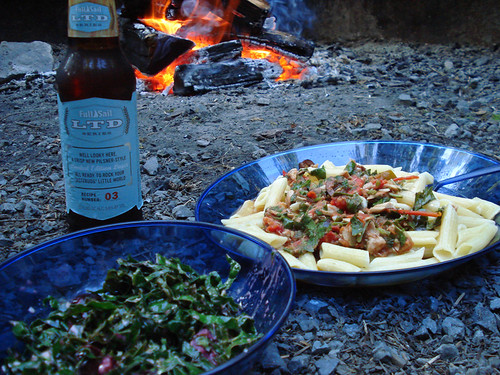
The menu? Penne puttanesca, kale and cherry salad, boozy campfire cheese and, of course, smores. We figured that by mainly using tinned or preserved ingredients (kalamata olives, tuna, anchovies), puttanesca would be easy to transport. To make matters simpler, we pre-cooked all of the noodles so that boiling water wouldn't be a strain on our water supply. The pasta was a good choice, since it tasted just as good once it cools off, which seems to happen quite rapidly when camping. The only hitch we hadn't anticipated was chopping herbs and garlic, but the back of a Rubbermaid tub lid made for a serviceable cutting board.


As for the salad, it was our spin on a favorite dish from Dove Vivi. There, they finely shred lacinato kale leaves and toss them with a lemon-and-garlic heavy dressing and shards of ricotta salata. For our purposes, we made a creamy lemon-chevre dressing and threw in a handful of pitted and smashed cherries for a sweet counterpoint. It greatly helped to lightly sauté the kale to take just a bit of the bite off of it (though a longer bath in the dressing would likely accomplish the same thing). I think the salad was so good that we'll probably re-visit it at home; hopefully the taste compares even without the wood smoke.

We were eating well, but we certainly weren't stuffed yet. To fill that what-do-we-eat-now period between dinner and dessert, we took a cue from Chow.com's camp-food article and tried out their campfire cheese. Simply put, douse a wheel of soft-ripened, bloomy-rind cheese with liquor, wrap it in foil, and bury it in the coals. In place of the recommended brandy, we used the bottle of bourbon we had on it. American-made booze for an American holiday. It came out beautifully.


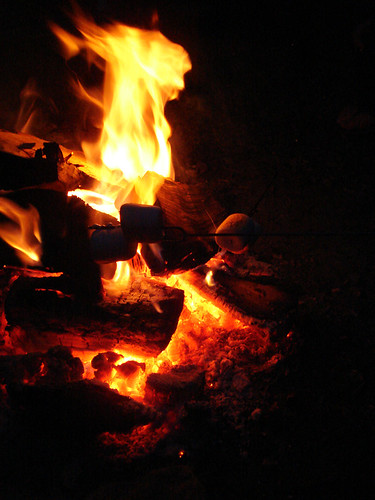
For dessert, smores were an easy choice. What wasn't so easy was talking A out of trying to make her own marshmallows to bring along with artisan chocolate and fresh-baked graham crackers. As much as we care about ingredient provenance, there are some things that just aren't worth messing with. Our only innovation came thanks to Kate and Kalin's telescoping, rotisserie marshmallow skewers. Well-fed, it seems that life in the great outdoors ain't so bad. We hope we earned ourselves a repeat invitation.

Thursday, July 9, 2009

new york glimpses: farm-fresh

If you were worried that our week in New York left us starved for the bountiful Portland markets, you can rest safely assured that we did manage to find some good farm-to-table meals. While it might be hard to imagine that such a bustling metropolis leaves much room for agriculture, New York has a surprisingly vibrant farm-fresh community. Let's not forget that NYC does play home to urban CSAs, a thriving Greenmarket network, two Edible publications, and Slow Food USA's national office. We made an effort to see it all.

A lot of the sustainable food efforts begin in Brooklyn (space is, afterall, a bit more available than in Manhattan). Just a week before we arrived, the first-ever Brooklyn Food Conference drew food movement heavyweights to discuss social equity and local food access. And a week after our return, I read about a rooftop farm in industrial Greenpoint that's beginning to supply local cafes. Good things are growing.

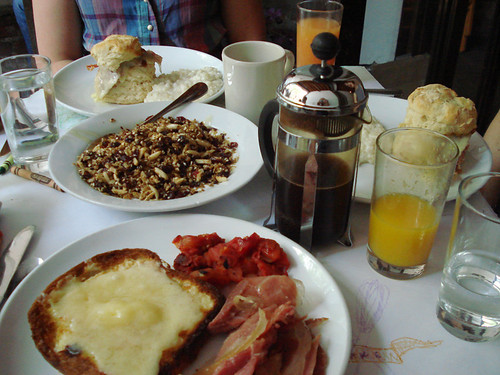
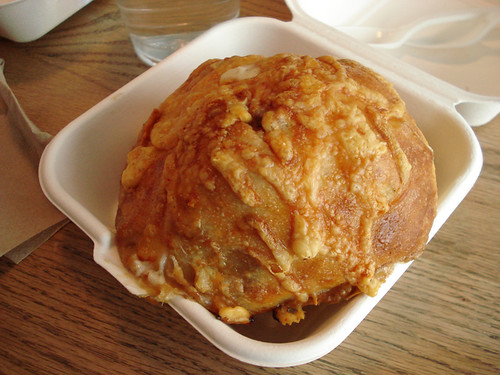
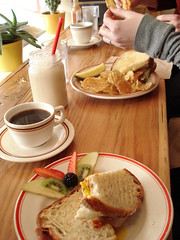
Off a side street in Williamsburg, egg is dishing up simple, farm-fresh meals in a bright and spare space that belies its hearty Southern appetite. With crayons on the tables and groggy, bleary-eyed hipsters waiting on the sidewalk, we should have known to expect some serious hangover-busting vittles. To share, we ordered a serving of the house-made sorghum granola (a breakfast appetizer?), while A chose the biscuit sandwich and I went for the "Eggs Rothko." What a glorious mistake. Of course it was too much food, but at least it was too much delicious food. A's sandwich split a crisp, craggy biscuit to contain a mound of fried country ham, fig jam and farmhouse cheddar. My Eggs Rothko took a spin on a classic egg-in-a-basket by cooking an egg inside a thick slab of brioche, then broiling it all beneath a generous heaping of grated cheese. Taken with a forkful of country ham shavings and broiled tomatoes, every bite was a toothsome wonder.


We enjoyed our meal in the scant shelter of a small front patio, bordered by a miniature vegetable garden. To supplement their adorable street-side tomato planter, the chefs of egg have started a farm in the Catskills, which they document on their simple and engaging blog. Any size garden is an exercise in humility, but for a restaurant, it also offers a hearty dose of empathy with your suppliers.

That same in-house commitment to ingredients and artisan labor informs the staff at Diner, along with their sister restaurants Marlow & Sons and Bonita. We've written before about the Diner family of restaurants and our huge crush on their work, which ranges from in-house butchering to an awesome food journal. Well, after a long time of ogling from afar, we finally had a chance to taste their cooking. Now A and I don't cook meat all too often (even though we still have two hens and 20 lbs of pork in our freezer), but we do like to sometimes order it out if we trust the source. Given the fact that Diner buys whole-animals from local farmers and breaks them down to their chef's specifications, there was no way we were going to miss the meat when we stopped by Bonita early in the week. I had a trio of killer steak tacos, while A went for a deliciously juicy pork burrito. It was worth the wait.


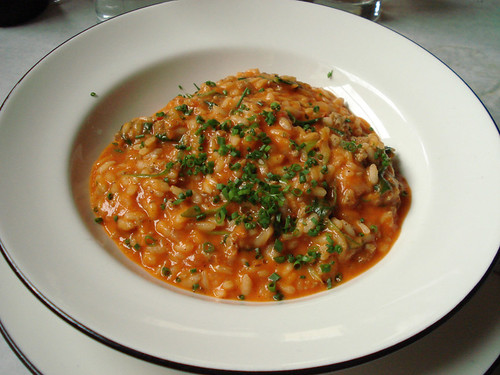
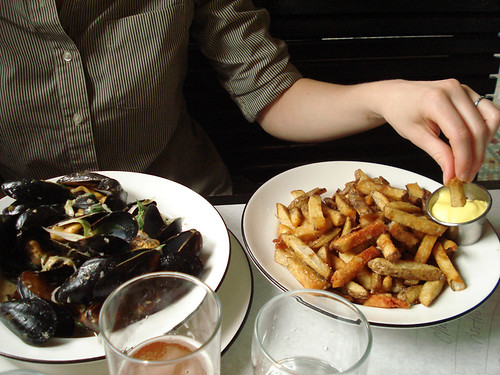
A few days later, after a morning of sustainable food gab with the gracious staff at Slow Food USA, we made our way over to the train-car diner named Diner for an early lunch. The interior was bright and quiet on a weekday morning and charmingly worn-down, with old tile floors and wooden booths. A immediately zeroed in on a bowl of mussels swimming in a tomatillo and green onion broth (with a hearty helping of thick-cut fries, of course), while I ordered Diner's tomato-based risotto with housemade sausage. Both dishes were tangy and savory and completely comforting for a cool, overcast day.


Just around the corner from Diner, Marlow & Sons vends local artisan products from a specialized grocery store/oyster bar. Had we not just eaten, we probably would have grabbed a stool for some local half-shells, but as it was, we contented ourselves by purchasing a food literary magazine and a collection of local chocolates.

We were bolstered to see (and sample) so many restaurants that were emphasizing local sourcing and old-school skills, yet one establishment puts them all to shame: Blue Hill. After last year's Slow Food Nation, A and I started nursing a longtime, big-time chef crush on Dan Barber. Apparently, we weren't alone. Just a few nights prior to our reservation, the Obamas chose it for their NYC date night, garnering some big points for supporting sustainable ag in the process. You see, Blue Hill isn't just any restaurant; it's not even just any restaurant with it's own farm. It is a restaurant with a fully-fledged agricultural education center. A few years after founding Blue Hill on a side street near NYU, Dan Barber connected with the Rockefeller family to open the Stone Barns Center for Food and Agriculture, just 30 miles up the Hudson River Valley. The center runs tours and classes about four-season agriculture and livestock husbandry, while also playing home to a very farm-focused, on-site restaurant.

As much as we wanted to visit the farm, we didn't exactly want to hitchhike out to Stone Barns, so we decided to stay in town and visit the Greenwich Village restaurant. We were seated on the back patio, which has the quiet feeling of an urban greenhouse. From the moment we sat down, we knew this meal would be unique. Before we'd even ordered, our server presented us with a row of diminutive, raw vegetables suspended on a small fence of skewers. This was immediately followed by homemade butter and lardo, paired with kale- and carrot-scented salts, and two adorable asparagus "burgers" on tiny brioche buns. Currently, a lot of chefs are getting awfully coy and playful with their amuses bouches, but something about Blue Hill's approach made it clear that these starters really were an introduction to the restaurant's farm-centric philosophy. They aren't just little foodie jokes, each bite is a primer for the simple, distinct flavors to follow.


I could truly write a lot about this meal, but I'll try to just outline what A and I shared. I ordered:

Spring vegetable salad with pistachio and homemade chevre
Cobia (a firm whitefish) with ramps and prosciutto-wrapped asparagus in a pistachio-caper sauce


A chose the "Farmer's Feast" tasting menu, which included:

Soft-shell crabs with rhubarb and spring lettuce salad
Poached egg in spring greens puree
Berkshire pig with burdock root and rhubarb
Chilled rhubarb soup with fromage blanc sorbet

Everything was phenomenally fresh and displayed a complete devotion to the essence of each vegetable. Every individual component of the composed salad we shared was prepared to best show-off its flavor; some were crisp and raw, others were lightly blanched, while still other ingredients were lightly marinated. I've never had a meal that tasted to simply, so clearly of the fresh produce it used. And I can think of no higher compliment for what Blue Hill is trying to do.

Saturday, June 27, 2009

new york glimpses: on the move

Chalk this one up as a victory for Portland: our food cart scene puts New York to shame. True, it's a city of 12 million people and probably 1 million food carts, but most vendors don't venture much beyond the hot nuts/soft pretzels/hot dogs triumvirate. Meanwhile, in our Portland neighborhood alone, there is a waffle taco cart, an ice cream and pancake cart, a grilled cheese bus, and a retro trailer slinging baked goods and juices. In every neighborhood, food carts circle their wagons on overgrown lots and in empty parking spaces, creating an impromptu culture of makeshift cafes. Now, that's not to say that New York doesn't have any good cart food - they do have their own awards ceremony, after all - just that they're a lot more mobile than their Portland brethren, making them harder to track down.

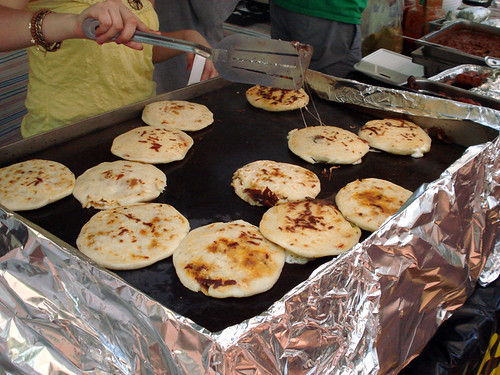
On our first day in town, we went with our friend Hannah down to the weekly vintage bazaar called the Brooklyn Flea. Yes, we did want to check out the mid-century baubles and funky thrift-store clothes, but we knew we wouldn't be lugging home a suitcase full of Fiestaware; we came for the food. After we returned from last year's adventure to Red Hook, we heard tell of some amazing Central American cooks grilling up food for the neighborhood's weekend ballgames. While we didn't venture to Red Hook again, the Red Hook Ball Field Vendors made the trip up to Fort Greene for the Flea. We zeroed in on their stand and ordered a bean-and-cheese pupusa, along with a sweet corn tamale. The pupusa was crisply grilled on the outside and was filled with a savory melted cheese that tasted delicious with the pickled cabbage and hot sauce mounded on top. The tamale was unlike any other we'd ever tried: it had no filling inside the soft, steamed masa, but tasted exactly like a meltingly sweet ear of mid-summer corn.


Keeping with the stuffed-and-filled theme, we queued up for two other flea market street vendors. First up was Elsa's Empanadas, where we quickly downed an order of spinach, cheese and raisin handpies. They were nice and flaky and the filling had the right balance of tangy and sweet. Tantalizingly, the Empanada stand was right next to Asia Dog, but A steered me away from a kimchi-garnished hot dog and over to dessert.

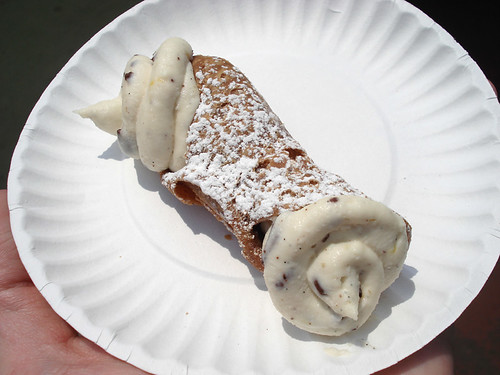
Salvatore Bklyn does handmade ricotta with hipster street cred. What caught our notice were their hand-stuffed cannoli. I have a real weakness for cannoli - we've even made them ourselves once, which entailed no small amount of deep-frying and pastry bags. Best to leave it to the experts. And these were certainly expert, with the right amount of outside crunch and a lightly sweetened, curd-y filling. The more I consider it, the more that I realize that stuffed foods are pretty much made for street carts. Well, those and foods-on-sticks. But as far as portable edibles go, it's hard to beat a cannolo.


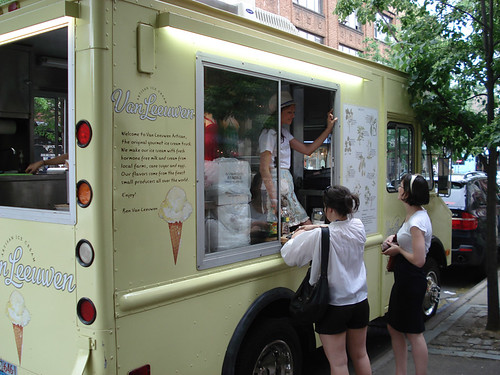
From then on, our mobile eating stayed on a decidedly sweet note. Walking down Bedford Ave. in Williamsburg, A nearly shrieked when she saw a buttermilk-colored truck passing our dishes of small-batch ice cream. Van Leeuwen ice cream uses simple ingredients to craft simple flavors. With our friend Hannah, we ordered a peppermint-chocolate chip scoop and a dish of red currant and cream. Both flavors had a fresh creaminess, despite being custard-based, but the currant ice cream was particularly memorable for its balance between tangy fruit and sweet milk.


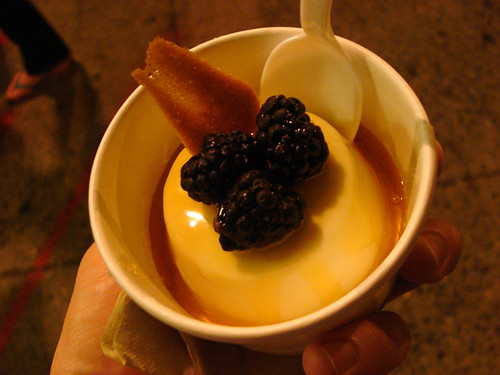
The next evening, after making dinner with our friends Catherine and Quincy, we were struck by two realizations: we hadn't bought dessert, and we were just a few blocks from Dessert Truck's late-night parking grounds. You might recall our nighttime sugar-fix from last-year's visit, but if not, I should fill you in: Dessert Truck sells haute cuisine desserts in paper cups for six bucks. It's a brilliant business plan. On this visit, A ordered a goat cheese cake, while I opted for the pavlova. Individually, the components of the pavlova (crisp meringue, red fruit gelee, creme fraiche) were spot-on, but for some reason, they just didn't quite jive. I'm sure some of it had to do with the difficulty of breaking a meringue with a plastic spoon. That said, A's cheesecake choice more than made up for mine: a few blackberries and a drizzle of rosemary-scented caramel were a great accompaniment to the rich cake. This is one we might have to work on re-creating at home.


After a few days of going without a mobile-food-fix, Hannah informed us of a weekly fixture just around the corner from her midtown workplace: the Treats Truck. Late one afternoon, we strolled up Lexington to where it was parked, only to be generously barraged by samples. Normally, I take a free taste (and I think most people are like me on this matter) and walk away thinking, "Sucker...you didn't trick me into buying anything!" But hell, the Treats Truck proprietess more than tricked us; she up-sold us two brownies, when we'd only meant to get a double-peanut-butter sandwich cookie. I have to hand it to her, though - she knows her product. The PB cookie was really good, but imagine downing an entire box of Girl Scout Tagalongs, and you'll begin to get a sense of its mouth-parching stickiness. We also enjoyed our Mexican chocolate brownie, which tasted more of Ibarra hot chocolate than the overly-infused chile concoctions everyone else seems to love. Of everything we ordered, though, the pecan butterscotch bar ranks among the most addictive desserts I've ever had; it was decadently sweet and sticky in that slightly under-baked way. With sweets this good, I suppose I could be okay with having to follow a moving target.

Thursday, June 18, 2009

new york glimpses: easy-bake

As long as we're at the beginning, we might as well start with breakfast. Easily, one of the best aspects of staying with friends in the city was that we could get an early start to try a different bakery nearly every day. We've written about our wishy-washy indifference to brunch before, but baked goods we heartily support.

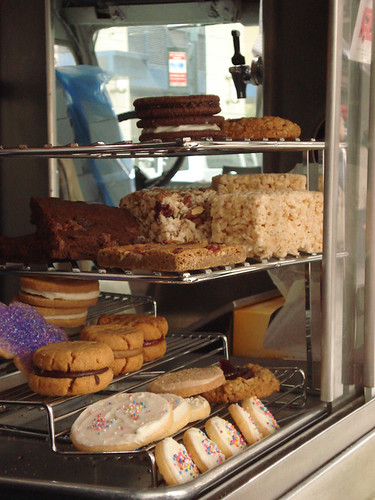
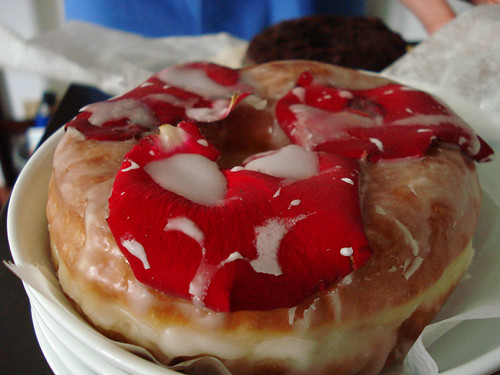
So as soon as we had a morning in the Lower East Side, we made a return pilgrimage to Doughnut Plant to see if it matched our sugar-coated memories from last year. Since their flavors rotate seasonally, we snagged two new creations - a creme brulée doughnut and a rose petal one - along with a classic "Blackout." Excellent doughnuts, terrible coffee. But, oh, how those pastries tasted! The creme brulée was a tall dome, glazed with a hard sugar crust and filled with a light, eggy custard. While it was good (though no comparison to it's namesake dessert), I preferred the rose petal doughnut and the heady perfume that came through in each bite of its glazed exterior. The verdict, however, relied upon the Blackout, which won us over to doughnuts when we first tried it last year. In every way, its dense, gooey, chocolate crumb held up to our memories. We spent a good 20 minutes reasoning out how they could possibly make a doughnut taste so much like flourless chocolate cake. We may never know.


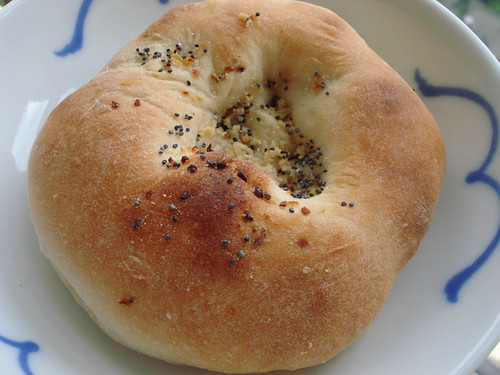
As we left Doughnut Plant, I looked up at the neighboring storefront to see a sign for Kossar's Bialys. I remembered the name from Mimi Sheraton's poignant (downright sad if you're the type to cry over a food book) The Bialy Eaters, and knew that we had to stop in for a second breakfast. According to Sheraton, Kossar's is among the last places in America where you can find a decent bialy, so we selected two of their garlic versions (along with some more "nouvelle," though delicious, challah bagels). Kin to the bagel, bialys are a bit flatter and have a rougher crust and a shallow depression in the center. While bagels gain their glossy exterior from a pre-bake dip in boiling water, bialys are simply put in the oven, as-is. Nestled in its dimple, the Kossar's bialy had a smear of salty, poppy-seed studded garlic mince that made the roll absolutely addictive. With the experience of Kossar's under my belt, I can say that until now I have tasted some sorry bialy impostors.


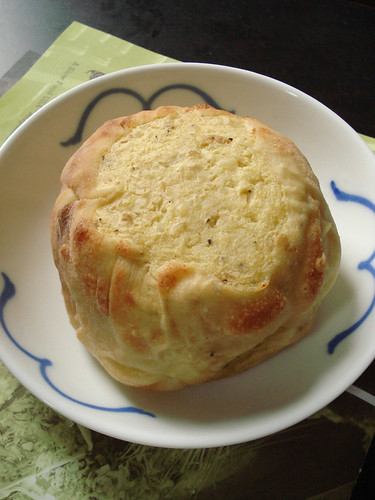
Later in the week, we continued our search for early-morning, Yiddish baked goods; next on our list was Yonah Schimmel's Knishery. While A and I have commendable appetites, we very well may have met our match in the knish. I have to admit that prior to Schimmel's, I was as unfamiliar with a knish as most gentiles. Helpfully, Edible Manhattan just ran an article on the endangered knish - that lost icon of New York cuisine - which sheds some light on this overlooked pastry. A classic knish is composed of an imposing mound of seasoned, mashed potatoes, which is wrapped with a pastry band and baked to steaming perfection. It easily weighed a pound and even split between the two of us, that thing was a struggle to complete. That's not to say it wasn't a savory delight, particularly with a dab of deli mustard.


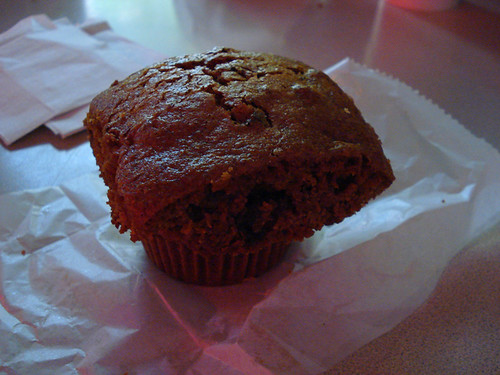
The further along we went in our breakfast escapades, the larger our pastry discoveries seemed to grow. On our last day in the city, our friends Macy and Annie took us to Carrot Top Pastries to witness some terrifyingly-large croissants (frisbee-sized!) and the squarest muffins I've ever seen. We smartly steered away from the croissants and ordered their signature carrot muffin, with heaping tops spilling over the lip of the muffin pan. Like a moist, lightly-spiced slab of carrot cake, the muffin was a meal unto itself and went great with some pretty decent diner coffee.


Finally, our stomachs led us to Momofuku Milk Bar later that afternoon. While not technically breakfast (I'm not sure you could confidently call any of Milk Bar's offerings the best start to your day), there were early-morning staples peppered throughout a menu of decadent sweets. A branch of the David Chang's coyly inventive Momofuku mini-empire, Milk Bar was set up to showcase the creations of pastry chef Christina Tosi, who was profiled as a bit of a sugar-coated evil genius by the New York Times. In a crowded, standing-room-only space, they serve up compost cookies, crack pie, candy-infused soft-serve, and their infamous cereal milk - the infused leftovers of a bowl of soggy cereal. If we weren't down to our last few hours on the trip (and their food weren't so damn filling), we could have easily committed ourselves to slowly working our way through their Wonka-esque array of surreal sweets.


As it was, we sampled the sour gummy soft-serve (which won that hilarious remark, "It really does taste like sour gummies!") and order a serving of chocolate mint ice cream, an English muffin sandwich, a loaf of green-curry banana bread (for the plane!) and something called, "The Volcano." The soft-serve was redolent of Thin Mints and incredibly satisfying. A's English muffin cradled a poached egg, bacon and meltingly sweet onions, while my "Volcano" seemed to include a little of everything. Bacon, braised onions, gruyere, cream, potatoes were held inside of what resembled a sourdough bread bowl. Think of it as a neo-knish, stuffed with scalloped potatoes. Of course, we enjoyed everything with the ubiquitous bottles of sriracha sauce at each counter. It's really no wonder we had such stomachaches for the flight home.

Friday, June 12, 2009

new york glimpses: city living


Well, we're back at home and (mostly) caught up. We're also (mostly) recovered from all of the eating and drinking we packed into our week in New York. It's been slow getting this first post up, but that is largely because this trip was so different from the last time we visited the city. Though it also might have something to do with how lethargic we've been with all of that extra food in our system.

When we went last year, we stayed with my uncles in Jersey, just outside of the city. Their home was lovely and they couldn't have been more gracious hosts, but when a few of our friends recently moved into the city proper, we knew we couldn't turn down the offer to crash on their hide-a-beds. Anyone who knows us has heard how we prefer incognito tourism on vacation, so spending all of our time in the city let us indulge our penchant for "playing local."

I'm sure that our perennially-patient NY friends will roll their eyes and sigh at this one, but we really did feel like our trip was much closer to day-to-day life (if you didn't work) than our usual tourist blitz. I mean, we actually saw other people, and largely tried to keep our full meals to only 3-per-day. We even visited a lot of local grocery stores, though I guess that's pretty typical of our travel M.O.

Eschewing sightseeing in favor of everyday living made our trip unique; it was genuinely interesting to take stock of how our friends live and to transpose our lifestyle onto New York, imagining how we might adapt to life there. We spent a lot of our trip discretely looking for local iterations of the most important parts of our life (farms, markets, cooking shops), as well as seeking out the amenities we lack in Portland (first-class museums, new ethnic foods). In the process, we also noticed the absence of certain things that characterize our experience of Portland - easy bicycling, for one. Yeah, A and I both might walk faster than the average Portlander, but there is something to be said for Stumptown's quiet, unassuming pace-of-life.

Happily, our friends Catherine and Quincy offered an encouraging example of New York living. They had homemade stock in the fridge, dried beans in the pantry, and compost beneath the sink. When they looked in their fridge, they likely just saw the humor of trying to live the life they do in a cramped, walk-up, East Village apartment, but we saw simplicity.

Oddly, when we look back on our trip, our rose-colored visions of a dream life in New York all center on getting back to essentials. Ever since early this year, A and I have both had simplicity on the mind and have (ineffectively) dreamed of paring down our possessions. Now that we're back, we'll turn to one another and wistfully muse on our "simple" life in New York. "We'd only bring the essentials," we say, "who needs all of this extra closet space? Imagine how much free time we'd have to read and relax if we could just start over without all of these obligations to friends and volunteer commitments..." Ha. I can't imagine that "simplicity" ranks very highly on many people's reasons for moving to New York. This puts us squarely in the "idealistic dork" category.


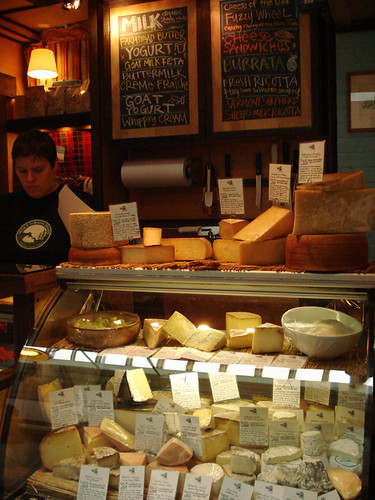
Regardless of our naivete, it was still fun to act out local life for a week. Of everything we saw (and ate) in the city, there were two particular breakfasts that probably best encapsulated all of the quotidian romance of our New-York-living fantasy. For A, it was our early morning visit to Saxelby Cheese in the Essex Street Market. Purchasing a pint of Amish farmstead yogurt just might have made the entire trip for her. I could see the gleam in her eye as she imagined her daily trip to the fromager for a plougman's lunch of cheese and bread.


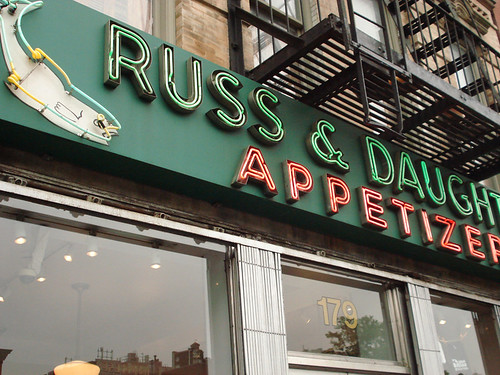
Now, as for myself, I was taken with the same place that entranced me last year: Russ & Daughters Appetizers. Brimming with unique foods and buzzing with old-world knowledge and class, this place epitomizes New York food to me. Whenever I walk in, I dream of incrementally working my way through their cases of smoked fish. Think of it: me, a modern-day Calvin Trillin, noshing my way down Houston Street. I could easily live on their smoked sturgeon alone.

But taken together, these reveries are all part of that soft-focus idealism that comes with travel (like the allure of Cleveland in 30 Rock). There's always that moment when you want to pack it all up and start a new life in an adopted hometown. It wouldn't be a good trip without it.

--------

Instead of our usual day-by-day breakdown, for the rest of our posts on our trip, we'll be writing up themed impressions of our best finds in the city. Hopefully it ends up being a little more engaging than a slide-by-slide narration of the museums we visited. Or, I should say, the foods we sampled.


Right upon our return, we came across
a broadcast of KCRW's Good Food, which toured New York, visiting many of our favorite places (and giving us a few ideas for our next trip). It's a consistently great radio show, and this episode, in particular, is worth a listen.

big ups


High fives to Navarre, one of the most deserving restaurants to ever receive the Oregonian's nod for 2009 Restaurant of the Year. When I think about the best meals I've ever eaten in Portland, Navarre pops up again-and-again. They're a slow-burn kind of place - the sort that sneaks up on you as a dawning realization that you're part of something really unique. And I think they like it that way: they're a little under-the-radar, definitely not-for-everyone, and very much an idiosyncratic reflection of very specific seasonal moments. The O writes:

"You come here to eat food from a serious chef who cooks like a Frenchman in a cabin, pickling and preserving, butchering meat, turning it into sausage and pâté, whipping up pies and jams and making it all work with the fresh supplies at hand."
John Taboada has created a restaurant that responds to local farms, roving cultural cues, and personal whims. Whenever I visit the restaurant, I always think of my cooking teacher who liked to tell stories of Taboada navigating the French markets and returning with the very best-of-the-season produce and an old French housewife's recommendation for cooking it. His place is intimate and entirely inviting. Whether we were enjoying brown butter razor clams or a slab of gateau d'epices, the food has always made us swoon.

All of the acclaim is well-warranted. The only downside is now we'll have even longer waits.

Friday, May 22, 2009

new york bound

Christoph Niemann contributes to an illustrated blog in the New York Times called "Abstract City." Earlier this year, the rooted through his kids' legos to construct his quintessential New York experience. These were two of my favorites:


With that, we're off to New York for a week for a hardscrabble week of five meals a day and little else. When we return, you can expect stories of Russian Jews, cookbook stores, upstate farm cuisine, and more doughnuts.

Monday, May 18, 2009

cake tasting

A lot of our own wedding planning went by in a blur. Where other couples might have deliberated for weeks over which caterer to use or where to hold the event, we ended up making quick, clear-cut decisions. When you get right down to it, can you really imagine us not knowing what kind of food to have for the reception?

Still, we probably could have played the planning card a bit more, if only to leverage it for samples and handouts. I mean, we didn't even once go cake tasting - we just picked what we wanted and ordered it. No nonsense, but possibly nonsensical.

So imagine our luck when our good, soon-to-be married friends invited us along (or maybe we invited ourselves) to sample the offerings at two Portland bakeries. Could we really say no when they so clearly needed our help?


What I found out was that wedding planning can be pretty fun when it isn't your wedding. Without the pressure of having to consider what flavor cake my aunt would like, I was free to ask questions of the bakers like, "Now if the bride and groom decide on 'ruins of Italy' theme, can you make a leaning cake that looks like the tower of Pisa?" "If they want a dark chocolate cake, could you still make it entirely pink?" "Can you photo-transfer their pictures onto the ganache?"

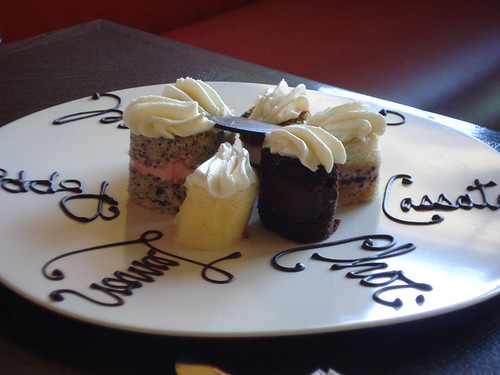
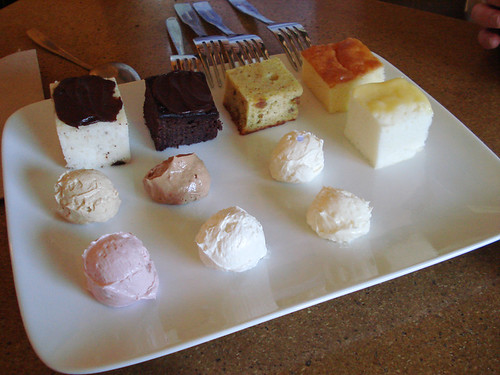
It was funny for a while, until I realized that people do, in fact, request cakes that are exactly this stupid. So I pulled it together and focused on the flavors. Aside from how delicious they are, I want to high five Baker & Spice for their "build-your-own-cake" presentation. If it were my choice, the decision for which bakery to use would have been cinched by the scoops of frosting alone. I could have happily mixed-and-matched spoonfuls of buttercream with forkfuls of cake all morning. If our friends want to make me happy at their wedding (and isn't that the point?), then they'd be wise to set up a cake construction bar. I want to see sprinkles, frostings, ganaches, edible flowers and miniature sugar bride-and-grooms. And I want to be able to put them together myself.


So, here's my advice (and you can't say it's unsolicited, since you invited A and me along!):

Don't pick a flavor you're allergic to.
If you go with frosting calligraphy, make sure your decorator can spell.
And if you really want to impress us, you should bake it yourself.

(Oh, and I vote for the chocolate with mascarpone cream-cheese frosting.)

Wednesday, April 22, 2009

planting blind


For the past several years, A and I have patiently made do with a back-stoop container garden. We told ourselves, "When we move into a house with a yard, then we'll start a real garden." Well, that time came and apparently, it also went. Call us chickens (hey, that sounds like a good idea for next year's garden), but we dragged our heels not knowing what (or how) to plant and settled for another year of pots. But we have BIG PLANS for those containers.

I suppose if we were really to consider the logistics of container gardening, we'd realize that we're just undertaking a costlier, less effective version of in-ground sowing. And yet those little, plastic, "terra cotta" pots exude safety - they woo us into believing that they'll protect our little herb starts from the fits of our gardening inadequacy. "Why trust the soil?" they ask, "It's just so deep - you have no idea what's down there." In reality, the containers probably reduce our success rates (and yields) and require more attention and watering. The problem - at least this year - was that damn up-front business of planning. Well, that and a skewed sense of scale.

By the time we worked up the confidence to turn our entire backyard over to raised beds, we were already kind of behind in the process of building frames, tending our compost, and stomping out the extant weeds. We wouldn't have even known about these steps if it weren't for the well-intentioned advice of a good friend of ours. This friend is a qualified gardener, grade A - the sort whose footsteps sprout fully-grown plants in her wake (she even writes well about her garden). Maybe she can't conjure vegetables from thin air, but she is sprouting heirloom bean starts on her office desk, meaning she's leaps-and-bounds ahead of us in terms of gardening skill. And that means that her "simple" advice is predicated on years of accumulated planting know-how. For A and I (who both have unhealthy needs to feel like experts), her gardening encouragement unintentionally pointed our our complete lack of experience.

Time to scale the plans back a bit. Maybe cardoons and fruit trees wouldn't make the cut this year, but we could certainly step our gardening effort up a bit. So, inspired by our friend's abundantly green thumb, we decided that if we were going to resort to containers again, we should at least endeavor to plant our own seeds. This is probably the first time since lima beans on the classroom window-sill that either of us have grown something from seed. So, on an unseasonably hot Sunday afternoon, here is what we laid out:

slow-bolt cilantro
valentine mesclun
loma lettuce & alaska early pea
blue borage
helios radish
cherry jewel nasturtium
french chervil
lemon basil
garlic chives

We consulted a few gardening books, but I'll be damned if I could definitively say that we treated any of these things properly. How do you even plant something at an eighth to a sixteenth of an inch deep? Do you cover the seed with a single grain of dirt? Well, I suppose seed depth is a moot point if we wash them all away with our over-eager watering. And if anything even sprouts, then we'll no doubt be faced with a ruthless amount of thinning; our security measure was to plant dozens of seeds in each pot.

Luckily, I happen to really like the tidy look of bare dirt in our just-planted containers. So, if nothing sprouts, at least it will always look like we've just begun.

Friday, April 3, 2009

sons & daughters

The last time we visited New York, we had wanted to stop into a small cafe and grocer called Marlow & Sons, but never made it. I guess it proved more difficult than we thought to squeeze in five or six meals each day. Now that we're headed back at the end of May, it's at the top of our list. Scrappy, bearded, and a little old-fashioned, this place totally embodies the great things happening right now in the Brooklyn food scene (just recently written up in the New York Times).

I was just talking with a friend who used to live in Brooklyn and her opinion was that the food producers were the only thing keeping Williamsburg honest. I think that's probably a pretty fair call - the brewers and picklers and chocolate makers are all crafting something really genuine, right in the middle of a lot of artificiality and gentrification. And they're forging a community that feels different from anywhere else I can think of.

With all of the farm-love and artisan processes, you could have replaced "Brooklyn" with "Portland" and left the rest of the New York Times article pretty much the same (sometimes it feels like we live in the 6th Borough). Still, I can't help but feel like Portland, for all of its raw ingredients, could really use to step up its game. And Marlow & Sons is a perfect example of how strong our food shops could be.

I first came across the restaurant through the snarky, foul-mouthed blog run by their butcher, Tom Mylan. Marlow & Sons is connected to two other places - Diner and Bonita - which realized that, together, they could get better-quality, farm-direct meat and have more control over cuts by breaking their animals down in-house. So Mylan apprenticed himself to some upstate butchers and learned the trade. That was enough to get me interested in what they were doing.

From there, I found out about Mylan's role in the UnFancy Food Show, which acts as an antidote to the bloated annual Fancy Food trade show. Instead of featuring high-dollar booths hawking goji berry power bars, the UnFancy party invited a slew of local artisans to share their handmade foods. Among the participants was The Diner Journal, a food lit-mag published by the Marlow & Sons owners. Sort of like a low-budget Gastronomica, the Journal approaches food from a very different direction than your standard 15-minute-meals-and-travel-porn food magazine. In the last issue, one of their editors painstakingly detailed every step and utensil involved in one of Elizabeth David's famously terse recipes. A ten-page essay written on a single paragraph of instructions - the sort of writing that gets you thinking about food.

As for the restaurant itself, Saveur just featured Marlow & Sons in their latest issue, with some great pictures of the oyster-bar/grocery store. Based on our experience this week with the chocolate caramel tart recipe, there is no way we'll miss them this trip. But when we finally visit, we'll also have to make a detour up the street to visit their newest venture.

After beginning a butchering program, it was only a matter of time until the owners would go and start up an old-school meat shop. Now open for business, Marlow & Daughters was just featured in a nice little video from Coolhunting. And that video is what kicked off this post, making this the most circuitous lead-in ever to a 3-minute clip. Watching it made me want to carve a steer, but then I remembered the remaining 1/4 hog we have in our chest freezer and thought better of it.


(Coolhunting regularly posts fantastic video profiles - just take a look at this feature on another "UnFancy" Brooklyn-based kitchen business: knives from Cut Brooklyn)

Tuesday, March 17, 2009

growing on me

Head out on any Sunday morning, into any neighborhood in Portland, and tell me what you notice. I can guarantee you three things:

1. Bikes
2. Lines
3. Breakfast

That's all you'll see, and it paints a pretty clear picture of the town I live in. Portlanders ride their bikes to places where they can stand in ridiculously-long lines and wait for a brunch table to open up. And then they write about, as shown by the recent features in Portland Monthly and MIX magazine, which penned big, sloppy-kiss, love letters to the first meal of the day. Breakfast is everywhere, and not just on the weekends. We have two friends who both work in morning spots who tell us that the crowds show up all week long. Call it a hangover cure, call it a ritual, call it a social scene, but one thing is clear: Portland *hearts* breakfast.

Now, as for A and me? Not so much.

Anyone who's known us long enough has probably held witness to our breakfast rant. Blah to scrambles, blah to hash, blah to french toast and pancakes and waffles. Basically, I feel like when I go out for breakfast, I get a mediocre, under-flavored dish with a high mark-up and some burned coffee. And there's always too much food, which I inevitably eat every bite of. Plus, I'm a sucker for a lame special and brunch menus are rife with featured dishes. So when I want sweet, I'll fall for savory, and when I hunger for something savory, I'll be tricked into ordering a sweet dish. This means that I almost always end up ordering some tarted-up, whipped cream-covered french toast and giving myself a bellyache. Yeah, you could probably say a lot of my breakfast issues are probably of my own creation.

So breakfast just never really did it for me. But a few months ago, I was totally surprised by an issue of Saveur devoted to breakfasts around the world. Here were some meals I could get behind. A Singaporean vegetable curry. Sheep's milk cheese with honey and olives from the Mediterranean. Miso and quick, cabbage pickles in Japan. A beer and pretzel mid-morning snack from Germany. By the time I'd finished reading the issue, I was ready for a second breakfast.

Since that issue, A and I have found ourselves going out to more and more breakfasts, and we've gradually been inviting our friends out for brunch more often, too. In a way, I feel like we've started to become - dare I say it - brunch connoisseurs. So, as recent converts, you can take our advice for what it's worth, but we thought we'd share a few of the places we've recently been digging, and a few we're soon to try...

Broder
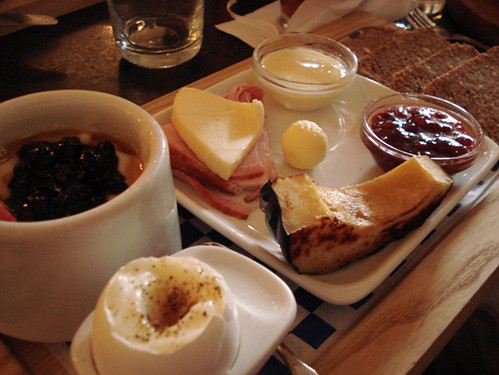
This Swedish place has a routine close to what we'd eat at home on an ideal morning, making it our favorite breakfast in town. Their bords bring together a poached egg, granola, cheese, cured meat and fish, jam and toast for a simple, attractive meal. But that doesn't mean you should overlook the delicious aebleskiver pancakes and the smoked trout pytt i panna (hash). Plus, the space is so effortlessly chic and Scandinavian that you leave determined to redecorate your home kitchen.


Little Red Bike Cafe
Run by a young couple who used to man a farmer's market stand, the adorableness of this tiny cafe is only rivaled by their cute-as-punch (if sometimes a little sappy) blog. With good, bike-delivered coffee, a list of egg sandwiches named for biking lingo, and a bike-thru service window, it's pretty damn Portland. Their house-made ice creams aren't to be missed - the last time we ordered a salted caramel milkshake I awkwardly told the owners how delicious it was three or four times.


Tastebud
Whether we're just grabbing some of his wood-fired, Montreal-style bagels at the farmer's market, or we're sitting down in his Southeast cafe, we really love Mark Doxstader's approach to the morning. His formula's simple: things taste good from a wood oven. Things like baked beans, bagel sandwiches, and roasted potatoes, that is.


Screen Door
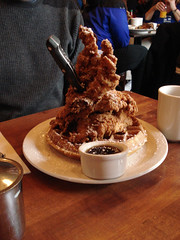
This place falls at the complete opposite end of the spectrum from the other breakfast spots we've been enjoying. It's probably the most traditional brunch-style place of the lot, and the portions are definitely anything but modest (it is Southern, after all). Still, anywhere that has breakfast corndogs on their menu wins a place in my heart (and a return visit to order some). If you're going to do waffles and benedicts and other breakfast chestnuts, this place does them right.


NEXT ON THE LIST

HA & VL
Jellied pork blood, spicy tripe, soothing chicken pho, and hot, Vietnamese coffee. Early in the morning, you ask? Well, when they sell out of the favorites by 9:30 am, you better believe it.

Navarre
With their rustic and farm-fresh European small plates, this is one of our hands-down favorite restaurants in town. We just found out they do a late brunch on weekends, and I don't even think they change their menu for the mornings. Sounds perfect.

Pambiche
Cuban sweet breads, plantains, empanadas and beans prove that other countries really understand how to begin the day. No need for Mrs. Butterworth when you can douse everything in banana ketchup.

Beast
Prix-fixe four-course brunch menu? It feels so decadent. And it probably will be, given chef Naomi Pomeroy's magic way with pork. I'm imaging bacon pastries, poached eggs, and a cream-laden dessert. I'm also imagining myself making reservations very soon.

With only two mornings each weekend, we've got a lot of eating to do. But this list doesn't even mention Simpatica, Pine State, Moxie, Flavourspot, Wong's King, Little T Bakery, or cold, leftover pizza from Dove Vivi. I guess that A and I need to fess up to the fact they we may just happen to enjoy breakfast.

Tuesday, March 10, 2009

you might think twice before eating that vegetable

Blueberry Danish, 2006

While googling DIY scratch-and-sniff (it's a long story), I came across a series of completely enthralling photos by Kathryn Parker Almanas. Among the hospital photos and the pictures from her trip to the Museo di Storia della Scienza in Florence (I've been, and it's awesome), she's done a lot of work staging medical dissections and "studies" of everyday foods.

Anatomia di Pane VIII, 2008


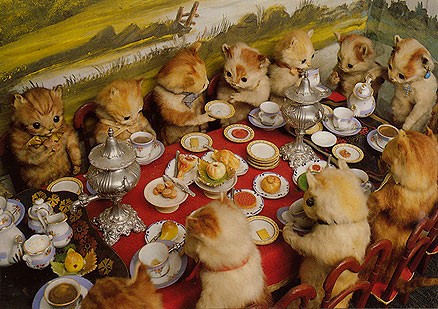
Even though I'm a fairly squeamish person, I am totally enamored of taxidermy. Whether it is a hunter's trophy or a natural history diorama, it is all about theatrics. For every codified taxonomy of species, there is a kitten tea party; it's equal parts science and fiction, and I love it. I even just enjoy the basic aesthetic of taxidermy, with it's wooden plaques, glass display cases and pseudo-scientific instruments.

Breakfast I, 2006

So while I covet all of the beakers and trays in Almanas' photos, what I really latch onto about the images are her compositions. She does a fantastic job of quoting 17th century Dutch still lives, with their low, slanting light and that same entwined artifice of sterility and decay. Or that famous Rembrandt painting of the anatomy lesson. The photos are partially reserved and objective in the prim manner of early medical science, but there's also a real fetish made of out of the repulsive and gratuitous. The way she lingers over the graphic details gives her photos a violent, forensic quality, like the evidence of a hastily cleaned-up attack. Her site has a few truly grotesque pictures of berry-stained bread dough, or dark fruits in a stainless steel sink, but this one really got me when I first saw it:

Swiss Chard, 2006

When I noticed the red-juice stains on the asceptic trays, my stomach did a turn. They look so animal.
And they're just vegetables.

Thursday, February 19, 2009

pok pok express, now servicing new stops

I think people are generally surprised at our answer when they ask A and me to name our favorite restaurant in Portland. The quizzical looks on their faces always betray that they were expecting a refined, European-inflected restaurant or a rustic, farm-to-table bistro in the vein of Chez Panisse. Sure, there are plenty of both in our top 10 list, but no, our favorite is a Thai place. Granted, this certain Thai place happens to be Pok Pok, so anybody who's surprised at out choice must never have been there.

I'm not quite sure how to write about Pok Pok without embarrassing myself (or A). Whenever I tell people about this place, I tend to get a little worked up, mixing up my words and talking a bit too loudly. But seriously, the food is un-damn-believable. Unless you've been to Thailand, it's probably completely unlike anything you've ever tasted; Pad thai is absent, as are all other Americanized dishes. In their place, Pok Pok serves Southeast Asian drinking food with a nose for authentic (and esoteric) flavors. Fiery hot barbecued boar collar with iced mustard greens, turmeric-hued catfish stew, salads with sawtooth and betel leaf, and addictive fish-sauce wings. Every dish is mouth-wateringly spicy and alluringly aromatic. As proven by this review, owner Andy Ricker is devoted to his ingredients. This is a man to be trusted when it comes to Asian food.

When we moved into our current apartment, it only took one ride on our nearest bus line to realize that, if we took it all the way through downtown and back over the river into Southeast, that it would be deliver us on Pok Pok's front lawn. We christened it the "Pok Pok Express." Since we moved in, we've been 2 (3?) times and still haven't used the bus to get there. But each day, as we commute to and from work, it's a struggle not to just keep on riding in the direction of Pok Pok's heavenly khao soi. Now, the temptation has become even worse.


For months, Portland food writers have been frantically swapping gossip about Pok Pok's rumored expansion into Chinatown. Now, Ping has finally opened. And it is right at our downtown bus stop. As a partnership between Ricker and John C. Jay of Wieden + Kennedy, this place has quite the pedigree of cooking chops and hip branding. The future is bright.

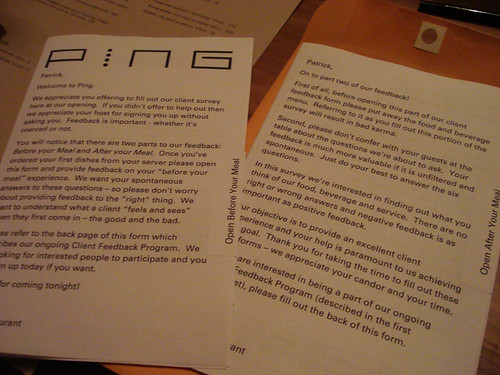
Now, you can chalk it up to being a superfan, but as soon as their placeholder website went live, I'd already signed up for their mailing list. As one of the overeager first, A and I were invited to a preview night for the restaurant last Saturday. The look on A's face was priceless - it was like getting asked to head backstage with her favorite band. Sometimes, there's a payoff for being obsessive.


Right when you step inside, it's got that same kind of cool as Clyde Common, another favorite of ours. The kind of cool where you feel hipper for being there, instead of thinking you're not up to par with the other patrons. Let's call it "inclusive cool." But even more than being hip, it feels established, like an old and weathered noodle house. From the wall of antique radios to the vintage tin advertisements, every detail is carefully considered and well-placed. It's how I imagine I'd style a restaurant were I to open up shop.


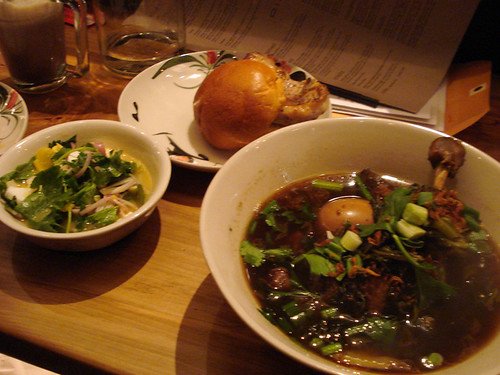
I can already tell Ping is going to enter our "heavy rotation," mainly because nothing on the menu would have seemed out-of-step at Pok Pok. Even though Ping expands the scope to include dishes from Japan, Korea, China, Macau, Singapore, Malaysia and India, everything is prepared with the same attention to native detail and eye-opening flavor. What I can confidently report from our representative "smattering" of their dishes is that the food is Good and Unique. So what did we try? Chicken heart skewers, fish balls, kopitiam toast (coconut egg jam), steamed gai lan, salted duck egg salad, ju pa bao (Macanese pork bun), and pet pha lo (aromatic duck leg stew). Every one a winner.

The chicken hearts had a rich, irony, and essential flavor, while the grilled kopitiam toast made for an unusually sweet and nice starter. We ordered the gai lan (Chinese broccoli) half-accidentally, but ended up pleasantly surprised by how light and flavorful this dim sum staple was prepared. Ping's pork bun was the end-all-be-all of literal interpretation: a whole pork-fried pork chop nestled into a halved, sweet, brioche bun. Pork + bun. Very satisfying. Of everything we tasted, I think the pet pha lo stood out the most. Rich with star anise, the brothy stew played really well off of the pickled mustard greens and chili vinegar accompaniments. My mouth is watering just to write about it.

Well, A and I can safely add Ping to that growing list of crave-worthy Asian restaurants we daydream about. If it weren't for a prior commitment on Tuesday night, we might have already headed back for their official opening, and a for a bowl of the ramen we missed. It may just be that I'm starting to feel a bit of Euro-pub burnout, but 2009 is shaping up to be a year of Asian food. Welcome to the 21st century, right? Still, I'm starting to worry that it might be a tad geeky to get this excited about Asian food. We'll see what my co-workers say when I start bringing in kimchi for lunch...

Monday, February 2, 2009

six more weeks...

Facts and thoughts on Groundhog Day:

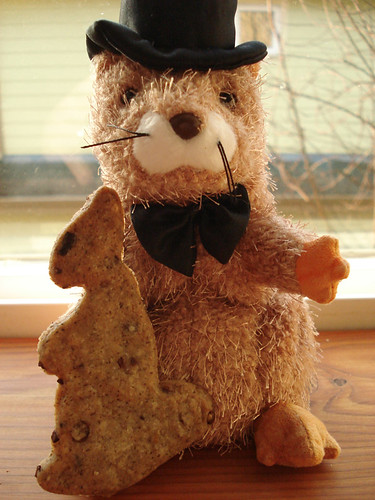
Yes, we made cookies.
Yes, that is my very own groundhog-shaped cookie cutter and top-hatted rodent. I also have a mug.

Growing up, my family celebrated Groundhog Day each year as diligently as any church holiday and I could never figure out why my peers didn't mark the day with cookies and cards like we did at home. I'm not sure if any of us can remember how the festivities began, but they certainly haven't let up over the years. Maybe it had something do with my dad being a librarian; after all, Punxsutawney Phil spends the other 364 days of his year in the Groundhog Zoo at the Punxsutaweny Memorial Library.

Yes, I've proudly visited him there. (We always did a lot of library tourism on our vacations.)

For those of you who don't mark rodent-centric holidays on your calendar (February 2 - remember it for next year!), here's a little run-down: based on German superstition, if a groundhog sees his shadow on Candlemas, then it bodes 6 more weeks of winter. Sure, Spring is technically in about 6 weeks anyway, but this holiday gives the folks of Punxsutawney, Pennsylvania an excuse for lots of top-hats, braggadocio and some pretty epic mustaches. A lot of other cities (all with equally baffling names) boast their own groundhogs and their predictions can vary wildly. I would recommend that they all band together to form some sort of unionized weather service, except that I know the rest of them are impostors. Shubenacadie Sam? Staten Island Chuck? Bah.

If (for some reason) you didn't get up at daybreak to watch Phil's prediction live this year, you can still see it on groundhog.org. The fact that Phil snagged that URL is enough for me to legitimize his prognosticating primacy.

My favorite part of this year's holiday coverage was that GOOD magazine compared him to a soused gambler:

"Phil has a motley track record. At 30% accuracy, he doesn’t even beat the flip of coin; he’s more like a drunk at a poker table: You could make money simply by betting against him."

And yes, that was part of an article using the movie, Groundhog Day, to illustrate complex ideas in economics, physics and theology. Who could blame theorists for trying? That film is fantastic. Last week, I came across an artist online who was illustrating a book of famous Bills and Williams in mock masonic garb called the Billuminati.
Yes, the Bill Murray spread was the best.

And yes, Punxsutawney Phil saw his shadow this morning, predicting six more weeks of winter.

Tuesday, January 20, 2009

the alaska of the tropics, part two (big island)

P:

So, Alaska. I mean, Hawaii. I mean ... We (inevitably) got a little long-winded in our post about the first island we visited, which meant that I didn't get to explaining the title. Well, guess what? The title only gains more clarity on the Big Island.

As we drove along the edge of Kailua on our last day on Oahu, I suddenly had an insight (!) that Hawaii was a lot like somewhere I'd been before: Alaska. Maybe it's their isolation from the continental 48. Maybe it's that both states tendered prominent political candidates this year. Maybe it's their similar climates. Wait, scratch that - it's actually hard to put my finger on what exactly gave me that idea. But there are some similarities between the two states that are worth pointing out:

-a disenfranchised native population that's a tourist-draw (totem poles and luaus)
-incredible natural beauty
-rich and hearty local cuisine (moose? plate lunch?)
-senior citizens on tour buses (and cruise ships)
-blue tarps (seven out of ten homes in both states have a plastic tarp covering some sort of junk in the front yard - it's an empirical fact)

Granted, a place like Waikiki is a far cry from "The Last Frontier" to the North, but we did an admirable job of avoiding the touristy resorts and sticking to a little more of an off-the-beaten-path trip, making my comparison a bit more understandable. In the end, Alaska and Hawaii boast their own quirky cultures, where people lead lives unique from anywhere else in the states. I mean, where else would A have run off first thing in the morning in her pajamas to pick giant, tropical fruit from the top of a fence off of a neighbor's tree? Yeah, it probably wouldn't have been Alaska, but my point remains: Alaska = Hawaii.

A:

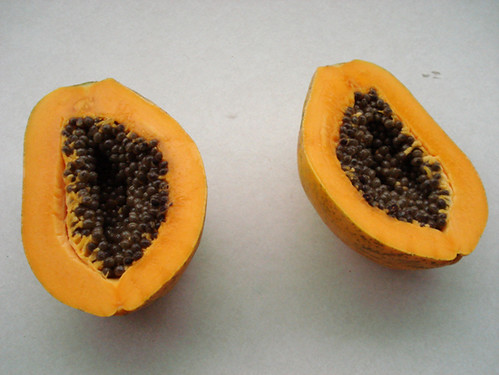
We had papaya trees in our front yard. Having arrived at our rental in the middle of the night, I first glimpsed the trees when I awoke the next morning. I picked the first papaya right off of our back lanai, but it was a small, under-ripe specimen and I knew it must be only the beginning. Thus, I set off to explore the rest of our acreage, and came back with two enormous, deliciously ripe papaya.

I don't know what came over me, really - it was as if my true, animal nature came bursting out of me and I had to hunt and gather. So, I hunted the best papayas (which just so happened to be right beyond our fence on neighboring land)...and once I found them, I gathered. Below, you will see the fruits of my labor.


Papaya is particularly good eaten cold, but we were so excited to try the fresh-picked fruit that we sliced one right open. The perfume was intoxicating, almost overwhelming.
Perfectly ripe and seductively sweet, I can safely say that I have never in my life tasted a better papaya. We devoured the fruit in a matter of minutes, and I was hungry for more.

As we drove into Kona later that morning, I noticed a sign for the South Kona Fruit Stand and immediately requested a detour. Though the smoothie bar and cafe were closed, the stand had plenty of exotic fruits for sale, most grown organically next door. Struck with the idea that I probably would not return to a tropical island in the forseeable future, I loaded up on everything in sight - local Ka'u oranges, Rangpur limes, butter pear avocados, mangos, organic estate-grown coffee, abiu, and haupia/lilikoi (coconut pudding with passionfruit). The pudding was a nice, mid-morning snack, as all of the fruit was a day or two from ripeness. The abiu - small, yellow fruit with a translucent flesh that has the texture of lychee and the sweet, rich flavor of vanilla pudding - were the most unlike any other fruit I've tried. Our bags bulging with treats, we trekked off to find snorkeling gear for P's introduction to the sport.

P:

As the storm clouds gathered closer to shore, we suited up for my inaugural foray out snorkeling. Even though it may make me a weenie, I'm not a big fan of swimming in lakes - the feeling of plants and fish brushing past me in the murky waters just gives me the jeeblies. So, to put it mildly, I was withholding judgment on snorkeling. It remained to be seen whether I'd be better with non-pool swimming if I could see with whom I was sharing the waters, or if it was best left to my imagination.

We'd been steered towards a sheltered bay that boasted a lava rock shoreline and a historic park: Pu'uhonua o Honaunau. The waves slapped me against rocks as I fumbled with my flippers, before I made an ungainly plunge out into the waters. Holy. Crap. That is one strange, claustrophobic feeling to be breathing underwater, through a tube, with your eyes wide open. But wow, did I see some cool fish: puffer fish, trumpetfish and too many butterfly fish to count. At about the same time as I reached my limit for swimming with the fishes, a torrential thunderstorm broke over the coast. I'd just climbed out of the waters, but A (a true lover of the sort of quiet time that snorkeling affords) was drifting further and further out, oblivious to the weather. She did eventually look up from her aquatic reverie to realize we were calling her back to shore.


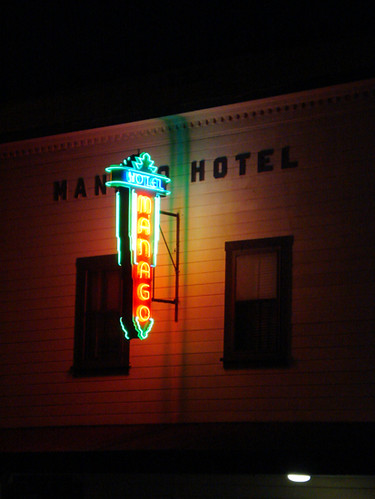
In October, we read a feature in Gourmet magazine about 20 great American restaurants from when the magazine was founded that are still going strong. Among them was the Manago Hotel, in Captain Cook, Hawaii, not far from where we'd been snorkeling. We'd called ahead that day to make a reservation, since the place still operates on plantation hours, meaning you need to be in by 7:30 pm to be served. The hotel dining room was not nearly as stately as that phrase makes it sound, but it was awesomely kitschy and probably hasn't changed since the day it opened. On the wood-paneled walls, a felt letter board menu listed the entrees and while almost everyone at the table ordered some local fish, I took the article advice and ordered the house special: a gravy-drenched pork chop.

Everyone at a table shared the family-style side sides, which came out with a pot of genmaicha tea before the rest of the meal. Sugary-sweet black-eyed peas, pasta salad, steamed vegetables and lots of white rice - island food circa 1950. With liberal dosings of soy sauce, we devoured most of the plates before our main courses even arrived. My pork chop was pretty delicious, covered as it was with a brown gravy and pan-seared on the bone, but A's choice of opelu, a less-fishy mackerel, caught all of our notice as the best-tasting fish at the table.

On our way back to our house that evening, we made a short detour to the southernmost bar in the US, Shaka Restaurant in Na'alehu. I don't mean to be a spoil sport, but they are resting on a tenuous claim - they're at least a few miles from the very southern tip of Hawaii. If someone wanted to be a huge jerk, that crown is there for the taking. Other than that, there's not much else to say on that front other than that my beer did taste very southern.

A:

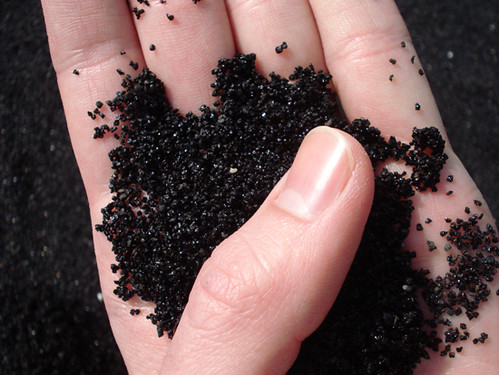
Our third and final day on the Big Island was volcano day. After a breakfast of cold papaya, linguisa, and toast with jaboticaba jam (grapes that grow out of the trunks of trees - my brother's find at the fruit stand), we set out for a black sand beach. Punalu'u beach is known for the presence of endangered sea turtles, that often drift onto dry land to sunbathe on the warm sand. We were lucky enough to see three while we were there - surrounded, of course, by tourists trying to get there picture taken with the turtles. It always astounds me when people blatantly ignore both posted rules and common sense, standing within inches rather than the suggested fifteen feet from the basking animals. I'll admit that I am particularly attentive to rules - perhaps I should be an officer of the law when I grow up? - but, seriously, regardless of regulations, is it that difficult to understand that standing nearly on top of living creatures might distress them in some way? And that maybe if you distress these turtles too much, you might not have a turtle to take your picture with next time around?


Off of my soapbox, and onto lunch. On our way into Volcano National Park, we stopped to grab food in a small town that was rumored to have outstanding malasadas. Unfortunately, the donuts were only available on the weekends, but the rest of the food at the unassuming cafe was surprisingly tasty. I briefly contemplated a hamburger made with local, grass fed beef, but eventually settled on the loco moco with fish. Traditionally consisting of white rice topped with a hamburger patty, a fried egg and brown gravy, ours replaced the patty with a cut of fish. Looking back, I wish I'd gotten the patty, but the meal was still a satisfying way to prepare for a hike through a lava crater.

Kilauae Ika erupted in 1959 and formed a lava pool at the base of the crater. The cooled lava now provides a short, scenic hike that begins and ends in rainforest and allows you to trek across the floor of the crater. We had lots of fun muttering from above about stupid tourists getting too close to the steam vents in the crater, only to head straight for them once we reached the floor. We even took a family photo next to one of them. It's always particularly touching when a family risks severe burns while posing for next year's Christmas photo.


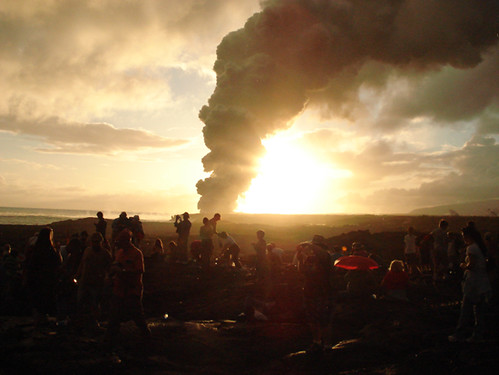
As late afternoon wore on, we drove out to the edge of the park where you could watch eruption meet ocean. Before dusk, the site is impressive enough - as you drive up through the lava fields and hike over cooled lava coils toward the viewing area, a HUGE, billowing steam cloud looms ahead. Every so often, a spray of rocks shoots into the air and the crowd collectively "ooohs". As dusk settles and the sun sets, however, the real show begins. The base of the steam cloud begins to glow red, and the shooting rocks become red sparks that burst into the sky. These were far and away the best New Year's fireworks I have yet to see.

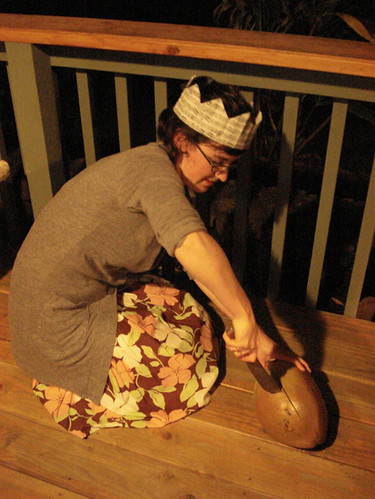
P: That night, with the spoils of a surprisingly good local grocery store and farmer's market, we made up a hodge-podge dinner to celebrate New Year's Eve. Thai fish curry to take advantage of the local produce; hoppin' john for some New Year's fortune. After a long day of volcano hikes, everyone began to crash by 10:30, but not before A could run outside with a coconut, a dull machete and a few glasses of wine in her. Looking back, I can not believe I let her tippsily hack at coconut in the dark, but then again, I was distracted by the sparklers. Between her efforts and her mom's even-more-nerve-wracking chopping, they split the outer husk and set to work boring out a hole for the juice. With the help of a lava rock, they split the fruit for everyone to taste and I remembered that I don't really like fresh coconut all that much. Thanks for your hard work, sweetie! It probably wouldn't have been a good end to the trip to lose her finger in Hawaii.