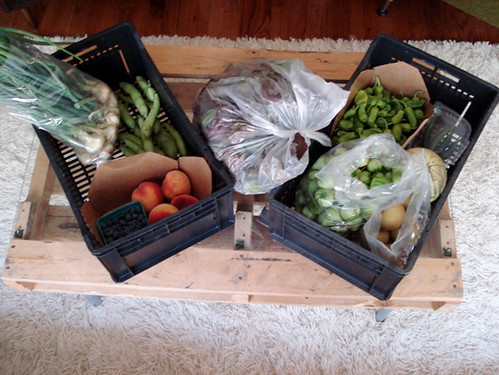
That's right: P & A are hitting the road for a weekend of food-addled wanderlust. Is this a photo of how we pack for a trip? No, it's just one shot of the overwhelming mess that is our recent move. You heard that correctly - we just finished a rapid-fire move across town and we are already leaving the place. Why? Because we're crazy. Crazy for food.
We're setting off on a pseudo-vacation for Labor Day weekend to attend Slow Food Nation. For the past couple of months, we've been managing the blog for the Portland chapter of Slow Food USA, so we will be traveling to San Francisco to listen to speakers on sustainable foodways and to taste as much as we possibly can (all strictly on assignment, of course). We'll be visiting the Victory Gardens, sampling street foods, exploring the market vendors, and participating in guided tastings of the best American artisanal foods. Plus, when we're not at the festival, we'll be eating in San Francisco.
And, immediately after we return, we'll launch ourselves headlong into the Time-Based Art festival. P will be blogging their events for the third year at Urbanhonking.com. The shows at TBA are always challenging, always exciting, and always surprising. This year, there will be more free performances and visual arts than ever before and the line-up for the late night program (THE WORKS) looks awesome.
We're still pouring over the program and making our plans, but as of now, here's who we're stoked about:
Reggie Watts (who'll blow your mind)
Antony and the Johnsons
Jerome Bel explaining contemporary French performance art to traditional Thai dancer Pichet Klunchun
Zidane
Fritz Haeg
So it may be a little quiet around here for a few weeks, but you can always follow along on the Slow Food PDX blog or the PICA TBA blog. Maybe once it is all over, we might actually have the time to see friends again. Or, you know, finish moving in.
Wednesday, August 27, 2008
time off (hardly)

Thursday, August 21, 2008
freezer dreams
A and I both love seafood, and happen to live around the corner from an exceptional fishmonger. Still, we always end up worried about declining fish populations and balk at the high prices of sustainable choices. Then we end up with a quarter-cup of sustainably-miniature Oregon bay shrimp or four runty sardines. Not exactly dinner.
So when the Iliamna Fish Co. set up an agreement with our CSA farm, Viridian, to offer a salmon share, we signed up before thinking what we'd do with all that fish.
Even after splitting our share with my parents, we still have seven two-foot long planks of frozen fish, bundled in twine. I guess it is time to start thinking up some creative uses for salmon. According to A, our problems did not stem from ordering 25 pounds of frozen salmon, they came from not having a chest freezer. This has been a common refrain around our house for the last few months, as we've packed our freezer more and more full of berries, stock, chickens and freezer jam.
This, I imagine, is what A sees when she sleeps:
Actually, that isn't entirely true; there may be frozen berries and sides of pork leaping over it, as well.
It certainly hasn't helped that some of our friends recently purchased a chest freezer, which they placed in their office, just off of their kitchen. "If they can live with one inside their home," pleads A, "why can't we just fit our own freezer in here?" pointing to where our couch currently resides. I have heard recommendations for placement everywhere from "in the corner" to "in the closet" to, my favorite, "in the bathroom." I think that everywhere A looks in our apartment, she sees a custom-shaped chest freezer ready to be plugged in. I need to stay strong, because our lack of a chest freezer is the only thing keeping A from ordering 65 pounds of slaughtered hog. Not that I'd be entirely opposed to it.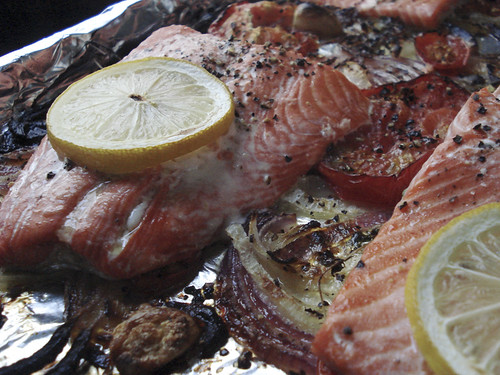
broiled salmon with tarragon, tomatoes, and onions to use up a bunch of our summer ingredients. It was dead simple and incredibly flavorful. The cooling anise flavor of the tarragon and pastis balance perfectly with the tang of the roasted tomatoes. And the salmon (oh!) was firm and deeply-colored and buttery-tasting.
Right now, as I admit what an amazing deal it was to buy all of this salmon, A is probably claiming her first victory. That, and comparing dimensions of chest freezers online with the width of our doorway.
Friday, August 15, 2008
special delivery (from korea).
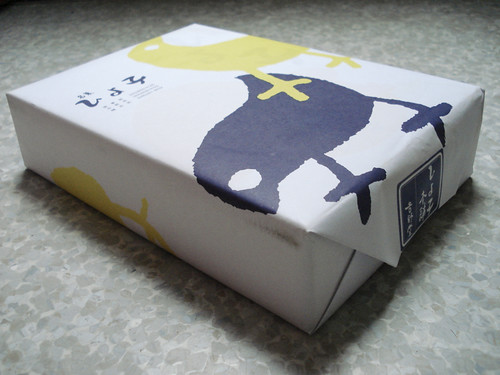
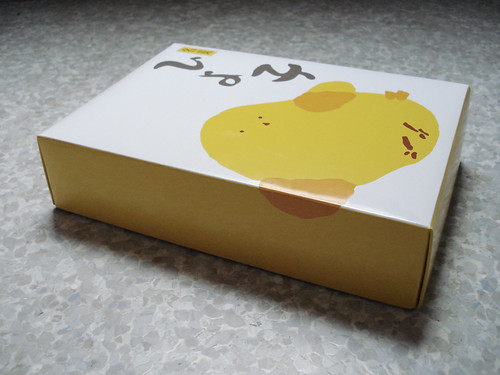
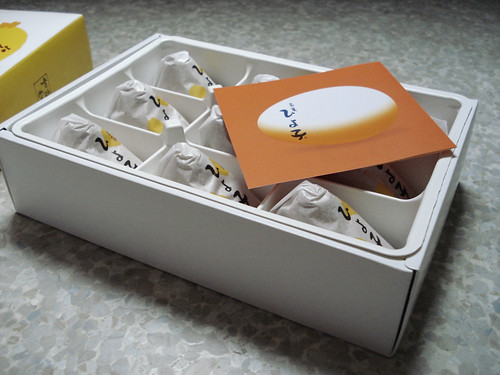
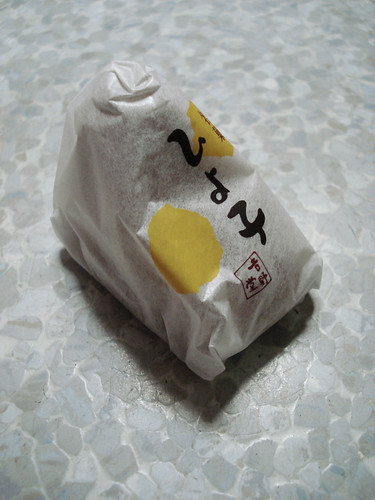
A's parents just returned from Korea and left this on our table:
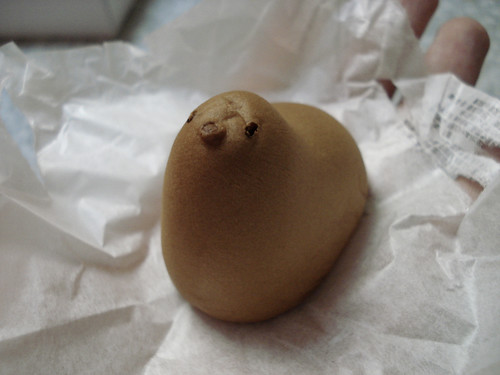
Instructions? What am I supposed to do with these?
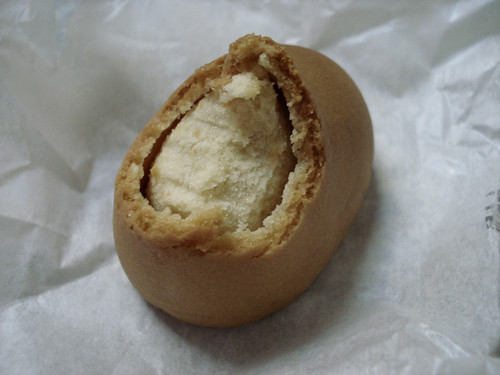
Mmmmm. It tasted like a cross between marzipan, yellow cake and mochi. Maybe with a hint of burnt toast. Mystery solved.

Wednesday, August 6, 2008
i love the south
Seriously. In the rose-colored romanticized way, because I don't think I'd actually love it if I lived there. Know why? Humidity.
But A and I both have Southern family (and a few transplant friends), so we've had reason to visit a few times, always enjoying it. Southerners are just some truly charming people, right down to the way A's grandma always used to ask for glasses of "wah-uh." I know there are quite a few un-charming Southerners, but that is the beauty of only living in the South of my imagination; I can have a very selective love affair.
At least when it comes to cuisine, I don't need to be too selective. Biscuits, sweet tea, gumbo, crayfish, mint juleps, fried chicken, red beans & rice, catfish, okra (yes), and some damn fine barbecue. I really can't think of a bad meal I've had in the South - I've even come across some of the best Vietnamese food in my life in New Orleans.
Two segments on a recent episode of Good Food nicely reinforced my Southernphilia
The first is a chat about classic sweet tea with Martha Hall Foose, author of a recent Southern cookbook. Now I love sweet tea, but what really caught my attention was the "mailbox" cocktail that she mentioned. When standing around her rural mailbox waiting for yesterday's newspaper to be delivered, she shares a strong drink and some conversation with her neighbors. There's one word to describe this: "genteel." If there's a second, it's "practical."
(It may take a moment to load. Check here if you can't hear it.)
The second is an interview with Shirley Corriher about White Lily brand flour and the quest for the perfect, pillowy biscuit. I love this conversation - everything from her unyielding devotion to an eccentric name-brand product, to the classic one-upsmanship of who boasts the best biscuits:
(Same goes for this one. Check here.)
I could just about die every time she makes that slurping sound to explain the absorbency of the flour.
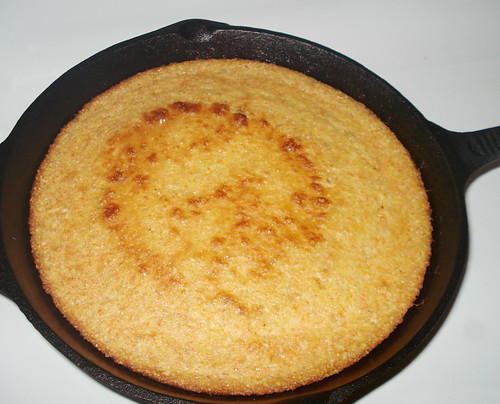 So when I got a hankering for some Southern classics (red beans & rice and stewed greens), I turned to the Lee Bros. recipe for skillet cornbread that we've mentioned before. This recipe can not be stopped. I used three kinds of cornmeal we had laying around (including two great heirloom varieties from Ayers Creek), and subbed in soymilk & yogurt since we didn't have any buttermilk on hand. Results? Still delicious. It is easy, versatile, and the perfect foil for some smoky-ham Southern flavors. Plus, if you are wilting greens on the stove and tending a big pot of stew, this tasty bread just goes right in the oven.
_____________
Skillet Cornbread (Adapted from Lee Bros. Southern Cookbook and necessity)
1 T lard or unsalted butter
1 1/2 c stone-ground cornmeal
1 t baking powder
1 t baking soda
1/2 t salt
1 t sugar
1 large egg
1 1/2 c. whole or lowfat buttermilk (preferably whole) [or 1 c. soy milk and 1/2 c. yogurt if you're scrounging the cupboards like we were]
2 T unsalted butter
1. Preheat the oven to 450. Grease a 12-inch skillet with the lard (or butter), leaving any excess in the pan, and place it in the oven.
2. In a large bowl, sift the dry ingredients together. In a medium bowl, whisk the egg until frothy and then whisk in the buttermilk. Add the wet ingredients to the dry ones and mix thoroughly. Melt the butter in a small skillet over low heat, and whisk the butter into the batter.
3. When the fat in the large skillet is smoking, carefully remove the skillet from the oven and swirl the fat around to coat the bottom and sides evenly. Pour the batter into the skillet; it should sizzle alluringly. Bake for 15 minutes, or until the top of the bread is golden brown and the edge has pulled away from the sides of the skillet. Remove from the oven
4. Cut the corn bread into wedges in the skillet and serve hot.
Monday, July 21, 2008
and sometimes there's just pie.
Two of our best friends are getting ready to leave Portland to move to New York, which has set me thinking a lot about our city over the last few days. Maybe this is dorky to admit (not that we're exactly charting new territories of cool with this blog), but I am a huge Portland booster. I follow a slew of local arts-and-culture blogs, I excitedly track the future plans for our city, and sometimes I get goosebumps when I read the editor's intros to local dining guides or the Willamette Week Finder. Together with A, I keep a running list of recommendations for out-of-town visitors - so many that we probably turn most guests off of Portland permanently.
I understand that Portland is no utopia. We can be insular, myopic, overly self-congratulatory, quick-to-settle, and insecure. We still don't have decent public transit on most of the Eastside, a lot of our neighborhoods seem hell-bent on making themselves into themed malls, and there appears to be no end in sight to the bland condo development. In spite of these failings (and more), there is a lot of energy in this town that gets channeled into some really exciting projects; projects that make it feel alright to stay in Portland, even when I sometimes long for a change.
Time for a little PDX boosterism.
MTV News came to Portland recently and they didn't eff-up the coverage! They even picked decent bands to interview. Experimentation, collaboration, positive vibes. Watching this kind of stuff just makes me swell up with pride. If you don't already have plans - check out the PDX Pop Now! festival next weekend.
As for other festivals, PICA just recently posted their Time-Based Art 2008 Festival preview video. I've mentioned TBA before, so I'll keep this short: it is one of the best parts of my year. I've gone into every year excited about a few events, skeptical of a lot more. Each time, I'm blown away by how engaging and entertaining the whole festival is. Sure, there was that terrifying Japanese noise music last year, but riding my bike between events and late-night happenings, I just end up feeling totally in love with the city. Somewhere in the video around Mark Russel saying, "Portland is the only place where this happens in the US...," I still start to choke up. So while the PDX future is brimming with music and arts, what about A and my real love? Last year, the New York Times proclaimed that Portland was in a "golden age of dining," so doesn't it follow that food would be the best indicator of Portland's zeitgeist? Artist Tricia Martin is in the process of reviewing submissions for her Pietopia contest, using baked goods as a cultural barometer. This isn't about cliched Portland aphorisms - this is chance for highly personal readings of the city. According to Martin's original call, participants are to submit pie recipes that reflect their current perspective on life, describing how the technique, ingredients, or style of the pie represents their experience. Taken together, these pies will portray how people are living in Portland. [Note: It is taking all of my self-restraint to avoid bad pie-centric puns.]
Unfortunately, the submission date came and went, but I'm looking forward to the unveiling of the pies on August 20. I think this project has so much potential - it doesn't just get people thinking about Portland, it begins to unpack the myriad things that food can represent and communicate. If the Portland food-scene is to grow, it certainly needs more intelligent and creative approaches to the culture surrounding eating.
I feel like there are good things happening in Portland and, for the time being, I like it here.
Then again, I suppose New York has some pretty decent music, arts, and food, too.
Friday, July 11, 2008
garden update
As for houseplants, I retain a windowsill of sad cacti that our cat repeatedly walks across in his attempt to see out the window. Time and time again, I diligently re-pot them, hoping the cat finally tires of tormenting their spiny limbs.
Clearly, neither of us have very much successful growing experience.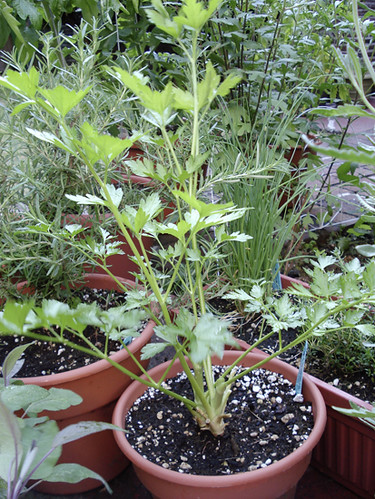
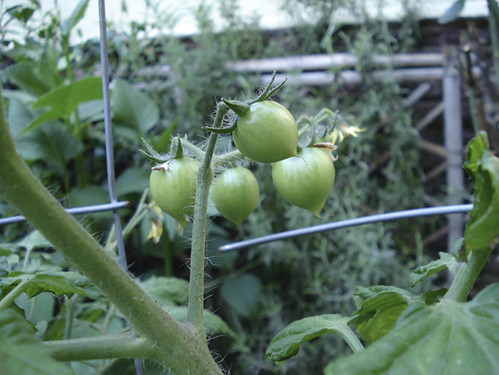
Nationwide, there has been a surge of activity this year from non-profits and artists in reviving the idea of victory gardens. We've actively followed the many projects, but I have to admit that it didn't exactly translate into bountiful rows of veggies in our yard. Blame it on apartment living. We did make some big improvements over last season, though - we got proper-sized containers, we increased the number of tomatoes we planted, and we tried a few new varieties. So far, so good. As small as our patio container garden is, I've really come to enjoy tending it. It's nice to walk out on our back stoop and water the plants in the evening, pinch back the buds on the basil, and obsessively check the growth of our tomatoes.
There is a lot we still have to figure out. We didn't fertilize. We didn't really pay much attention to sun/water needs. We still don't quite understand pruning. We certainly didn't start anything from seed. I can only imagine that gardening in the actual ground is even trickier. Still, we have picked up a few new tricks and our plants are doing worlds better than they were last year.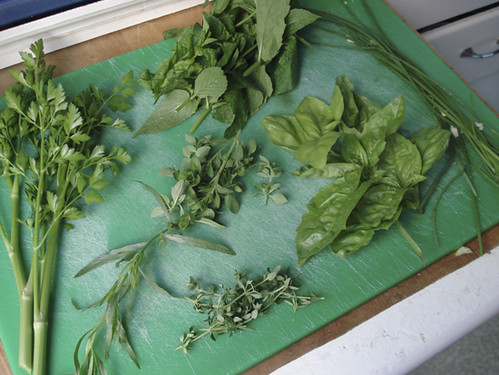
And in my imagination, we'll also be planting artichokes, brussels sprouts, tomatillos, chicories, climbing peas, pole beans, lovage, fenugreek, winter squash, potatoes, cavolo nero. It's fine to dream, but once I start planning out make-believe succession schedules and looking at plans for cold-frames and greenhouses, it might be time to remind myself that I'm a real greenhorn at this.
Monday, June 23, 2008
farm fresh
Every Thursday morning between now and October, I will awake with a giddy sense of anticipation. I will check my email before I head into the office, hoping for a hint of what is to come. I will walk to work inhaling the morning air, which seems to have just a hint of something vegetal in its scent. I will struggle to focus on tasks for most of the morning, but will find myself daydreaming about mixing, frying, simmering.
You see, Thursday is when my CSA arrives.
Last August, I walked by a co-worker's desk to find an overflowing flat of the plumpest, most delicious-looking blueberries I had ever seen. When I asked her where they had come from, she told me she had recently joined a CSA (Community Supported Agriculture) with Viridian Farms. When I pressed for more information, she explained that membership had closed for the year, but (BUT!) she knew someone who had signed up for a share and no longer wanted it. What I did next probably violated the CSA code of ethics, but I'm thankful every day for this transgression: I impulsively emailed one of the farmers and let her know that a friend of mine had signed up for a share and would not be taking it - could I please, PLEASE (waitlist be damned) take her place?
The following week, P and I picked up our first box: peaches, blueberries, a simply enormous bag of tomatillos, asian pears, fava beans, pimentos de padron, and, and, and... We were floored. And thrilled. And most of all, grateful. A) This was some of the best, freshest produce we'd had, even from the farmers market and B) it was far more produce than we felt we had paid for.
Oftentimes when you pay in advance, you save money and a CSA is no exception. When you reserve a share you are committing to support the farmers upfront, during the time of year when they most need the money (spring can a be very difficult for farmers) and they're likely to thank you for it. Granted, CSA's vary in terms of the variety and quantity of produce you might receive, but in general when you buy directly from farmers and, in particular, when you pay in advance for a season of produce it means getting better products at better prices. Your savings probably won't compare with those you can get at a discount grocery, but for the security of knowing where your food comes from (salmonella scares, anyone?) and knowing that it's produced in a manner that is fair and sustainable, these prices can't be beat.
After our first week of gastronomic delights, the ten that followed (which, incidentally, were the same ten that led up to our wedding), were filled to the brim with incredible local, seasonal meals that were completely inspired by and utterly indebted to our CSA. Largely, P and I credit Viridian Farms with launching us whole-heartedly into home-cooking. We have always enjoyed cooking, but before Viridian was a part of our lives, weeks were structured around many nights of dried pasta with sauce and tacos, interspersed with more elaborate meals (mostly on weekend nightS). Being given an assortment of the freshest seasonal produce each week forced us to be creative with our cooking in a way that was utterly painless and infinitely exciting. This enthusiasm carried over to the remainder of the year, when we no longer had our CSA box coming but were so used to experimenting and cooking with whatever was freshest that we scoped out the best grocery stores and dedicated ourselves to market shopping in a way that we never had before.
Being a part of a CSA meant that last year we were able to visit the farm and pick flats of blueberries for $10 (in addition to the flat we got for free). It means that I know, intimately, where my food is coming from and that I have come to know and love the people who grow it. It means that I begin to know the history of the place in which my food is grown -
farmer Leslie's family has been farming for three generations and there is a rosebush on her property that used to be designated for corsages and now provides petals for rose butter and other delicacies. It means that I am becoming accustomed to the rhythms of this place. Our small apartment and tiny yard don't leave much room for the garden we wish for, but I feel in touch with the growing season through my CSA. When we've had a cold spring, like this one, I know that summer produce has been delayed, that summer squash and early summer beans are still a few weeks out. I know that during spring and early summer I will be receiving a slightly smaller box each week that will be offset by the full bounty of produce that will come later in the summer.
Given my eager countdown of the days until this summer's CSA start date (beginning from the last date of last year's share) and the excited conversations that P and I have, almost weekly, about our CSA, you may wonder why we've never written about this before. I wonder that myself quite a bit. Maybe it's because we were too busy writing about our wedding and by the time that whole (epic, beautiful) mess was over, so was our CSA. Or, because it became so much a part of our lives, that it seemed like our version of the grocery store (and who wants to hear about a trip to the grocery store?). Maybe we have come to love our CSA and our farmers so much, that we are a little afraid to write about it. We're too close to the subject.
Whatever the reason, here we are entering into another summer and our CSA is back, this time for 20 glorious weeks. Already, we have discovered new favorites like peach leaf ice cream (with an amazing, subtle almond flavor), rose petal and black pepper shortbread, and Puntarelle alla Romana (see cicoria catalogna puntarella a foglia stretta), and have relished in standard comforts like sage grilled cheese and fried egg sandwiches.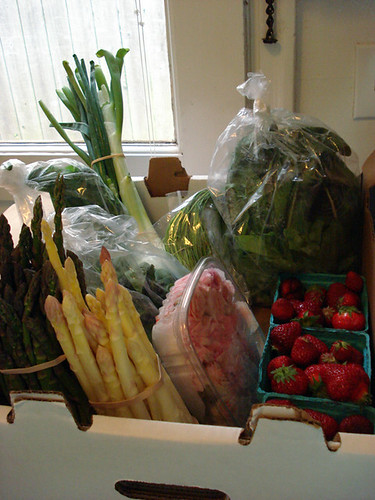
-----------------------------------------------------------------
Fried egg and sage grilled cheese sandwiches (serves 2)
(We made these sandwiches the night of our first box of the year. We were too tired to cook an elaborate meal and had received a huge container of sage, so this twist on the classic grilled cheese sandwich fit the bill)
2 eggs (preferably farm fresh - during this time of year, there are usually plenty of vendors selling eggs at your local farmers market)
Handful of fresh sage
Small block of cheddar (we used Beecher's Flagship, but any will do)
4 slices of bread
Butter
Fry the sage leaves in a nob of butter until they start to turn brown and crispy and give off a pleasant, nutty aroma. Remove from heat and reserve. Butter the undersides of the bread, then place a layer of cheese on the unbuttered side, make a sandwich and put this into a pan to cook over medium heat. Fry on one side until the bread is golden brown and the cheese has begun to melt, then flip and repeat. While the sandwich is grilling, fry one egg (you can keep the yolk, but it might get extra messy - we like to smash ours). When both sides are browned and the cheese is nice and melty, remove from the pan, open the sandwich and place the egg on top of the cheese. Then place a layer of the crispy sage, top off the sandwich and enjoy!