

Thank god for science.
Tuesday, February 26, 2008
bold new frontiers...

Monday, February 25, 2008
Here we go, a-waffling
Lately, the weather has been gorgeous in Portland. Not only that, but the weather has been gorgeous ON THE WEEKEND. Wonder of wonders. It's been the kind of weather that makes you forget its only February and spring is still over a month away: sunny, clear, and warm (in comparison with the usual winter weather, of course). We've been so excited to closet our rain gear and winter coats that we haven't much felt like spending time inside, which has necessitated more eating out than usual.
A few weeks ago we had one such beautiful Saturday and, though we were overflowing a bit in the leftovers department, we decided to have lunch out at a food cart we've been meaning to try. Despite my normal aversion to all things fast food, I am a sucker for the food cart. There is something very jolly about a little van or trailer packed with people and food (admittedly this is probably jollier for me than for those who are packed), serving tasty and often unusual treats. I also like the fact that I'm buying the food from the person who cooks it, enabling me to properly thank my chef for a satisfying meal. And, yes, it's fast...and sometimes that's fun.
Mississippi Avenue in North Portland has become a kind of haven for food carts. The neighborhood is one of our favorites and every time P and I stroll the streets I seek out the carts with my eagle eye, looking for any that I haven't seen before and reminding myself of the ones I am aching to try (ridiculously, up until a few weeks ago we had tried not-a-one). Here is the range I've noticed: Baked goods/juice , Filipino, Mostlandian, good old fashioned BBQ and a recent addition, a waffle cart.
The waffle cart, Flavourspot, used to have just one location, on North Lombard - a bit of a trek, which partly explains why we had yet to try it. However, they recently opened a second location on Mississippi, from which they now serve their sweet and savory waffle sandwiches - tasty waffles wrapped around an assortment of ingredients from lemon curd and whipped cream to sausage and maple spread.
I don't know if the world is divided into pancake people and waffle people in the same way that it is divided between those who listen to the Beatles and those who prefer the Rolling Stones (I like both, but then, I'm a bit of an anomaly); if it is, I fall decidedly on the side of the waffle. You may try to convince me otherwise, but in the great battle between waffle and pancake, I know where my loyalties will always lie. Where the waffle's texture is perfectly balanced between a buttery crisp exterior and a light fluffy interior, the pancake's is uniformly flat and spongy. Where the waffle delightfully stands up to the maple or other syrup you drizzle o'er its surface (and into its dimples), the pancake quickly becomes soggy and unappetizing. Try as you might to dress up a pancake, I will always see it for what it is: a poor substitute for a waffle.
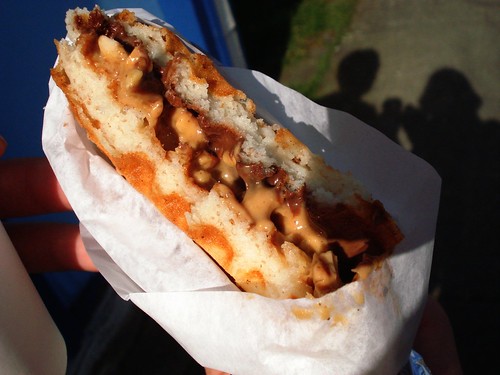
Flavourspot offers some damn fine waffles. The exterior is perfectly crisp and buttery (but not overly greasy) and the inside is airy, but still chewy. The fillings range from traditional - butter and powdered sugar; to savory - a waffle take on a croque monsieur; to decadent - a waffle wrapped around an ice cream bar (seriously). I decided on the Sweet Cream with Jam (whipped cream cheese and Strawberry Jam) and P went with the (Veggie) Sausage and Maple. Both were fantastic and we devoured them quickly on the lawn chairs next to the cart. While immensely satisfied, we weren't yet sick, so we decided to share a third waffle: chunky peanut butter and nutella. I was plenty sick after that, but oh, the glory of the waffle...
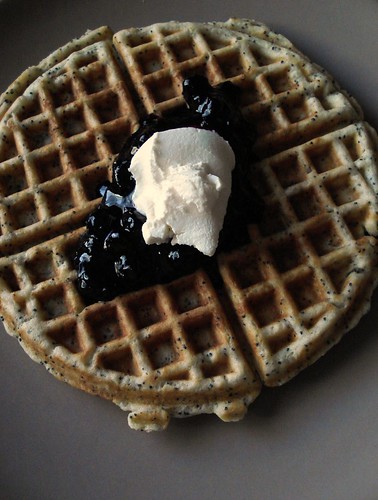
I was so inspired by the success of our waffle cart outing, that I decided to make my own. Waffles are one of those foods for which mixes abound, and yet they are incredibly easy (and far superior) if you make them yourself. The key is the butter, which contributes to the pleasant crispness and lightness and also aids the release from the waffle iron. I modified a recipe from the Joy of Cooking to make my Poppyseed buttermilk waffles, topped with mascarpone and blueberry-lemon syrup. I've included the basic waffle recipe below, as well as the modified version.
I discovered the pleasures of waffles for dinner while studying in Norwich, England. A favorite restaurant of mine was The Waffle House, which served everything waffle, sweet and savory concoctions alike; the fresh spinach, potato and chickpea curry was my favorite for dinner. (Portland, too, boasts a waffle restaurant, but I have yet to try it.) You can use the basic recipe below to make savory waffles, just omit the sugar in the recipe. Serve them with sundried tomatoes, goat cheese and arugula, or with a rich mushroom sauce. I strongly abide by the traditional adage, "a waffle a day keeps the devil at bay."
_____________
Basic Waffles
from Joy of Cooking
[You can vary the amount of butter in this recipe. Joy offers three options: 4 tablespoons for reduced fat, 8 tablespoons (1 stick) for light and fluffy, 1/2 pound (2 sticks) for extra crunchy and rich. I happen to adore butter, but I went with the middle option and was perfectly satisfied with the richness of the waffle. Any more butter and I fear the waffle may have melted on my plate]
Preheat a waffle iron. Whisk together in a large bowl:
1 3/4 cups all-purpose flour
1 tablespoon baking powder
1 tablespoon sugar
1/2 teaspoon salt
Thoroughly blend in another bowl:
3 eggs
1/4 cup to 1 cup (1/2 to 2 sticks) butter, melted
1 1/2 cups milk
Make a well in the center of the dry ingredients and pour in the wet ingredients. Combine with a few swift strokes of the whisk. Spoon about a half cup of the mixture into your pre-heated waffle iron and cook until steam has stopped emerging from the cracks in the iron and the waffle releases easily when the lid is opened.
Poppyseed buttermilk waffles
with mascarpone and blueberry-lemon syrup
Adapted from Joy of Cooking
To make the waffles:
Prepare the waffles as above, but decrease the baking powder to 2 teaspoons and add 1/4 teaspoon baking soda and a 1/3 of a cup of poppyseeds to the dry ingredients. Substitute buttermilk for the milk.
To make the sauce:
Put about a cup of berries into a pan with the juice of a small lemon and 1-2 tablespoons of agave syrup (substitute sugar if you don't have the syrup on hand). Cook, stirring, on medium heat until the syrup thickens.
Enjoy the waffles with a drizzle of blueberry-lemon syrup and a dollop of mascarpone.
[These would be delicious on a brunch menu if you're cooking for friends. The waffles keep well in a 200 degree oven. Or, you could do as we did and go it alone (together). That way, you can freeze the leftovers in plastic and enjoy them throughout the week, for a wholesome (read: decadent) start to your day!]
Sunday, February 17, 2008
the duck that laid the golden egg
"Eggs!" we both exclaimed, and immediately split up to make sure we'd get some fresh from a local farm. Our usual go-to stand was sold out so A ran to the Kookoolan stall (our chicken and rabbit supplier) only to find they, too were out of chicken eggs. In their place, she returned with a carton of duck eggs and I don't know if we've ever been so thrilled to take home the also-ran. We went for chicken eggs and left with duck eggs - that seems like a pretty good consolation prize, right?
Now, as soon as I get home from a typical grocery outing, I set about opening everything we bought at the store, skimming little samples off the top of each food. A usually mocks me mercilessly for this, but with the duck eggs, she was on board. We both knew we had to see what they were like.
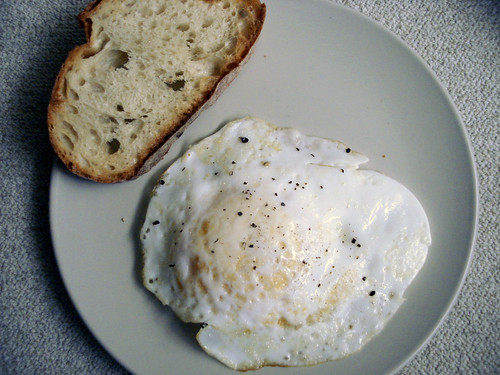
Duck eggs are pretty much the ugly duckling of the egg world: blueish-brown, splotchy, and mammothly-proportioned. Ours were so overgrown that the carton tabs were strained a full inch away from closing. Upon cracking through the dense shell, though, there before us was the most beautifully orange (and huge) yolk we'd seen. (Not to keep this metaphor running, but I wonder how swan eggs taste....?) Into the pan it went and soon we were enjoying duck eggs over-easy, jostling to sop up all of the just-cooked yolks with our toast. With a higher fat content than chicken eggs and an amazingly savory flavor, this egg was really exceptional.
We knew then that we would have to make something to showcase their flavor that night.
Though it had been a while since we'd made fresh pasta, we figured there could be no better occasion to pull down the pasta maker than for a rich egg dough. Wanting to keep our meal simple, we decided to tweak the classic Roman dish cacio e pepe (pasta with sheep's cheese and black pepper) to use black pepper-flecked pasta in place of the pepper in the sauce. If you've overlooked black pepper in the past as just a seasoning afterthought, this is the dish to reintroduce yourself to its sharp, slightly sour-hot taste.
And, if homemade pasta isn't in your plans, the classic cacio e pepe is a flavorful and easy dish to knock out. We've included the directions for both versions; if you go the pre-made pasta direction, check around to see if you can find fresh pasta at a market in your area.
__________________
Adapted from Chez Panisse Pasta, Pizza & Calzone
The basic proportions:
1 cup flour
1 egg
1 tablespoon freshly cracked black pepper
[we did 2 cups flour, 2 duck eggs, 2 tablespoons pepper and it was just enough for four servings]
By hand: Scoop the flour into a mixing bowl, make a well in the center of the flour and crack the eggs and pepper into the well. Whisk the eggs with a fork, slowly incorporating more and more of the flour from the sides into the mixture until is beginning to come together. Knead it until it balls up in the bowl, then turn it out onto a floured work surface and knead for five minutes. Add a little olive or water if it feels too tight, a little more flour if the dough seems wet. Rub with olive oil, cover with plastic and let rest for 15 - 45 minutes.
Alternately, by food processor: Throw all of the ingredients into the food processor and pulse until it balls together. Turn the dough out onto a floured work surface and continue as above.
Rolling out the pasta: After the dough has had a chance to rest, break off a golf ball-sized piece and flatten it slightly. Run it through a pasta maker starting at the widest setting (1) and continuing until about the number 6 setting. Flour both sides of the sheet lightly and run it through the tagliatelle/fettucine (wide) blades of the cutter. Set the pasta aside on a sheet until you are ready to boil it and continue with the rest of the dough.
Making the sauce: Bring a pot of water to a boil for the pasta. Meanwhile, grate 1/2 pound pecorino romano cheese or other hard, sheep's milk cheese and chop up about 3 tablespoons of Italian (flat-leaf) parsley. If you use black-pepper pasta, you can go ahead and skip this next step with the pepper. If you are using plain pasta, toast 1-2 tablespoons of whole black peppercorns in a dry skillet over medium-high heat, until they become fragrant. Transfer them to a mortar and pestle or wrap them in a kitchen towel and coarsely bash them open.
When the water has come to a boil, throw in the noodles and cook about 45 seconds to 1 minute. Before you drain the pasta, scoop out 1/2 cup of the cooking liquid and set it aside. As you drain the noodles, toss the cheese (and, if using plain pasta, the crushed black pepper) into the still-warm pot with the cooking liquid and quickly mix it together. Throw the pasta back in the pot along with the parsley and toss everything to coat!
Monday, February 11, 2008
towards a new theory of convenience
What A didn't mention about our ill-fated quiche attempt is that our obsessive interest in cooking and our new determination to eat more locally and sustainably means that we have absolutely zero "convenience" foods on hand. A year ago, if you'd opened our cupboards, there would have been far fewer heirloom beans and whole grains; their absence filled by a few microwaveable Indian foods or Annie's mac & cheese cartons. At the very least, we might have had some frozen garden burgers that could fill in for dinner in a pinch.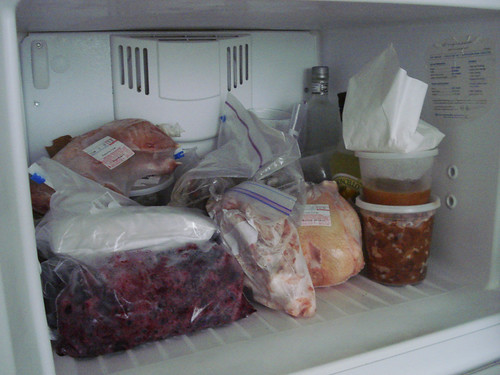
Not that I miss frozen pizzas, but our self-imposed way of cooking means a lot more planning and a lot less free time, right? Only if you accept the premise that "convenience" foods are marketed under. Primarily, quick-cook products depend on the belief that in the balance of time versus enjoyment, the scales will always tip in favor of saving time. While it's true that a lot of from-scratch meals require advanced notice and lots of dedicated attention, many dishes that we're used to consuming pre-prepared only take an extra ten minutes to make by hand. Those ten minutes translate into such a better flavor that for A and I (as I'm sure you all could guess), it's simple to choose the extra work over the easily bland.
The other issue that plays into this effort vs. pleasure debate is that a lot of people seem convinced that cooking is some old-fashioned drudgery. I can go off on a diatribe about how our society doesn't value the knowledge and intelligence inherent in physical acts, but I'll keep it to this: I believe that many people think that cooking isn't enjoyable because, to them, preparing a meal equates with heating up something that's already been made. There is no ownership over the flavors, no problem-solving, and no skill. Maybe it is just the socialist in me speaking, but I think that most people enjoy applying their knowledge and ideas to projects, feeling like they are doing something essential and good. Making a meal from scratch satisfies a creative need, as well as our tastes.
In truth, it is our own fault that we couldn't figure out a quick alternative to a quiche - we had plenty of ingredients on hand to make simple, satisfying meals, we just weren't seeing them for all of the dried beans we had.
So, with this post, A and I are going to start posting an occasional series of recipes that revisit "convenience." It'll be a way to share dishes that are quick to make, rely on pantry staples, and reinvent foods that we are all used to buying pre-made, but really don't require much more time to make yourself. To get it started, it seems only fitting to start with a dish that seems to be the antithesis of quick: stock. The best stocks always take hours of slow simmering, and often a little bit of roasting before the ingredients go into the pot. But A and I have discovered the beauty of simple Japanese soup bases, and that means a homemade stock in about twenty minutes.
____________
Dashi Broth
Adapted from A New Way to Cook by Sally Schneider
1 ounce dried kombu kelp
5 cups water
1 ounce dried bonito shavings or furikake (substitute 1 ounce of dried nori for a vegan version)
1/4 - 1/3 cup tamari or mild soy sauce (depending on taste)
2 tablespoons rice vinegar
1 inch-long knob of ginger, peeled and sliced
2 teaspoons sugar
Place the kelp and water in a medium saucepan and slowly bring to a simmer over medium-low heat, about 10-15 minutes. Remove the kelp with tongs or a slotted spoon and discard. Remove the pan from the heat and add the bonito shavings (or nori). Do not stir. When the bonito has sunk to the bottom, after a minute or two, strain the broth through a fine strainer. Press the remaining bonito or nori to extract all the liquid, then discard the solids.
Return the dashi broth to the saucepan. Stir in the tamari, vinegar, ginger and sugar. Bring to a simmer over low heat and keep warm as you add your desired soup ingredients.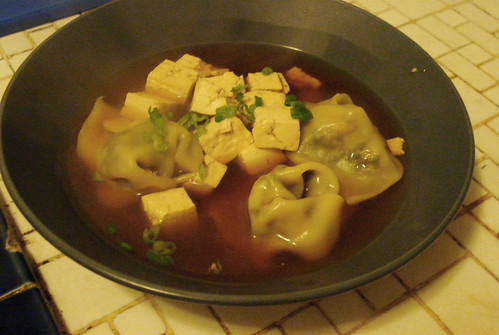
Monday, February 4, 2008
blood, sweat and quiche
 Last weekend, we may have made the meal of the year. I know it's a bit early to declare something like this, but truly, it was spectacular. We had agreed to watch my in-laws' puppy (a task that, however adorable this puppy is, made me vow to forgo puppies and children for the next ten years) and consequently found ourselves stuck inside for most of the weekend. Undeterred by this turn of events (it was raining, anyway), we spent most of the weekend making food: muesli, sourdough no-knead bread, chocolate chip cookies, lavender shortbread with sea salt, and the aforementioned meal of the century. What else were we to do? Little Oscar, only three months old, needs to go outside to do his "business" after nap-time or active play, which by my calculations was about 95% of our waking hours. So, we cooked.
THE MEAL was truly restaurant quality (and easy to boot): poussin marinated in paprika and olive oil, then broiled and placed over lemony sauteed kale and onion resting on a bed of pillowy soft polenta, the whole meal drizzled with a pomegranate reduction. It was based on a Mario Batali recipe with the addition of polenta we'd recently acquired from Ayers Creek Farm (read more about them here). It was also a triumph of eating locally, something we've been working into our lives more and more these days. The kale and onion were direct from Oregon farms, the polenta from Ayers Creek, and the poussin sourced locally by Viande Meats. I tell you all of this not to gloat, nor to preach, but simply to provide a contrast to a time when things were not so easy.
Eating locally provides plenty of pleasures. There are nights (most nights) when I am astounded by the variety, the bounty, the incredibly tasty (and surprisingly easy) combinations that come forth from within a 100 miles of where we live (see above, for emphasis). However, as with anything, there are also the lows...the nights that look more like last Thursday. These nights roll past 8:30 with P retreating from my grouchiness to the bathroom to shave, while I hungrily pick at my chicory salad until all that remains is a pool of dressing, both of us waiting for the quiche in the oven to finish its long journey from raw ingredients to plate. [I should qualify this by admitting that we have never been very successful when making quiche. I know you may laugh at this. Quiche is supposed to be one of the quick fixes of home-cooking: mix up the eggs and milk, toss in some vegetables and maybe some cheese, throw everything in a tart shell (pre-prepared for extra convenience) and pop it in the oven for 45 minutes. Voila, dinner! Ours normally take twice that cooking time and never seem to have quite the firmness that we desire.]
There were a few hurdles during the meal that, had we been making this meal a year ago, probably would have pushed us to change course. The first, and probably most significant warning sign came in the form of dairy. We had decided to substitute milk for the cream the recipe called for and had picked up a gallon of whole milk from a local dairy. Or so we thought. P decided to take a quick swig before measuring the appropriate amount and immediately scrunched up his face. "Nonfat."
Oh, the horror.
Call me creamist, but I maintain that there is no earthly reason to drink/cook with anything less than 2%. You might as well be drinking water and, frankly, water tastes better. The evil fascists (actually very nice, friendly staff people) at the neighborhood grocery store must have cruelly switched bottles on us and, in our excitement to buy from a local dairy (with a returnable glass bottle, no less!), we had fallen for their scheme.
But, before I make you think this post is simply a diatribe about the evils of watery milk, let's just say that I blame the milk for the endless cooking time of the quiche and leave it at that.
The real problem with the evening was not that it was a night where everything seemed to be going wrong, ending with us eating dinner a full three hours after we had started cooking. There were many points during the cooking, and the waiting that followed, at which we could have abandoned the meal for something faster. At around 8:00, P noticed that I was getting a hungry look in my eye (never a good sign) and mentioned that maybe we should grab some food at a nearby restaurant. But the more we cook at home, the more I make a point to eat consciously, the less I feel like going out, and especially not for just any food.
Cooking locally and from scratch can become a sort of addiction. Once you are in the rhythm, you realize that cooking from scratch is not the chore that its made out to be (rarely the ordeal that I describe above). It can be incredibly soothing to watch the flour, water and yeast combine as you mix a bread dough and incomparably satisfying to taste the finished project. And there's the second layer of the addiction: taste. Home cooked food tastes differently than food you'll find in a restaurant. Of course, it tends to be less rich and salty, but the flavors can often be more distinct, whole and comforting. Eating local foods in the season in which they're meant to be eaten only heightens these tastes. Lately, it's the meals we make at home that I crave on a regular basis, the special occasion restaurant food that I want to taste on just that - a special occasion.
To compound these feelings, there is the inevitable guilt and confusion that I find when eating out at many restaurants. And no, this is not a concern about weight gain. Whereas before I used to eat a pile of take-out Thai without blinking an eye, now I find myself blinking both and, often, losing my appetite. When you know many of the people who grow the food that you eat, it's hard not to think of them as you bite into the factory farm chicken, the green beans from South America and the watery slice of tomato (in the middle of winter, no less). Not only that, but I've tasted eggplant in the height of the season, when the flavor is rich and fruity, the color vibrant, and the flesh firm, but tender. Eggplant in January just isn't the same.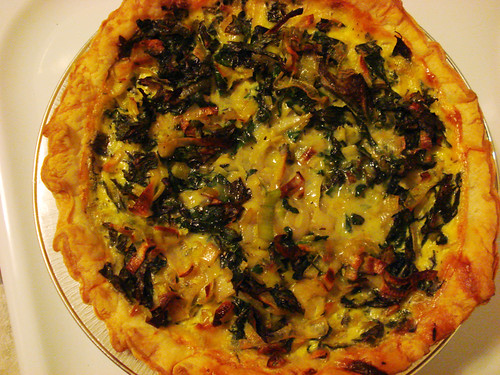
Thursday, January 17, 2008
the simple potato
Its only the third week of the year and A is already worried that we are falling behind on our resolutions. What started out as her anxiety about winter malaise ended up as a weekend filled with projects (homemade granola, bagel chips, dried kiwis, and our first attempt at no-knead bread) wedged in between outings (wine tastings, feeding our market cravings at Hillsdale, and trying new salts at the Meadow). She was definitely in one of her epicurean Laura Ingalls Wilder moods, when she wants to make everything from scratch and live off the grid, but still take advantage of all the city has to offer.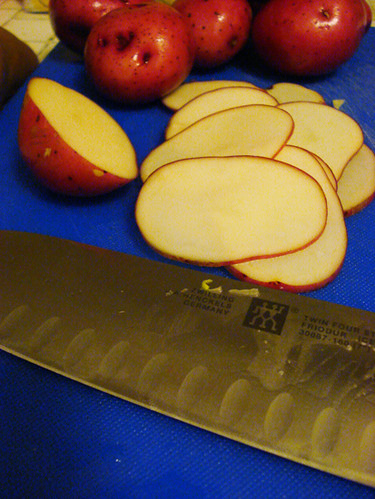
Given the potato's easy appeal, the UN Food and Agriculture Office has declared 2008 to be the Year of the Potato, in an effort to draw attention to world hunger and issues confronting farmers. (Incidentally, it's also the year of the Rat [mine!]). Their site includes interesting reports on topics such as how Andean farmers are preserving tuber biodiversity to how potatoes can serve as an agricultural tool for women's empowerment. Even better, it provides me with more trivia for my already trivial mind (Europeans consume 96 kilos per capita annually!) and a project for growing potatoes in a large bucket. Since A and I want to expand our container gardening this year, I think this may well have made it onto our list of projects.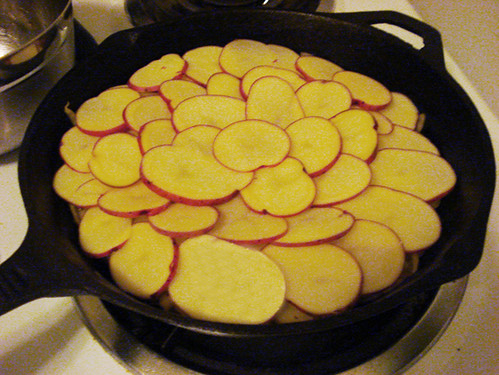
___________________
Potato, Fennel, and Pear Galette with Fourme d'Ambert cheese
1 1/2 lbs. potatoes (we used red creamers for this, but deep blue potatoes worked great for the kale version we'd previously made)
6 tablespoons butter
2 garlic cloves, sliced
1 medium fennel bulb, halved and cored
1 ripe bosc pear
1/4 lb wedge of fourme d'ambert
kosher salt and fresh ground black pepper
Begin by slicing the fennel 1/8 of an inch thick. Melt two tablespoons of the butter in a cast-iron skilled over medium heat. When it begins to smell fragrant, toss in the fennel and garlic slices and saute, stirring occasionally. When the fennel is just beginning to turn translucent, season to taste with some salt and black pepper. Continue cooking until the fennel has softened and its edges have just begun to brown. Remove from heat, transferring the fennel to a bowl and wipe out skillet.
While the fennel is cooking, thinly slice your potatoes about 1/16 of an inch. A mandoline will make short work of this and keep the thickness consistent. Heat another two tablespoons of the butter in the skillet over moderate heat and, as it melts, halve, core and thinly slice the pear. There is little need to worry about browning because you will quickly assemble the galette in the pan.
Brush the melted butter around the skillet and, with any excess, brush a sheet of aluminum foil that is slightly larger than the skillet you are using. On the stove, quickly begin layering about half of the potato slices in the bottom of the hot skillet, working inwards from the pan's edge in a spiral, overlapping each previous slice. Sprinkle with cracked pepper and kosher salt. Layer the pears in the same fashion on top of the potatoes, then cover with the cooked fennel, spreading it thinly into a single layer. With the remaining potatoes, cover the fennel with a final layer of overlapping slices. Brush with olive oil or a bit of melted butter and season with pepper and salt. Place the foil butter-side-down on the potatoes and weight down the galette by placing a heavy pot that just fits inside the skillet on the foil, pressing slightly.
Cook 10-15 minutes until the bottom layer of potatoes have crisped. Remove the pot and foil from the skillet and set aside. Holding a sheet pan tightly over the skillet, flip both over together, inverting the galette onto the sheet. Take a second baking sheet and place it over the galette on the first baking sheet. Hold both tightly together and invert the galette again. Brush the potatoes with a bit of olive oil or melted butter, cover with the skillet and invert once more into the pan. Return to moderate heat and cover with the foil and stockpot for another 10-15 minutes.
If you'd like to melt the cheese into the potatoes and really open up its aroma, preheat the oven to broil, remove the foil and stockpot and crumble the fourme d'ambert over the top of the galette. Place the skillet in the oven and broil lightly, watching that it doesn't brown too much. Otherwise, just go ahead and cut healthy wedges of the galette and serve alongside slices of the fourme d'ambert.
Monday, January 14, 2008
if at first you don't succeed, chai, chai again...
I've had a hankering for Indian food recently. Not your everyday, superficial, tip of the tongue need for something salty or sweet, but a deep down, pit of the stomach sort of desire. I wanted the spice, the tang, the layers of flavor that somehow remain distinct in channa masala or saag.
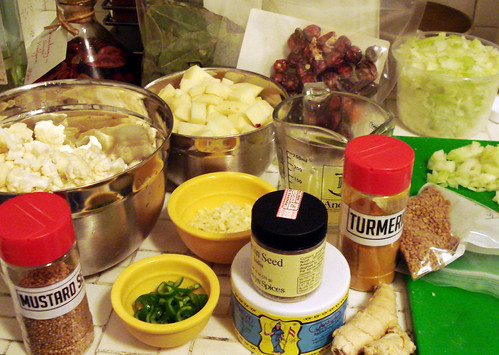
Indian food is something P and I have always found difficult to recreate in the kitchen. We can make pretty satisfying curries or dal, but they always seem to lack the depth you find in a restaurant. Still, we had recently discovered a dal recipe from the spice shop we visited in Montreal (found here) and decided to throw caution to the wind, feeding my hankering with a home-cooked meal.
The dal needed an accompaniment, so I rooted through the only Indian cookbook we have (not a standout - this is clearly one of the areas in which our cookbooks are lacking) and found a recipe for aloo gobi, or stewed potatoes and cauliflower. Then, we rounded out the meal with a little homemade chai (recipe below) and naan.
Flushed with the success of my bread last weekend, I decided to start the year off right and outdo my own resolutions. I set out to make bread every two weeks? Seriously, that was a weak promise. In competition with myself, as I typically am, I decided to win at my own game. However, as the middle finger on my left hand had been injured earlier that day in a freak trunk-of-the-car accident, it was up to P to do the kneading. I supervised closely and must say I was pleased with his technique (Let's face it, the man can whip up a souffle from a pile of sand. He's like a modern-day king Midas - turning everything he touches into butter), but the end result was not quite up to par. This was probably due to the fact that I opened the oven after 5-7 minutes (when the cookbook indicated the bread should be finished), noted that it looked uncooked, and popped it right back in for another five. It was tasty, but more cracker-like than naan. Next time, I suppose I might follow the recipe and see where that gets me.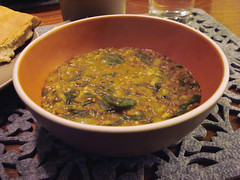
Therein reside the secrets that catapulted this meal worlds beyond any other Indian meal we've made: more cooking, more spices, better timing. Every flavor of the dal was delicately melded together, while remaining discernible. A taste began with the bite of garlic and cayenne, eased into flavors of onion and fenugreek, and echoed with the herbal notes of the bay leaf.
I was indeed satiated.
_______________________
Easy Chai:
1 cup water
1 cup milk (we use soymilk - I like the nutty flavor)
3 tsp. black tea, such as Assam or Darjeeling (or a mixture)
3 peppercorns
3 cardamom pods, bashed
2 cloves
Combine all ingredients in a medium saucepan. Heat over medium-high heat until boiling, stirring occasionally and increasing the frequency of stirring as it gets closer to boiling. Let the liquid foam up a few times - the foam is delightful. Take off the heat and strain into a bowl or, if you trust your aim, directly into two small mugs. Stir in a big spoonful of honey (or a smaller spoonful of sugar) and you're done!
This recipe is a little milder than what we normally make, but it's a good jumping off point for experimentation. I like to make it with a little more pepper; you may prefer a stronger tea flavor, or more cardamom. Also, feel free to expand the recipe - sometimes we make 1 1/2 or two times as much and have it in a pot; other times we just want a taste and the smallish mugs work out fine.
Subscribe to:
Posts (Atom)


