If two years ago you asked me for a run-down of my favorite foods, sushi would definitely have made the cut. That rich flavor and unctuous texture of the raw fish was enough to make me drool. Like I'm doing right now thinking about it. You can call me a hypocrite for mocking "living" fudge or raw bread, but some things are meant to be cooked and some aren't. Fish demands a gentle hand at the stove, making it an excellent candidate for being served raw. Bread, on the other hand, should be baked; not dehydrated.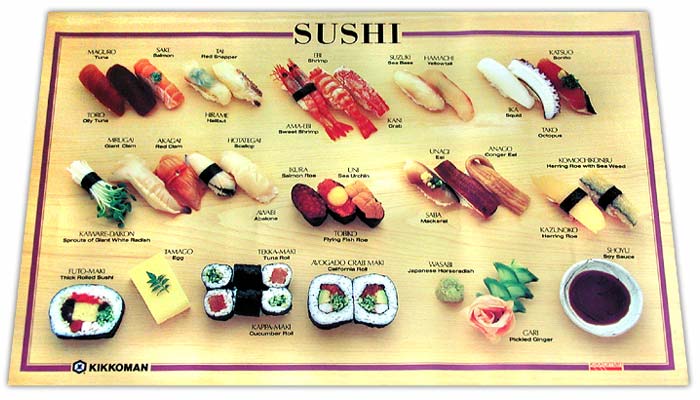
Recently, the Monterey Bay Aquarium Seafood Watch group released a new sushi-centric version of their great sustainable seafood guide (download PDF). Helpfully, it lists all of the Japanese names for the best fish choices. Unhelpfully, you've probably never seen any of the best choices in a sushi restaurant. On top of that, the few choices you have heard of get pretty specific about fishing practices. I'd wager that if you ask most sushi chefs in America if their tuna is US troll/pole caught rather than longline, you'll get a blank stare. Here in Portland, almost all sushi passes through a bizarrely infamous international cult. Hey, maybe they're a sustainable cult, but with only one supplier for most restaurants, there isn't a lot of choice in terms of fish sourcing.
Meet Bamboo Sushi. Brainchild of a former owner of the indie-chic Masu, it couples hip design with focused sustainability. Not only do they espouse green principles and focus on responsible sourcing, they are actually the first Marine Stewardship Council certified restaurant in the US. I think A and I almost wept when we ate there on Wednesday evening - for the first time in over a year, we went out for sushi. Everything was incredibly fresh and their preparations were really inventive. We swooned over each bite of the rolls and awkwardly sawed our nigiri selections in half with our chopsticks to make sure we all got a taste of everything.
To tide us over between visits to Bamboo, maybe we'll have to branch out into other Japanese foods (it's either that or we make miniature gunkan maki rolls with bay shrimp). Luckily for us, Bamboo offers some inspiration - one of their best offerings is a tsukemono plate of pickled eggplant, cabbage, daikon, onion, ginger, peppers, and squash. Over the weekend, we tried out a Japanese-style quick cabbage pickle, piecing together our own recipe from a mix of different books and websites. The results were great, but pickled cabbage just isn't the same as sushi. At least Bamboo has a happy hour, but is "low priced sushi" really a valid excuse to cut out of work early? It should be.
__________
Simple Cabbage Tsukemono
Adapted from Justhungy.com and Dorothy Lesem's Preserving in Today's Kitchen
1 head of napa cabbage
1 1/2 teaspoons kosher salt
1/4 teaspoon chile flakes
zest of one lemon
1 teaspoon rice vinegar
1 teaspoon fish sauce
1 teaspoon sesame oil
Clean and core the cabbage, chopping the leaves into 1-to-2 inch pieces. Place the cabbage in a large glass bowl and toss with the salt, chile flakes and lemon zest. Cover with a weighted plate that fits inside the bowl and leave to sit in the refrigerator for about an hour. A lot of moisture will be drawn out of the cabbage - drain off the liquid and toss the remaining cabbage with the vinegar, fish sauce and sesame oil. Serve with rice and broth simmered-tofu.
Monday, November 24, 2008
the raw and the cooked


Friday, November 14, 2008
chef crush
I love Dan Barber and I don't care who knows it. Maybe I identify with something about his geeky demeanor, but I swear, the guy could put dirt on a plate and I'd probably think it was clever cooking. A, loving wife that she is, is indulgent (and I have a hunch she finds him pretty cool, too). I think it probably all started with this story about a girl he once dated:
Or maybe it began with seeing him at Slow Food Nation when he recounted his visit to a Spanish farmer who raises "natural" foie gras geese without the use of gauvage (watch this video of the same speech at a different conference).
Then again, my fascination could have stemmed from this review of a dinner at his restaurant, Blue Hill at Stone Barns, which claimed the breathtakingly fresh courses made it the "most important Restaurant in America."
Actually, it could just be his dedication to forging a new relationship between farmers and chefs. As the Creative Director for the Stone Barns Center for Food and Agriculture, Barber helps guide the educational efforts on the working farm that supplies the majority of produce to his two restaurants. Not only that, but one of his restaurants is directly on the farm, allowing his chefs to pick their own greens and work directly with the animal husbands. The Blue Hill website features video profiles of some of their providers and the story of Barber's efforts to restore his family's farm.
And he's an keen thinker and polished writer, to boot.
Cooking is just about the most macho thing I do. In spite of being a pretty slight, geeky guy, I'm still drawn to the knives and heat and swagger of the kitchen. That's not to say I'm running six flame burners at home every night, just that kitchen manliness is one of the few places I'll throw down and jump at the chance to consult on grilling or carve something with a big knife. (Truth be told, I've got some chef crushes on the ladies, too.)
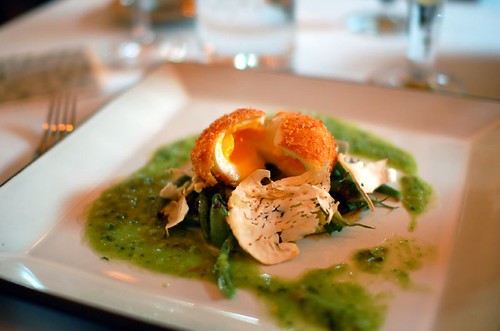
Still, I'm probably not kidding anyone with my kitchen posturing. And I think that is what attracts me to Barber's cooking - there is an intellect behind his efforts and something very gentle about what he's doing with food. At the Stone Barns Restaurant, there are two menu choices: five-course or more courses. In place of a list of dishes, they offer a chart of what is in season, from which the chefs will create the nightly meals. The results, from what I've seen and read, are really stunning, like this salad of a hazelnut-crusted poached egg with matsutake mushrooms, pistachios and garden gazpacho:
For a sense of the kinds of simple, clear flavors Barber coaxes out of his ingredients, just have a look at this fennel soup from New York Magazine. Now we only need to figure out how to get up the Hudson Valley the next time we visit New York...
Wednesday, November 5, 2008

Friday, October 31, 2008
catchy.
Thanks to two friends of ours who turned us on to Lykke Li, we caught her show at the Doug Fir last night. Let me just say, the Swedes know how to do cultural dissonance right. Her stage presence is like a spastic hip hop back-up dancer dressed like Stevie Nicks singing electro soul through a bullhorn. Because her music is bouncing around in my head today, I thought I'd post this video of one of her songs. This take sounds just like her awesome live version and it's just a little bit spooky for Halloween:
Breaking it up – alternative live video. Filmed by: Christian Haag from Lykke Li on Vimeo.
Wednesday, October 29, 2008
catching up
Whew. After the blitz of the last few months, we are just starting to get our bearings again. Now that we've surfaced, we've looked around and realized we are very out of touch with the new happenings in Portland. And just in time for the holiday rush of Thanksgiving planning, Christmas baking, and overeating to put us even further out-of-the-loop.
So it's time for some house-cleaning before the coming cheer steamrolls us. We've fixed-up the look of our blog, updated some of our links, added pictures to our Flickr page and, most importantly, re-vamped our map of favorite Portland places. A few weeks back, we picked up a copy of the Willamette Week's 2008 Dining Guide and knew we had to update our list of places-to-try. Now, our map points out some of our beloved places in town (food and otherwise) and the ones we are still looking to check out. I've tried to color-code the recommendations (with a key below), and I will continue to work on organizing the list (maybe by neighborhood) and adding new places. If you're looking for somewhere to go in Portland, we stand by our recommendations as a highly personal list of favorites. If you're looking for someone to go with to any of these places, we're in.
You may have to scroll down on the map to see Portland.
View Full-Size Map
Wednesday, October 15, 2008
never again
I have a serious fixation on candy corn. I'll admit that it's not a classy candy. It has no exotic ingredients and it's not crafted by French monks. You could argue that it has a slight honey taste, but eating a handful of them is really just like mainlining sugar. Most people I talk with turn up their noses at bad memories of a stale bowl of the candy sitting on a coffee table. I'd eat those ones, too. Each week, A, loving wife that she is, looks the other way as I toss a bag of candy corn into our shopping basket. It's an insatiable addiction.
Still, when it comes to my corn, I'm a bit of a purist. Candy corn is best consumed in October. It also should not taste of chocolate like the so-called "Indian Corn." The most leeway I am willing to allow is for a mellowcreme pumpkin, which is little more than GIANT candy corn. Therefore, I don't want to see "Bunny Corn," "Reindeer Corn," "Cupid Corn," or "Veteran Corn" when it is inevitably created. Other holidays don't need their own candy corn; Halloween needs candy corn.
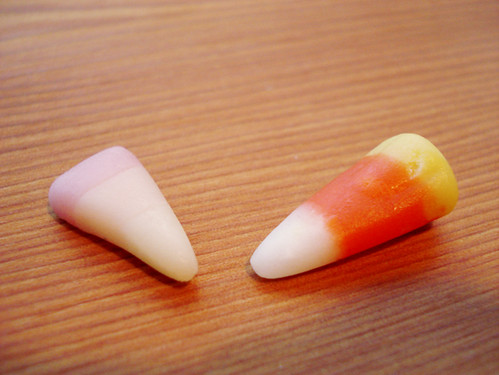
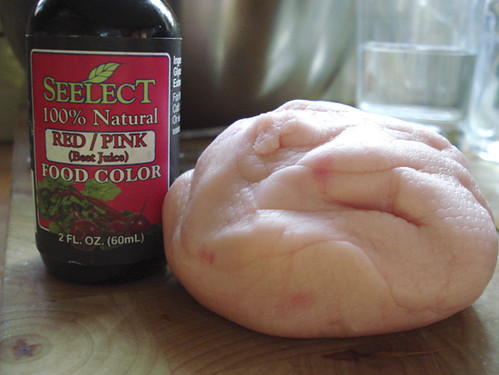
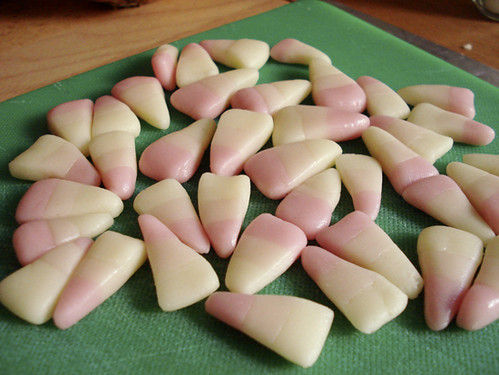
And I need candy corn. So when I came across a recipe for homemade candy corn, it seemed like the perfect, mildly neurotic cooking activity for last weekend. As candy goes, it even seemed simple. No candy thermometer. No esoteric ingredients. Food coloring was the only ingredient we didn't have on hand. And here is where ethics collides with fun - New Seasons carries only a few large bottles of standard food coloring (none of the primary-color sample packs) and a couple shades of all-natural alternatives for a lower price. Thanks to their ethics (and my stinginess) we bought one bottle of beet coloring instead of a bottle each of industrial red and yellow dyes. I ended up with pastel pink rainbow corn.
Making the candy was the most tedious process imaginable. For some reason, I disregarded the fact that every single person online who has tried the recipe complained about the time it took. Chalk it up to sugar-induced mania on my part.
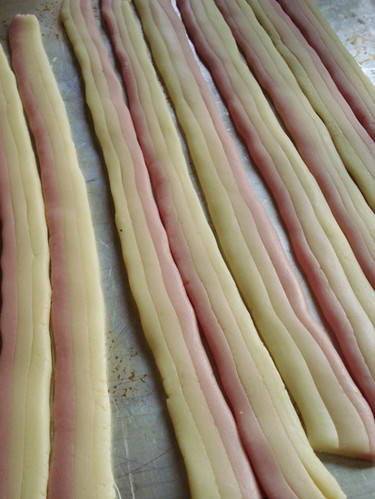
The process starts out alright - you heat the ingredients, knead in the dye, and roll out ropes that you press together into three-color bands. Then comes the shaping. You cut and cut and cut and end up with piles of rough triangles that need to be individually pressed and rolled between your fingers to take on that classic kernel shape. Sticky hell.
Two-and-a-half hours later, we finally had enough to fill a 99 cent bag. But hey, at least A didn't have to shamefully hide my candy addiction underneath our bulk grains and organic produce at the grocery store.
Thursday, October 2, 2008
festival weekend
Pancake breakfast. Corn roast. Sausage dinner. Clambake. Chowder cook-off. Grape stomp.
Whatever name they go by, we don't make it to nearly enough food festivals. After reading Calvin Trillin earlier this year, I had a real taste to get to some festivals (the dream would be Breaux Bridge in time for the crawfish), but the busy-ness of the summer meant that the prime festival season got away from us again. So imagine our luck to find ourselves at two (2!) food-centric festivals this last weekend. We made sure to get our fill.
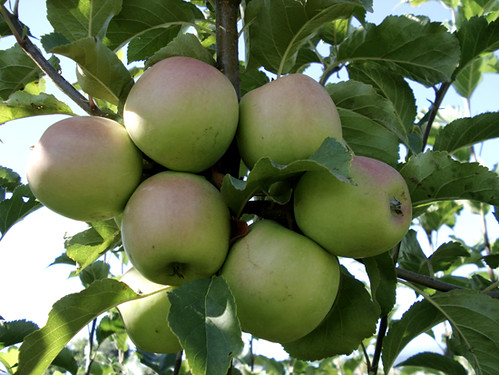
A good friend of ours has parents that run an apple root-stock farm out in Gaston. Now it only makes sense that someone growing the roots would happen to grow a few apples as well, but what do you do with them when a few hundred pounds ripen all at once? Make cider. For years, her family has been pressing their apples into jugs of cider (unfortunately not the hard sort) and it has grown into a huge, apple-themed gathering. This was our first year out for the festivities and while we missed the 70s cover-band, we did get an overload of fruit.
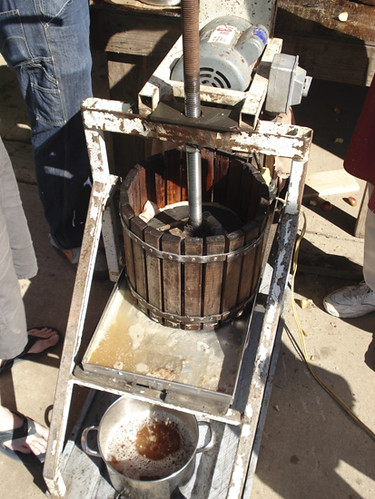
We spent our Saturday afternoon touring around our friend's family farm, chopping apples and wrestling with the rattling, roaring press. I have never seen nor eaten so many apples in one day. We ate some off the vine. We snacked on the chopped slices. We sipped cider. We ate fritters. Oh, the fritters: one family member was manning a propane-fueled deep-fryer, into which he dropped batter-dipped apple rings to puff up nicely. Once out of the oil, they received a quick toss in cinnamon-sugar. It was a perfect chance for me to practice the old "Leonard burn" by biting into the rings even when I knew they would scald the roof of my mouth. Hot, but delicious. If only I could have tasted them. Luckily, for all of our labor (if you count eating fruit off the vine and riding around in the farm jeep as "labor"), we left with two liters of the fresh-pressed cider.
After a full day of cider festivities, we couldn't bear the thought of a typical Sunday. That's where my Polish heritage came in handy. When we moved a month ago, we realized that we ended up only a few blocks away from St. Stanislaus, just a month prior to their annual Polish festival. What could be better than church-sanctioned mid-day drinking?
Growing up, my steady diet of chicken fingers and grilled cheese was supplemented on holidays with cabbage, sauerkraut, and things stuffed in cabbage. I don't think that went over too well. Fortunately, as I've gotten older, I've definitely developed a taste for the bitter, stinky and pickled, renewing my interest in some of my family's food heritage. It doesn't hurt that there were always some categorically tasty Polish foods (pierogi, potato pancakes, kielbasa - I'm looking in your direction).
Ever since we visited New York in the spring and missed Lomzynianka, we'd had a bit of an odd craving for some Polish food. The Portland Polish Festival (apparently the largest West coast celebration of its kind) had pierogi in excess. They also had an excess of bad (though technically good, I suppose) polka.
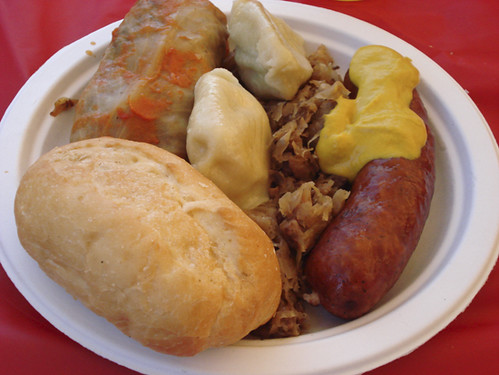
We had soft, fried plocki (potato pancakes) topped with applesauce and sour cream, great sauerkraut and mushroom pierogi, and kielbasa-studded bigos (a sauerkraut stew). Polish food is by no means a "light" cuisine; the word "hearty" comes to mind. And "leaden." It certainly helped to have some Polish beer to wash it down and a plum-filled donut to cap it off. I, for one, felt closer to my roots, or at least a good deal stockier.