
Tuesday night, we had a revelation. Why eat breakfast at P's uncles' in New Jersey when we could go straight into the city for this most important of meals, thereby fitting in one extra restaurant each day? If we were going to start having city breakfasts, we decided we might as well start big. And surly. We decided to start at Shopsin's.
Ever since P read a Calvin Trillin article on the cafe, it had become a must-eat attraction for our New York trip. Each time he talked about it, A became more and more terrified of the inevitable experience. You see, Shopsin's is not your ordinary, touchy-feely, mom's home cooking kind of cafe; there are rules at Shopsin's. No parties of five. No copying your neighbor's order. There was even a proscription against writing about Shopsin's (which we believe has *hopefully* been lifted). And, as rumor had it, those who broke the rules in Shopsin's original location could be banned for life. A did not want to be banned from any food establishment for life.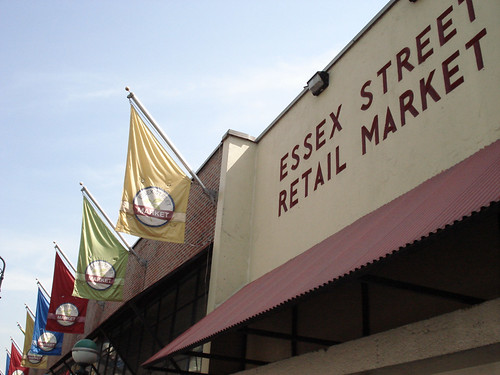
Now, A had worked herself up into a tizzy over the prospect of ordering, because Shopsin's menu is arcane and genre-defying. There are a few hundred options and everything is made-to-order. So A planned ahead and had a print-out of the menu from their website, from which she picked a few choices. When the time approached, she didn't choke, but rather admirably ordered the "Diego," while P ordered some pancakes. What was the Diego? Oh, just a mammoth bowl of poutine with poached eggs - perfect fries, brown gravy and egg yolk. Pancakes sounds awfully dull for such a storied place, eh? Not when they are made of mac & cheese suspended in a fluffy, sweet batter and served with hot sauce and maple syrup. Based on our best estimate, there were about ten of them, and we ate 'em all (and neither of us like pancakes! [as you roll your eyes]). The salty tang of the cheddar cheese went really well with the sweetness of the pancake and we both agree that they were best with just the syrup. Nothing could have prepared us for Shopsin's - what we'd read about it sounded gimmicky and sure, the cook did tell some women next to us to "stop fucking saying thank you," but there are few restaurants we've been to that have been more comfortable. Maybe it was the tattooed couple sitting at the counter whose wedding photo was tacked to the back of the kitchen door, but in a strange way, we felt like we were part of a dysfunctional and charming family for the hour.
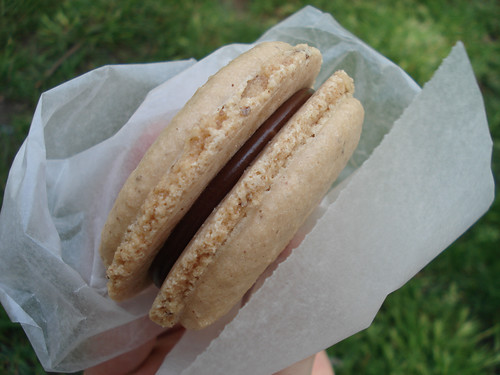
We headed uptown for a lunch before going to the natural history museum. When our plans fell through for Barney Greengrass ("The Stugeon King"), which was closed recovering from Passover, we thought we'd try Bouchon Bakery.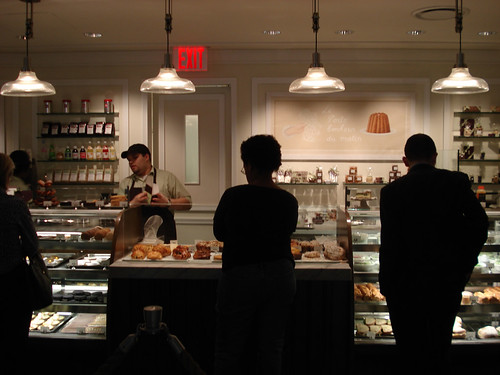
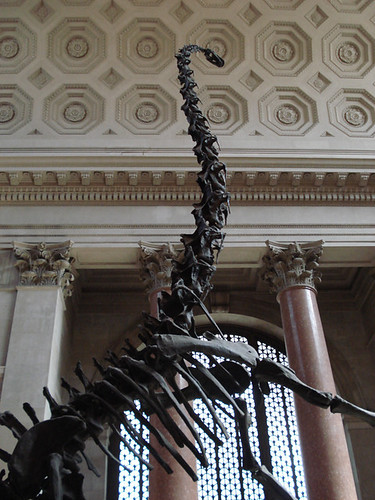
To be perfectly honest (and serious), we were both enthralled and could have spent two days there, rather than the three hours we had allotted for the museum. There was so much to see that we practically had to run through the exhibits, though we did catch a few highlights:
1. One wing boasts a nice new exhibit design that charts evolution based on common bone structures of diverse species. Cool.
2. The underwater room was truly spectacular and the famous blue whale looked even larger in life.
3. Dinosaurs. We felt this point needed emphasis.
4. We saw a 200 ton meteorite. Fun fact!: It is so heavy that its support pylons extend all the way into the bedrock below the museum.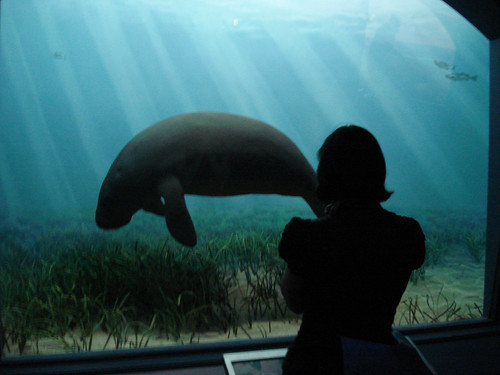
6. In the "African peoples" exhibit, we noticed that one of the mannequins had jeans and sneakers. The odd clothing made it seem like a live person was beneath the costume. Unfortunately, this felt less like a scene out of a slapstick Peter Sellers film than like something from a horror movie. It only cemented our shared belief that museums (or all places of learning, for that matter) are creepy.
Before heading back to P's uncles' house for dinner, we took a stroll through Central Park, making sure to first grab an overpriced coconut popsicle in case we got lost. We didn't, but the popsicle still came in handy.
_________
Essex Street Market - 120 Essex Street (at Delancey Street); J,M,Z @ Essex; F,V @ Delancey
Bouchon Bakery - Time Warner Center, 10 Columbus Center, 3rd Floor;
American Museum of Natural History - 79th St. at Central Park West; B,C @ 81st; 1 @ Broadway & W. 79th
Sunday, May 11, 2008
the city that never sleeps is always eating, pt. 3

Sunday, May 4, 2008
the city that never sleeps is always eating, pt. 2
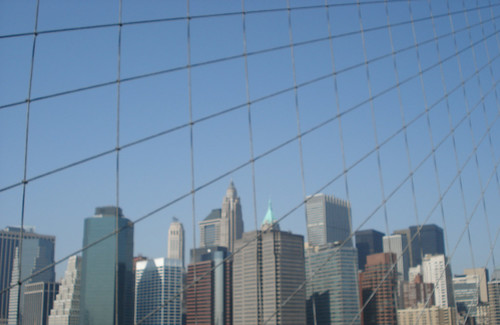
On the Brooklyn side of the bridge, we ventured down into DUMBO in a futile search for coffee and for the Slow Food USA headquarters. We're not sure what we would have done if we'd found their offices, but that is just kind of the way we travel. We think that we located the building, even if the offices were ten stories above us, but we never found that coffee. On the subway over to the Brooklyn museum, we saw an ad that the museum was closed on Tuesdays (thank you, subway sign) and promptly switched lines to return back to the Manhattan. This may make us sound like bumpkins, but it was par-for-the-course for the first few days; a lot of going one direction, realizing our mistake, and turning around.
That the museum was closed was a disappointment, but it meant we could get started eating even sooner. We headed to the East Village to grab some lunch at Momofuku Ssam Bar, where chef David Chang has gotten a lot of accolades (he's a recent James Beard award nominee) for his pork-saturated, witty Korean mash-ups. For being the middle of a lunch hour, the chic, 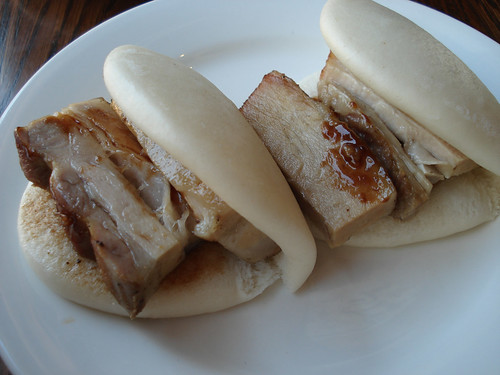
Since we'd heard tales of Korean burritos (ssam means "wrapped"), we went for the lemongrass pork sausage ssam. We were presented with a plate of condiments and savory sausage, which we wrapped up in lettuce leaves into little bites. Unfortunately, Momofuku had recently abandoned their practice of rolling all of the ingredients up in a rice pancake and wrapping it in aluminum foil like a mission burrito so, while still delicious, the ssam ended up being like many dishes we'd tried at other Asian restaurants. Luckily for us, the sandwich and our sides delivered much bolder flavors. Remember A's obsession with bahn mi? 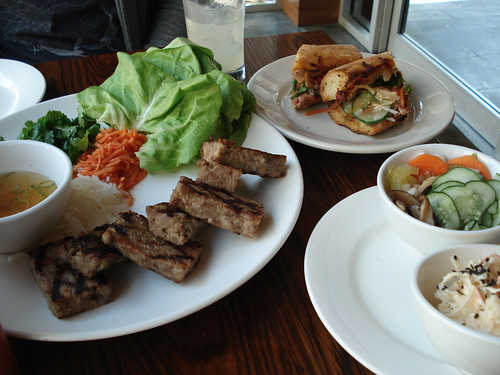
Waddling away from Ssam bar, we took a train over to the Chelsea Market, a Disney-fied concept of an urban market concourse. While there are some very cool vendors, the building has been rehabbed in such a way as to look really "raw" and "edgy," which ends up giving it a fake quality. In the middle of the shops, we stumbled upon a coffee shop that was boasting about their new, exclusive product: Stumptown coffee. This was only the first instance of what would become a very common theme throughout the week - NYC has a big crush on PDX.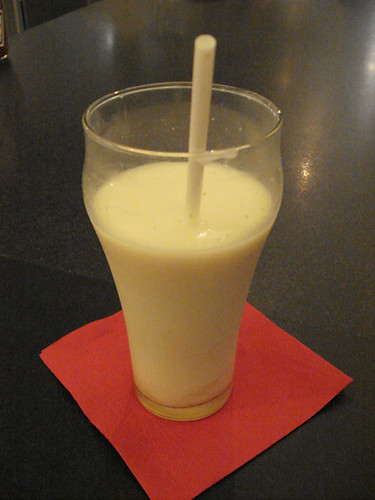
Afterwards, we walked through Chelsea down to Greenwich Village (ask us about our amazing celebrity sighting sometime), enjoying the charming brownstones and little boutiques. A few days before our trip, a friend at P's work had told us about a cupcake bakery that was the stuff of legend (the story involved someone eating two cupcakes in spite of a stomach flu). We knew it was near a Marc Jacobs, but had otherwise failed to get the address. As we passed a playground, P noticed a Marc Jacobs store and pointed it out, upon which, A demanded, "Where are the cupcakes?!" Right beyond the line of people waiting to get into 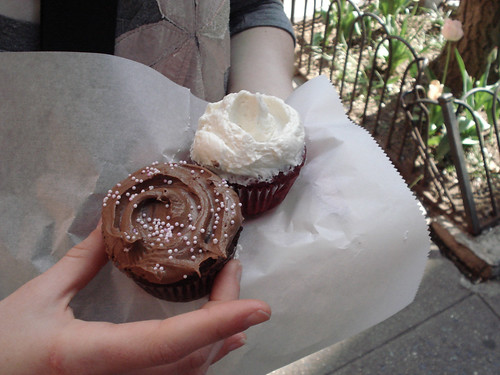
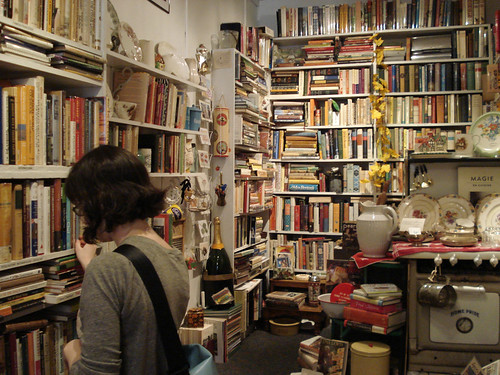
We caught a train to Brooklyn to meet up with two of A's older brother's friends for dinner. Having gone to a real institution for pizza in Scranton (Revello's), we went to a slew of up-start, pizza throne usurpers in New York. Franny's is a hip, sustainably-focused pizza place that reminded us a lot of Ken's back in Portland. They had a great bar with Italian-inflected drinks (we tried a prosecco and lovage (wild celery) syrup mix, and the Twice Bitter - fernet branca, Sanbitter soda, lime, and mint). 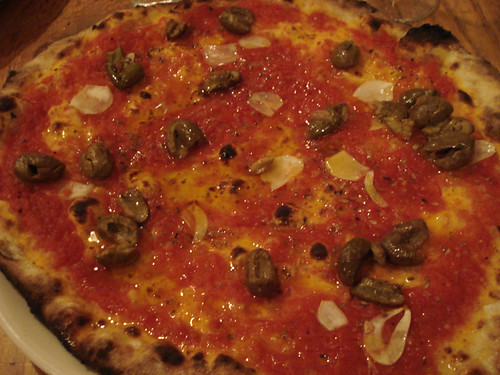
__________
Momofuku Ssam Bar - 207 Second Ave; L @ First St or Third St
Ronnybrook Dairy Bar - inside Chelsea Market, 75 Ninth Ave; A,C,E @ 14th St; L @ Eight Ave
Magnolia Bakery - 401 Bleecker St; 1,2,3,F,V @ 14th St; L @ Sixth Ave
Bonnie Slotnick Cookbooks - 163 W. 10th Street; 1 @ Christopher St.-Sheridan Sq.; A,B,C,D,E,F,V @ W. 4th St.-Washington Sq.
Franny's - 295 Flatbush Ave, Brooklyn; B,Q @ Seventh Ave.; 2,3 @ Bergen St.
Wednesday, April 30, 2008
weekend in scranton
Listen: we're not going to sugar-coat this for you. You deserve better than that.
Scranton did have a culinary heritage that P was actually looking forward to seeing again. And it burned down days before our visit. That meant our first meal in town was not a chili-covered hot-dog lovingly prepared on an old, Greek man's arm, but rather a bland lunch from Perkins. And man was it packed at lunch time. This is the sad thing about Scranton; it still has a handful of family-run places hanging on in the crumbling city, but most of the population flocks to the clusters of chain restaurants and malls that have sprung up around it's perimeter.
Scranton was once a booming city with beautiful downtown buildings (funded by the local coal industry) and earned its nickname as the "Electric City" for having the first electrified streetcar in the nation. The city still has one of the largest St. Patrick's Day parades in the country, but today its main claim to fame is its association with the American version of The Office. Mind you, the show is only set in Scranton; it's not filmed there. We did however see a nicely painted diorama celebrating the show's characters in the mall. We didn't see much else.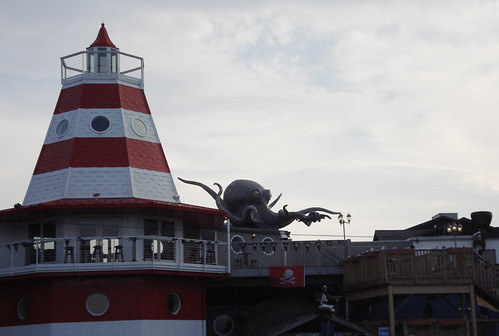
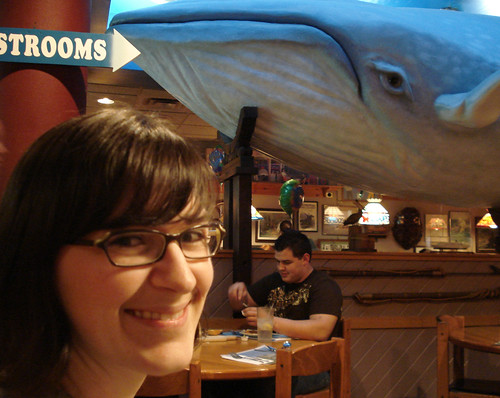
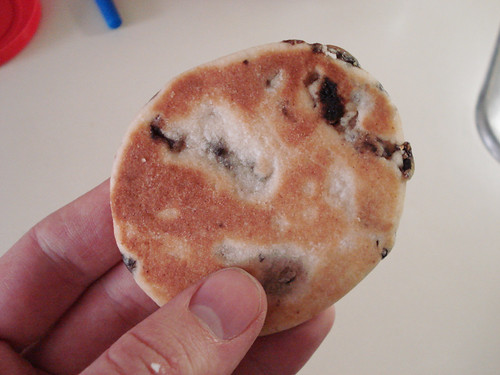
After trips to visit two of P's grandparents at the cemetery and a few more car-loops around the city, we ended up at one of the remaining family restaurants: Sibio's. The service left something to be desired, but the food was remarkably tasty Italian-American fare. A ordered the stuffed eggplant - mounds of creamy ricotta rolled in thin strips of eggplant. What would you expect to be on the side? Mashed potatoes and broccoli, of course. P's plate of rigatoni swimming in garlicky olive oil and peppered with spicy sausage, raab, and white beans was equally delicious. On the way out, we heard our waitress threaten to kick one of cooks in the face, so we were glad to escape, having eaten our fill.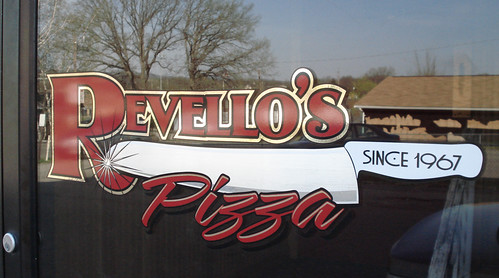
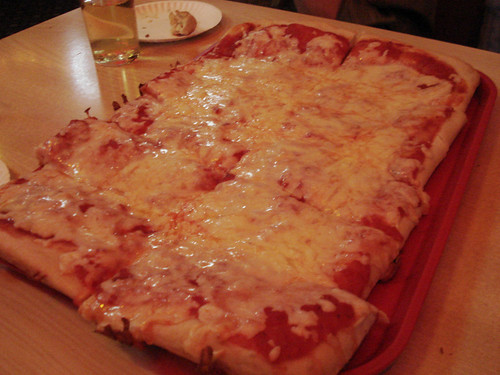
As we boarded the Greyhound that evening, P's grandmother climbed on board to make sure we took the one remaining, greasy pizza slice, sandwiched between two paper plates. Though we couldn't bring ourselves to eat it (after a tray-and-a-half at Revello's), the smell comforted us all the way back to the New York.
__________
Cooper's Seafood House - 701 N. Washington Ave, Scranton, PA
Sibio's - 1099 Quincy Ave, Scranton, PA
Revello's Pizza - 502 S. Main Street, Old Forge, PA
And, for when it reopens: Coney Island Texas Lunch - 100 Cedar Avenue, Scranton, PA 18503
Tuesday, April 29, 2008
The city that never sleeps is always eating.
For the privilege of eating our fill in New York, we paid with the clothes off our backs. Literally. That's thanks to Northwest Airlines (aka. "The Devil of the Skies"), who turned our hour-and-a-half layover in Minnesota into a fifteen minute mad dash to catch our connection. Needless to say, our bags couldn't run that fast. So if we happen to look a little haggard in our first few days of photos, you know why.
When we'd left Portland, the forecast for the weekend predicted some unseasonably-late snow, so we were pretty pleased to wake up Saturday at P's uncles' house in New Jersey to find 75 degree weather. 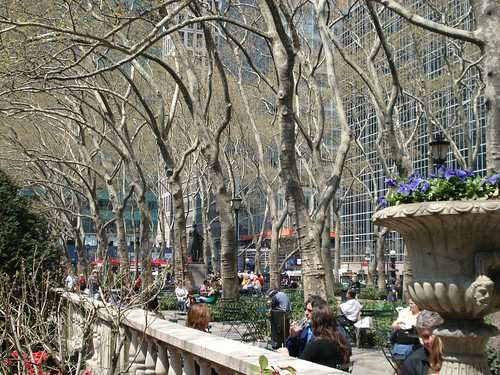
Not to worry - the rest of the day was spent tracking down food. After a pleasant outdoor lunch on Bryant Park, we rendezvoused with A's friend Hannah at her Brooklyn apartment. Still thinking of New York in terms of Portland-scale (a hang-up we'd have for most of the trip), we decided to take a "quick" jaunt down to Red Hook to find some key lime pies we'd heard about. Hannah, the most seasoned of the three of us, knew the trip would take over an hour, but she was easy-going and we were determined, so we ventured out undeterred. 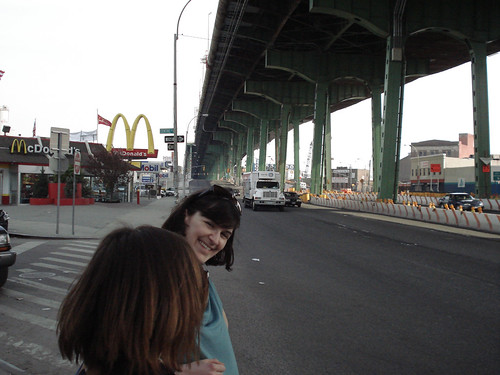
At long, sweaty last, we reached our destination - Steve's Authentic Key Lime Pies. This was a very good thing, because at this point Hannah was beginning to doubt not only our navigational skills, but the very existence of key lime pie in Red Hook. 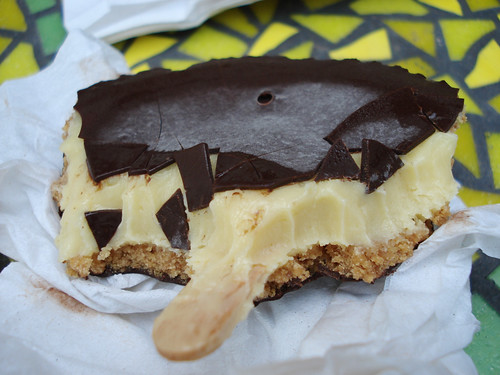
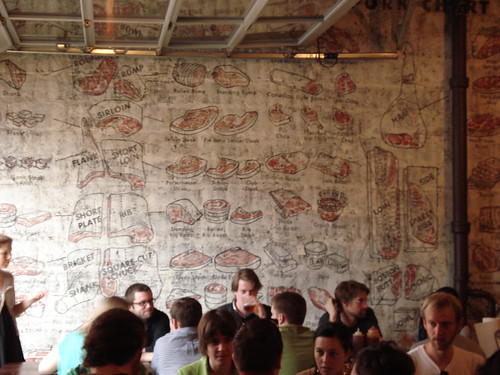
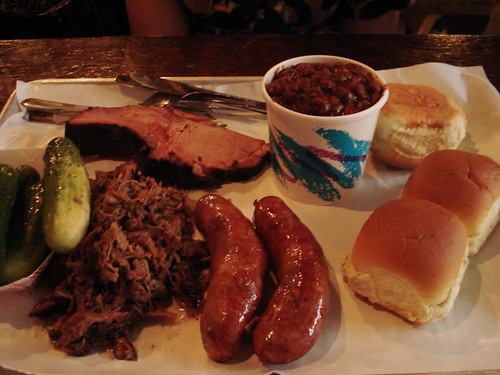
You all know that we have a special place in our hearts for carts, 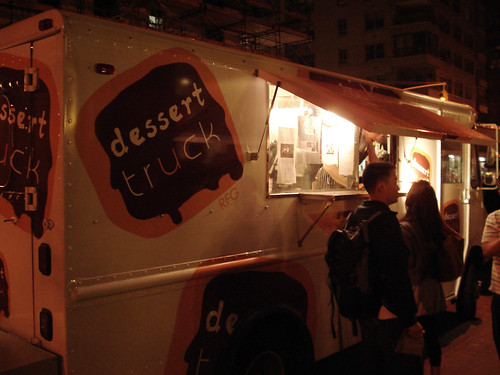
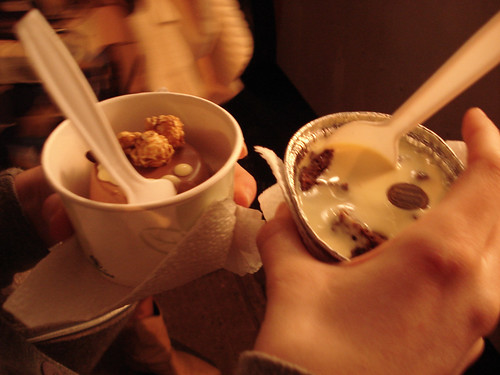
This may seem like a bout of frantic eating (all of the food above was consumed in the span of four hours), but in all fairness, we were on deadline. The next morning we would be leaving the city for two days to visit P's grandparents in Scranton, PA, a place not known for its rich culinary legacy...
or is it?
_________
Steve's Key Lime Pies - Pier 41, 204 Van Dyke St, Brooklyn; good luck figuring out a close subway
Fette Sau - 354 Metropolitan Ave, Brooklyn; L @ Bedford
Dessert Truck - University Pl. nr. 8th St.; 6 @ Astor Place; N, R, W @ NYU/8th
Wednesday, April 16, 2008
from the dept. of mobile dining
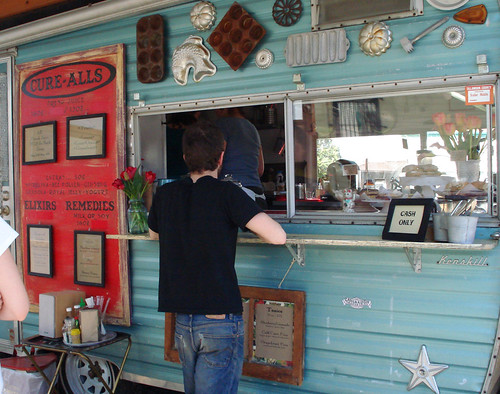
After huffing and puffing our way over to North Portland (hey, it's been a while since we've ridden across town - rainy-old-Portland's a tough place to bike half the year!), we pulled up to Moxie Rx. Take all of the Americana kitsch of a roadside dinner and cram it into a sunny little turquoise-and-red trailer and you've got a sense of what Moxie looks like. Sitting on their lot makes you feel like you're somewhere in the South, maybe Texas. The food, though, is 100% Portland, focusing on "elixirs" and "tonics" (juice blends) and comforting breakfast sandwiches and pastries that would probably fill the 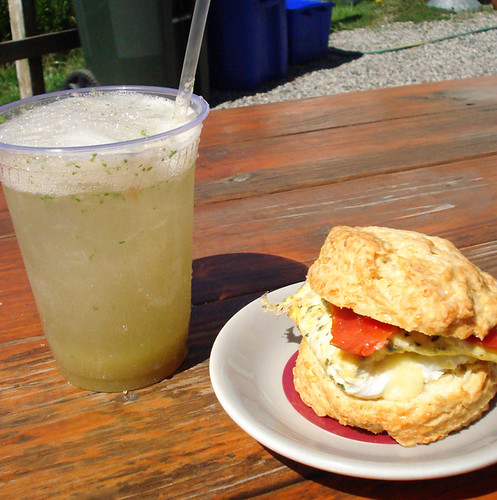
Junior Ambassador's looks more like a Home Depot storage shed than something on wheels, but that doesn't slow its emissary down from sharing his Mostlandian home cuisine with Portlanders. Springing out of the diplomatic successes of their early ice cream deliveries, Rudy (the T. in the M.O.S.T), started a food cart featuring panwiches (savory pancake-sandwiches) and fresh, unusual ice creams. We shared a Turkey Ruby panwich (turkey and red cabbage sauerkraut on rye pancake), which was toothsome and delicious. The pancake was much denser than a breakfast flapjake, probably yeasted, and more like a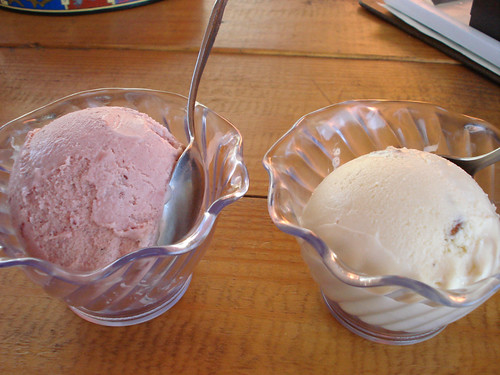

It's only five dollars.
There will be one-dollar Bridgeport beers.
All of the money goes to help MercyCorps NW's awesome small-business programs (which help out a lot of local restaurants).
See the Willamette Week site for details/directions.
Tuesday, April 15, 2008
things that make me feel smart, part 2
Psycho-geography.
Future ruins.
Experimental landscapes.
Urban spelunking.
Spatial theoretics.
Sonic architecture.
If UNIVERSE had enough indie cred to prevent me from seeming like a total geek, then this list of topics surely bursts that bubble. Well, I'm fine with that, because they're damn fascinating. So, while I know that we'll probably be seeing more food than architecture, it still seems appropriate that on the eve of our trip to New York I'd introduce you to one of my favorite urban spaces/architecture sites, BLDGBLOG.

Take for instance this story from the Guardian about a plan to construct a warehouse for unwanted books. To continue preserving books that no one is using, British libraries are constructing vast, windowless buildings in the industrial outskirts of London. Not for access, mind you, just for archival.
Or how about this urban design proposal that has been circulating for a few years now: What should Philadelphia do with it's overgrown, abandoned urban lots? Put them into production growing the city's food, of course. Enter Farmadelphia, a plan to revisit the agrarian past of Philly. But this project didn't just imagine a network of run-of-the-mill community garden plots; the designer's renderings proposed a full-scale agriculture of grazing livestock, rotational crops and wheat fields!
- One of the posts that got me hooked on this site: San Francisco's foundations are built on abandoned, scuttled ships
- The construction of ultra-luxe zoos and their promises for future suburban development
- The role of environmental toxins in aging
- Olympic security in Beijing, CCTV, and the future of reality film-making
- The calls of city songbirds are actually changing their cadence and pitch
- First the Louvre in Abu Dhabi, and now Dubai has purchased the rights to recreate and the city of Lyons
You might be able to speculate on it, but you just can't make this stuff up.
Friday, April 4, 2008
the godfather
We all have certain books sitting on our shelves that we know we ought to read, but always postpone. They frequently are books lent by friends or classics that we've been shamed into adding to our list. My own guilty example is Swann's Way by Proust. It is not something of which I'm proud - I picked it up when I was still taking French and because it struck teenage-me as a book that broadcasts intelligence - but when I notice it on our bookcase, it weighs on me with a heavy feeling of obligation. I've tried to read that book so many damn times and I just have to say: when a book begins with a discussion of sleeping habits, I'm probably not going to last.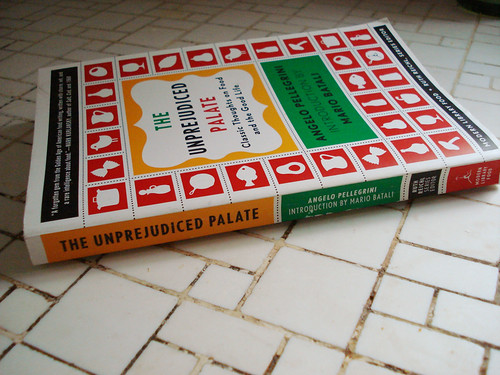
Do not mistake Pellegrini for some over-privileged epicure - all of his statements are firmly rooted in the value he places in honest labor and cultural knowledge. He advocates humility and tradition over decadence and indulgence and, because of this, sounds as though he is writing from the middle of the current dialogue over the politics of sustainable food. Over the last week since I read his book, I have come across numerous articles that show just how contemporary The Unprejudiced Palate is for having been written in 1948.
Last week in the New York Times, Eric Asimov offered his opinion on how parents should introduce their kids to alcohol, which brought to mind one of my favorite passages from the book:
"One summer morning several years ago, I was having an early breakfast with my three-year-old daughter in a small hotel in Utah. When the waitress asked what I wished to drink, the little girl announced to the bleary-eyed salesmen and the shocked grandmothers in the dining room that she would take coffee if they put a little rum in it. Since I had anticipated the possibility of frustration en route, I drew a little flask from my brief case and obliged the infant toper with a spoonful of rum in her coffee and milk. When we left the dining room, I felt certain that in the opinion of my fellow guests I hadn't scored much higher than an old soak and a corrupter of youth.
If, however, there was any wise among them, they must have seen in the incident a practical lesson in temperance. My daughter is now twelve. She still takes a teaspoonful of rum in her coffee and milk every morning. To date she has consumed approximately four thousand teaspoonfuls, or enough, say, to kill a whole circus of elephants."
This glib tone paired with common sense is absolutely classic Pellegrini. From the immigrant's point of view (Pellegrini came to the States shortly before the Depression), all of the brouhaha surrounding booze in the US is patently absurd and fully the result of a skewed relationship with food. "The self-appointed arbiters of the American's liquid diet," he writes, "have perverted that Hellenic virtue into a Puritan vice." Precisely by removing wine and drink from everyday conviviality and relegating it to bars, Pellegrini believes that Americans created their own drinking problem. Simply put: if you raise someone to appreciate the craft involved in alcohol and its place in a culture, they'll grow up to respect it.
Pellegrini argues that this embrace of excess in things that should be appreciated in their rarity is at the heart of America's distorted notions about food and health. One of the most interesting aspects of The Unprejudiced Palate is the abundance that Pellegrini finds in even the leanest of times and with the humblest of ingredients.
"A bunch of green onions, a few herbs, a handful of spinach, a little grated cheese and six eggs, can be fused into a delicious main course for the average family. The possibilities for going somewhere from nowhere are literally unlimited. They cannot be learned, of course, by those who persist in going to the grave on meat, potatoes, and gravy."
Because Americans have latched onto a handful of foods and consumed them in epic proportions, they have not only sacrificed their health, but also a lot of their ability to cook and even appreciate the value in alternatives to their current ways. By letting go of the myriad edible joys in the world and forgetting what they tasted like, it was a short step before stores were filled with imitation foods - the block cheddar "cheese" and bologna "salamis" that so perplexed the young, newly arrived Pellegrini. To me, this sounds a lot like Michael Pollan's recent talk in Portland in which he discussed the inviolable position of meat in the American diet:
But truly, the greatest argument Pellegrini makes for switching your diet towards more whole foods and vegetables is that, when freshly picked, there is simply nothing better:
"But above all else, they [two sewer-worker (and Italian) friends of Pellegrini] take great delight in eating what they produce in their gardens. While they argue about anything under the sun, and even about some things above the sun, they can never find reason to quarrel about this: that you can't beat what you grow in your own garden."
Across the country, growing numbers of people are currently seeing the value in replanting portions of their lawns or ornamental gardens with edible crops. In a sense, it is a return to the victory gardens that were so successful when Pellegrini was writing. Between a recent CHOW article on urban vegetable gardening, Fritz Haeg's Edible Estates, businesses like Your Backyard Farmer, and the "Food Not Lawns" movement, it is clear that people agree with Pellegrini on the importance of connecting with your food from soil to table.
"If you like your fruit ripened on the tree, bathed with the early morning dew or warmed to it very core by the midday sun, you must grow it on your little plot of earth. If you live in a climate where that is not possible, or if you are among the unfortunate millions caged in dainty little flats, I weep for you a brother's tears of compassion while I pray for your early release from bondage. But if you have the necessary facilities and still prefer the shade of the willow to the taste of a ripe peach, well, who am I that I should intrude upon your eccentricities?"
What struck me about the people's stories in the CHOW article were the vehemently negative reactions some of these gardeners received. It never ceases to amaze me how angry people can get when others strive to do better (or even just do "different"). Take for example this recent lambasting of Slow Food from Metropolis. I fail to understand where the author's apparent anger comes from - is he honestly defending McDonald's? Even if he is, how is it a problem for him that Slow Food hopes to preserve food traditions from being lost to the advance of narrowing, standardized food choices? And you don't have to read the well-written rebuttal (but you still should) to understand just how poorly Sterling understands what Slow Food does. All of his loaded language (ignore all of the word choices like "infiltrate" and just try looking up "myrmidon" in a dictionary) makes it seem as though Slow Food is a conspiracy to secure luxury comestibles for the super-wealthy. In fact, what Slow Food does is work to increase access for everyone to a diversity of foods - the very foods that used to (and, in many parts of the world, still do) sustain cultures that are the very opposite of privileged. And, I hate to have to explain it this simply, but food cannot exist in a vacuum - there need to be consumers in order for producers to have an outlet for their work.
So what really irritates me (& I believe would vex Pellegrini as well) is this tired and unfounded critique of enjoying good food as being elitist. As Pellegrini wrote (and he heaps just as much blame on chefs as on "gourmets"):
"They have broadcast a dastardly falsehood, perhaps to give a certain status to their labor of love - that cooking is an art. The implication of all their dithyrambic spewings on culinary matters, despite their protestations to the contrary, is that excellent food and drink are achievements in refinement beyond the attainment of ordinary mortals. [...]
The prevailing view seems to be that the preparation of a dinner in any way out of the ordinary means hours and hours in the kitchen and "an artist's touch" in the transmutation of ingredients. This notion, for which the precious cookery books are responsible, is as erroneous as it is widespread."
"...are sufficiently urbane and metropolitan to enjoy heartily a good dinner when it is served to them, but their gastronomic self has remained immature out of sheer neglect. [...] The difference between a gourmet and one who eats macaroni salad is precisely the difference between one who enjoys turnip greens and will bestir himself to satisfy a desire, and one who enjoys them but will do nothing about it."
To help restore the lost dignity of simple foods and cultural traditions, Pellegrini argues, we need to be willing to try our hand at tending our own gardens, stirring pots, and crushing grapes. We simply must reconnect with the labor and craft of eating. I can not imagine a better duty.


