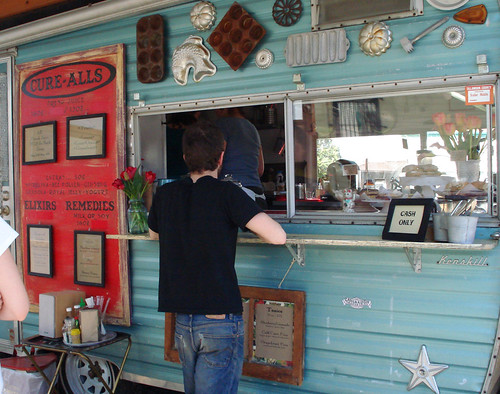
After huffing and puffing our way over to North Portland (hey, it's been a while since we've ridden across town - rainy-old-Portland's a tough place to bike half the year!), we pulled up to Moxie Rx. Take all of the Americana kitsch of a roadside dinner and cram it into a sunny little turquoise-and-red trailer and you've got a sense of what Moxie looks like. Sitting on their lot makes you feel like you're somewhere in the South, maybe Texas. The food, though, is 100% Portland, focusing on "elixirs" and "tonics" (juice blends) and comforting breakfast sandwiches and pastries that would probably fill the 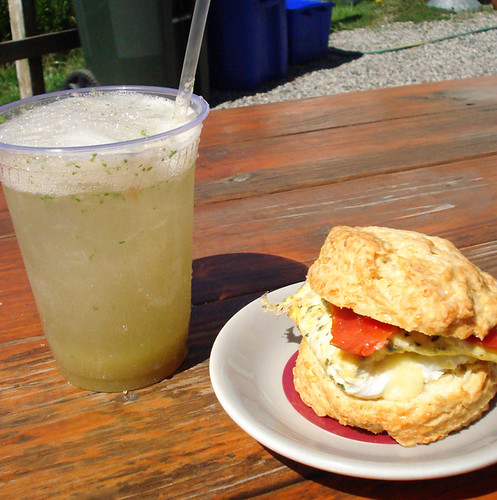
Junior Ambassador's looks more like a Home Depot storage shed than something on wheels, but that doesn't slow its emissary down from sharing his Mostlandian home cuisine with Portlanders. Springing out of the diplomatic successes of their early ice cream deliveries, Rudy (the T. in the M.O.S.T), started a food cart featuring panwiches (savory pancake-sandwiches) and fresh, unusual ice creams. We shared a Turkey Ruby panwich (turkey and red cabbage sauerkraut on rye pancake), which was toothsome and delicious. The pancake was much denser than a breakfast flapjake, probably yeasted, and more like a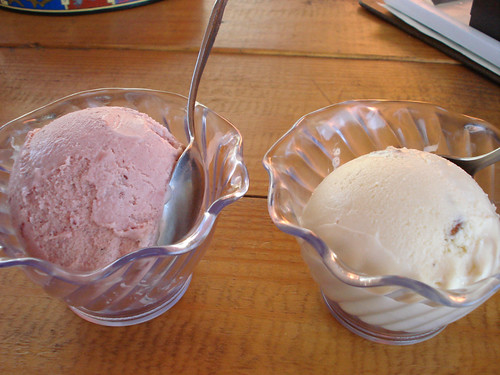

It's only five dollars.
There will be one-dollar Bridgeport beers.
All of the money goes to help MercyCorps NW's awesome small-business programs (which help out a lot of local restaurants).
See the Willamette Week site for details/directions.
Wednesday, April 16, 2008
from the dept. of mobile dining

Tuesday, April 15, 2008
things that make me feel smart, part 2
Psycho-geography.
Future ruins.
Experimental landscapes.
Urban spelunking.
Spatial theoretics.
Sonic architecture.
If UNIVERSE had enough indie cred to prevent me from seeming like a total geek, then this list of topics surely bursts that bubble. Well, I'm fine with that, because they're damn fascinating. So, while I know that we'll probably be seeing more food than architecture, it still seems appropriate that on the eve of our trip to New York I'd introduce you to one of my favorite urban spaces/architecture sites, BLDGBLOG.

Take for instance this story from the Guardian about a plan to construct a warehouse for unwanted books. To continue preserving books that no one is using, British libraries are constructing vast, windowless buildings in the industrial outskirts of London. Not for access, mind you, just for archival.
Or how about this urban design proposal that has been circulating for a few years now: What should Philadelphia do with it's overgrown, abandoned urban lots? Put them into production growing the city's food, of course. Enter Farmadelphia, a plan to revisit the agrarian past of Philly. But this project didn't just imagine a network of run-of-the-mill community garden plots; the designer's renderings proposed a full-scale agriculture of grazing livestock, rotational crops and wheat fields!
- One of the posts that got me hooked on this site: San Francisco's foundations are built on abandoned, scuttled ships
- The construction of ultra-luxe zoos and their promises for future suburban development
- The role of environmental toxins in aging
- Olympic security in Beijing, CCTV, and the future of reality film-making
- The calls of city songbirds are actually changing their cadence and pitch
- First the Louvre in Abu Dhabi, and now Dubai has purchased the rights to recreate and the city of Lyons
You might be able to speculate on it, but you just can't make this stuff up.
Friday, April 4, 2008
the godfather
We all have certain books sitting on our shelves that we know we ought to read, but always postpone. They frequently are books lent by friends or classics that we've been shamed into adding to our list. My own guilty example is Swann's Way by Proust. It is not something of which I'm proud - I picked it up when I was still taking French and because it struck teenage-me as a book that broadcasts intelligence - but when I notice it on our bookcase, it weighs on me with a heavy feeling of obligation. I've tried to read that book so many damn times and I just have to say: when a book begins with a discussion of sleeping habits, I'm probably not going to last.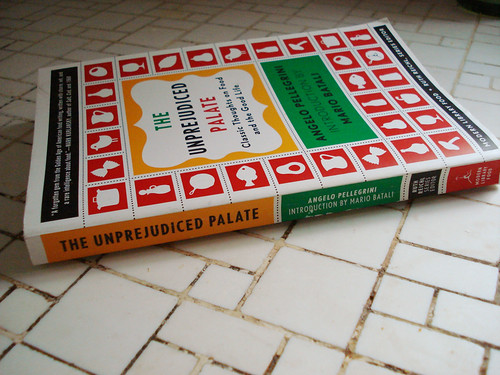
Do not mistake Pellegrini for some over-privileged epicure - all of his statements are firmly rooted in the value he places in honest labor and cultural knowledge. He advocates humility and tradition over decadence and indulgence and, because of this, sounds as though he is writing from the middle of the current dialogue over the politics of sustainable food. Over the last week since I read his book, I have come across numerous articles that show just how contemporary The Unprejudiced Palate is for having been written in 1948.
Last week in the New York Times, Eric Asimov offered his opinion on how parents should introduce their kids to alcohol, which brought to mind one of my favorite passages from the book:
"One summer morning several years ago, I was having an early breakfast with my three-year-old daughter in a small hotel in Utah. When the waitress asked what I wished to drink, the little girl announced to the bleary-eyed salesmen and the shocked grandmothers in the dining room that she would take coffee if they put a little rum in it. Since I had anticipated the possibility of frustration en route, I drew a little flask from my brief case and obliged the infant toper with a spoonful of rum in her coffee and milk. When we left the dining room, I felt certain that in the opinion of my fellow guests I hadn't scored much higher than an old soak and a corrupter of youth.
If, however, there was any wise among them, they must have seen in the incident a practical lesson in temperance. My daughter is now twelve. She still takes a teaspoonful of rum in her coffee and milk every morning. To date she has consumed approximately four thousand teaspoonfuls, or enough, say, to kill a whole circus of elephants."
This glib tone paired with common sense is absolutely classic Pellegrini. From the immigrant's point of view (Pellegrini came to the States shortly before the Depression), all of the brouhaha surrounding booze in the US is patently absurd and fully the result of a skewed relationship with food. "The self-appointed arbiters of the American's liquid diet," he writes, "have perverted that Hellenic virtue into a Puritan vice." Precisely by removing wine and drink from everyday conviviality and relegating it to bars, Pellegrini believes that Americans created their own drinking problem. Simply put: if you raise someone to appreciate the craft involved in alcohol and its place in a culture, they'll grow up to respect it.
Pellegrini argues that this embrace of excess in things that should be appreciated in their rarity is at the heart of America's distorted notions about food and health. One of the most interesting aspects of The Unprejudiced Palate is the abundance that Pellegrini finds in even the leanest of times and with the humblest of ingredients.
"A bunch of green onions, a few herbs, a handful of spinach, a little grated cheese and six eggs, can be fused into a delicious main course for the average family. The possibilities for going somewhere from nowhere are literally unlimited. They cannot be learned, of course, by those who persist in going to the grave on meat, potatoes, and gravy."
Because Americans have latched onto a handful of foods and consumed them in epic proportions, they have not only sacrificed their health, but also a lot of their ability to cook and even appreciate the value in alternatives to their current ways. By letting go of the myriad edible joys in the world and forgetting what they tasted like, it was a short step before stores were filled with imitation foods - the block cheddar "cheese" and bologna "salamis" that so perplexed the young, newly arrived Pellegrini. To me, this sounds a lot like Michael Pollan's recent talk in Portland in which he discussed the inviolable position of meat in the American diet:
But truly, the greatest argument Pellegrini makes for switching your diet towards more whole foods and vegetables is that, when freshly picked, there is simply nothing better:
"But above all else, they [two sewer-worker (and Italian) friends of Pellegrini] take great delight in eating what they produce in their gardens. While they argue about anything under the sun, and even about some things above the sun, they can never find reason to quarrel about this: that you can't beat what you grow in your own garden."
Across the country, growing numbers of people are currently seeing the value in replanting portions of their lawns or ornamental gardens with edible crops. In a sense, it is a return to the victory gardens that were so successful when Pellegrini was writing. Between a recent CHOW article on urban vegetable gardening, Fritz Haeg's Edible Estates, businesses like Your Backyard Farmer, and the "Food Not Lawns" movement, it is clear that people agree with Pellegrini on the importance of connecting with your food from soil to table.
"If you like your fruit ripened on the tree, bathed with the early morning dew or warmed to it very core by the midday sun, you must grow it on your little plot of earth. If you live in a climate where that is not possible, or if you are among the unfortunate millions caged in dainty little flats, I weep for you a brother's tears of compassion while I pray for your early release from bondage. But if you have the necessary facilities and still prefer the shade of the willow to the taste of a ripe peach, well, who am I that I should intrude upon your eccentricities?"
What struck me about the people's stories in the CHOW article were the vehemently negative reactions some of these gardeners received. It never ceases to amaze me how angry people can get when others strive to do better (or even just do "different"). Take for example this recent lambasting of Slow Food from Metropolis. I fail to understand where the author's apparent anger comes from - is he honestly defending McDonald's? Even if he is, how is it a problem for him that Slow Food hopes to preserve food traditions from being lost to the advance of narrowing, standardized food choices? And you don't have to read the well-written rebuttal (but you still should) to understand just how poorly Sterling understands what Slow Food does. All of his loaded language (ignore all of the word choices like "infiltrate" and just try looking up "myrmidon" in a dictionary) makes it seem as though Slow Food is a conspiracy to secure luxury comestibles for the super-wealthy. In fact, what Slow Food does is work to increase access for everyone to a diversity of foods - the very foods that used to (and, in many parts of the world, still do) sustain cultures that are the very opposite of privileged. And, I hate to have to explain it this simply, but food cannot exist in a vacuum - there need to be consumers in order for producers to have an outlet for their work.
So what really irritates me (& I believe would vex Pellegrini as well) is this tired and unfounded critique of enjoying good food as being elitist. As Pellegrini wrote (and he heaps just as much blame on chefs as on "gourmets"):
"They have broadcast a dastardly falsehood, perhaps to give a certain status to their labor of love - that cooking is an art. The implication of all their dithyrambic spewings on culinary matters, despite their protestations to the contrary, is that excellent food and drink are achievements in refinement beyond the attainment of ordinary mortals. [...]
The prevailing view seems to be that the preparation of a dinner in any way out of the ordinary means hours and hours in the kitchen and "an artist's touch" in the transmutation of ingredients. This notion, for which the precious cookery books are responsible, is as erroneous as it is widespread."
"...are sufficiently urbane and metropolitan to enjoy heartily a good dinner when it is served to them, but their gastronomic self has remained immature out of sheer neglect. [...] The difference between a gourmet and one who eats macaroni salad is precisely the difference between one who enjoys turnip greens and will bestir himself to satisfy a desire, and one who enjoys them but will do nothing about it."
To help restore the lost dignity of simple foods and cultural traditions, Pellegrini argues, we need to be willing to try our hand at tending our own gardens, stirring pots, and crushing grapes. We simply must reconnect with the labor and craft of eating. I can not imagine a better duty.
Monday, March 31, 2008
And now for something a little lighter.
I know my voice has been absent from this blog lately. I know that you have missed my cheerful wit and sharp insight. I have not followed through with my New Year's resolution to "post every two weeks" and I am sorry for it. But, I have good reason.
My mouth was too full.
The combination of weekly baking, a food-focused trip to Seattle, the river of chocolate that always seems to flow from Halloween through Memorial Day, and Easter weekend itself - which consisted mostly of eating chocolate, making sweet dough, eating resulting Easter bread and topping things off with yet more chocolate - has been a recipe for a stomachache. Driving home after Easter at my parents' house, with one hand on the wheel and the other buried in a bag of chocolate, I was all too happy to second P's motion that we eat lightly in the coming week. When he brought to the table what is, in my opinion, the ultimate sandwich, I began to look forward to our ritual cleansing.
Despite what one might think, after such gluttony, the P & A detox diet is never a tasteless or particularly spare affair. When I reach my breaking point, I want something simple and relatively light, but with plenty of flavor...just flavor that isn't quite so rich. Often, we turn to our repertoire of basic meals: homemade tomato sauce, braised chard with tofu (do not be 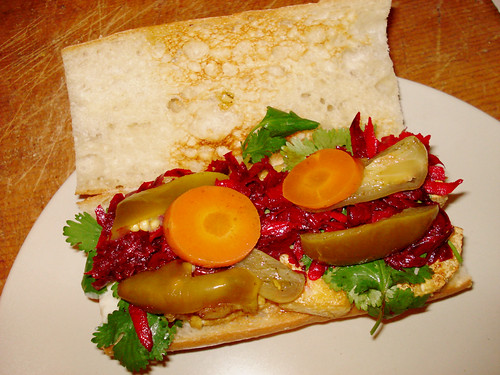
Bánh mì sprung out of French colonialism in Indochina and marries traditionally French ingredients like baguette, pâté and mayonnaise with elements from southeast Asian cooking, like cilantro and fish sauce. This combination produces what may be the perfect sandwich - the rich, salty flavors of meat and fish sauce are cut by the tangy brightness of the cilantro and pickled carrots and all is enveloped by soft, chewy, crusty baguette.
My first taste of bánh mì came a few years ago, when P and I ventured out to the small, nondescript, strip mall PDX eatery that is Cali Sandwiches. Cali Sandwiches had been recommended in the Willamette Week Cheap Eats Guide as offering tangy, rich and delicious sandwiches for under three dollars. As we were then poor college students with appetites far larger than our wallets would allow, this sounded like a pretty good deal. I cannot remember which bánh mì I ordered (common options are the aforementioned pate, chicken, pork and egg), but I do know that this was the beginning of a beautiful friendship.
If you need another reason to try bánh mì (but, really?? you need another?), I give you this: it is incredibly easy to make. We like to make a pseudo-vegetarian version (vegetarian in all but the fish sauce...), with tofu instead of meat, but you can do as you choose - it is the condiments that make this sandwich. Normally, we marinate the tofu and then broil it, but this last week we fried the tofu instead and it was better than ever. What's that? Anything fried should not count as part of a detox diet, you say? Well, it's a good thing I am too stalwart to be swayed by my peers.
____________________________________________
P & A Bánh Mì Chay
(has a certain ring to it, no?)
I feel a little ridiculous posting a recipe for this, because, well, it's a sandwich. There isn't much to it. But, since I haven't written in awhile, I thought I should probably add something to fill out my post.
Last time, we added a bit of carrot and beet salad (recipe from Chocolate and Zucchini), which gave the sandwich an earthy layer (from the beets), a tangy garlic zing, and messy drops of beet juice. Delicious.
1/3 cup peanut or vegetable oil (for frying)
1 pound tofu, cut into rectangles 1/2 inch thickness
1 baguette
1 bunch cilantro
1 small container pickled carrots and jalapenos (we tend to go for the small Herdez cans of carrots and jalapenos, but you can try any brand of pickled vegetables you like, or make your own!)
fish sauce mayonnaise (below) or plain mayonnaise
sweet chile sauce
Fish Sauce Mayonnaise
Combine four parts mayonnaise with one part fish sauce. (This proportion is pretty loose and is based largely on our love of fish sauce. Add the fish sauce to taste and, if you really can't stand the stuff, leave it out. P would probably say otherwise.)
Fry the tofu in the oil until browned on all sides, then remove the tofu and set aside (setting these on paper towel helps drain away excess oil). Layer the ingredients on the baguette, beginning with mayonnaise and finishing with a dollop of the sweet chile sauce (See? I told you this sandwich was all about the condiments).
[If you're looking to make an entirely vegetarian version, omit the fish sauce and maybe try frying the tofu in coconut oil or adding a splash or two of chili oil as the tofu fries. If you're looking for something a little less wholesome, look no further than the bánh mì at Momofuku Ssam Bar in New York for a little inspiration. And yes, we plan to go there when we visit the city in a few weeks.]
Sunday, March 16, 2008
professionalism, pt. 2
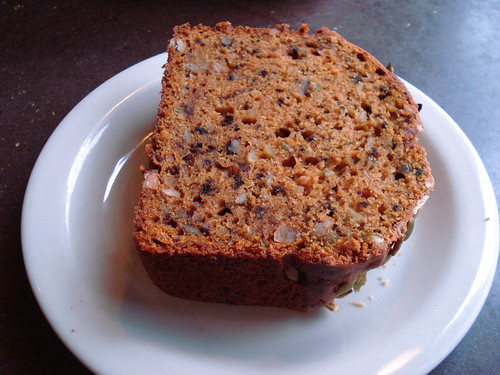
Across the street from the Ace, there just happened to be a nice little French country kitchen of a bakery, Macrina Cafe. A and I shared a slice of their squash harvest bread and a big onion bialy. 
Which is why we dutifully walked the five blocks to Top Pot, a Seattle staple for doughnuts that neither of us had tried before. Now Top Pot is undeniably stylish. It has a sort of streamlined, American glory days aesthetic with lots of stylized diner finishes. These are the sorts of doughnuts you'd be served on a train like this one. But A and I are tough doughnut critics, mainly because we don't like doughnuts. Why did we go to a doughnut shop, you ask? Well, the way we ate in Seattle leaves a lot of questions unanswered. Point being: if I'm having a doughnut, it better be amazing. 
We already knew where we were headed for lunch, but it was only a little after 11 and we'd just finished a pile of pastries. After about five seconds of debate over whether we should do something non-food related, we decided to just "scope out" our lunch choice, having heard stories of epic waits. Good thing we did. We reached Salumi around 11:45, only to find a line halfway around the corner from the storefront. Apart from the two schmoes who decided to park themselves in the postage-stamp sized window to eat their sandwiches in front of a hungrily waiting crowd, the 45 minute wait wasn't unpleasant and was made palatable by plates of salami passed through the crowd. And it is some damn tasty salami.
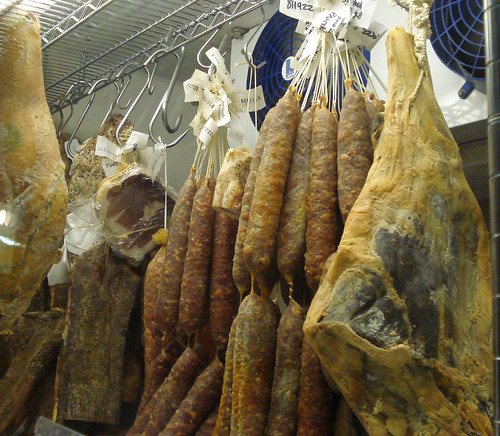
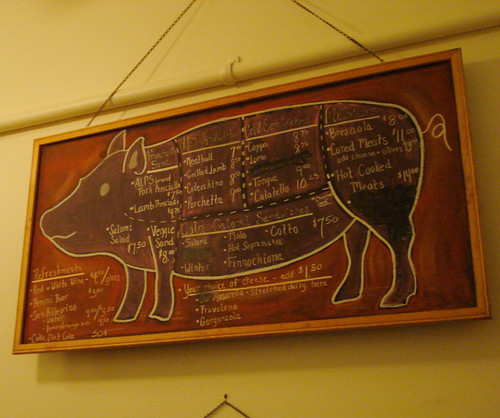
After retiring from Boeing, Armandino Batali (Mario Batali's father) decided he'd go to Italy and apprentice himself at a master salumeria, before returning to Seattle to make some of the best dry-cured meats in the US. If you can find them where you live (Steve's Cheese, Foster & Dobbes, or City Market in PDX), you need to try the finocchiona for a classic flavor and the mole for a sense of some of the new-school cures they are using. Recently, their house porchetta sandwich was named one of the best sandwiches in the country by Esquire, so we knew we'd have to try that. Then, because we are suckers for seasonal specials, we also got a cinnamon pork butt sandwich, which was too bad because the fat was a little rubbery and we really should gone for one salami sandwich. But let's focus on the good: the porchetta was unbelievable. 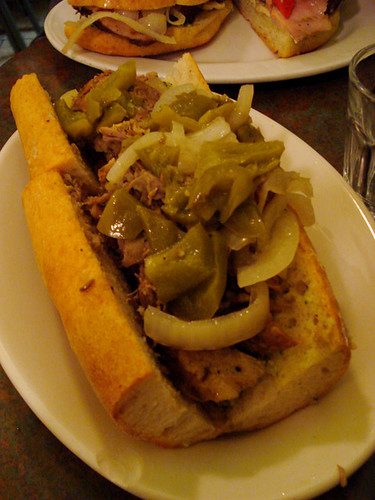
When you are bursting at the seams from overeating, what's the best thing to do in Seattle? Food related shopping. Not able to consider another bite of food, we decided to consider some of the cookbooks at Elliott Bay, a very charming store down in the old part of town. And after that? We went shopping for seasonings. At World Spice Merchants just below the Pike Place Market, we picked up a few unusual spices (the szechuan pepper may just warrant its own post) and took in the aromas. The strong smells were doubly appealing because throughout all of these wanderings, we were staggering around the city with the remains of a sandwich the size of our head in a paper bag. We were probably attracting flies. Now, I don't know if it was just the prolonged exposure to the sandwich or if all of our meals were just finally catching up with us, but we definitely hit our low point right around the time we decided to grab some food for the road home.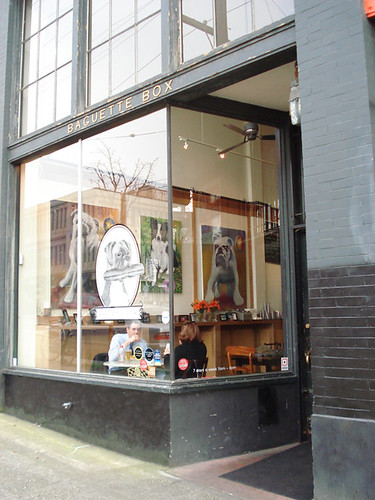
And then we ordered a side of truffle fries and ate them all before we made it back to our car.
I know what you are thinking, and it is 100% true: we know how to take care of business. Seriously, though, these fries were superlatively good. They were some of the simplest fries either of us had ever had - thick-cut and hefty - and the potato, truffle, and sea salt flavors all balanced out so as to heighten each other taste. And don't worry; when we eventually had the sandwich (we did actually wait a few hours), it was as tangy, spicy, creamy and savory as a good bahn-mi should be.
All in all, it was a funny trip to Seattle. I can't remember the last time I visited and stayed in the downtown the whole time. But, for that matter, I can't remember the last time I had three breakfasts and multiple sandwich-centric meals on one day.
Thursday, March 13, 2008
professionalism.
That one word. That is what makes this blog run.
Sure, amateur food blogging seems glamorous - the dinner parties, the exotic ingredients, the gourmet meals at hip restaurants. But these surface appearances are far from the seedy reality of being up to your elbows in polenta at 11 o'clock at night. When we went up to Seattle last weekend, we changed our plans at the last minute to only spend one day in the city instead of two. Your average carefree vacationer would have resigned themselves to missing a few of their intended sights, but what did we have to do? We said to ourselves, "P & A, you planned out two days of food to try, but you'll only be in town for 24 hours, how will you choose what tastes to skip?" And we answered ourselves confidently, "We won't. Too many depend on us to let something like 'time' get in the way of eating. We will have multiple meals if that is what it takes. We could not live with ourselves otherwise." We do it for you, America.
That is a very truthful account of how we make decisions; our choices are largely dictated by our stomachs and often involve imaginary dialogue with ourselves. And, that is a very truthful account of how we nearly made ourselves sick in Seattle.
Truth be told, we didn't head up to Seattle for the food; we went for a Magnetic Fields show, which just might have been a life-changing event for A, who has a love of Stephin Merritt that borders on obsession. The show was really just great - if you can track them down live, it is worth the effort. In concert, they perform everything acoustic, lending this chamber-pop-sort-of-feel to their cynical and darkly romantic lyrics. Fantastic.

[I'm getting long-winded. Like I said, we ate a lot. This sucker's getting split into two posts... Also, as I'm writing this, I'm listening to NPR's great coverage of SXSW - go check it out, Carrie Brownstein's blogging is hilarious.]
Wednesday, March 5, 2008
things that make me feel smart
Science, eh? See, we have other interests besides food. Yeah, I know that it was food-related science news, but my point remains the same: we are very well-rounded people. Right? In fact, while we mainly concern ourselves with our stomachs on this site, A and I have voracious appetites for ideas and learning. Dorrrrky. See, we were very into school. Probably too into it; probably to the exclusion of having lives when we were in college. I love immersing myself in reading about a subject, beginning to see all of the relations and overlaps, and crafting my own arguments about it all. Frequently, I find myself compiling website links and book lists and articles for a paper that is coalescing in my mind. Then I realize that people don't just write papers for fun and that this impulse probably puts me in a very lonely category of geeks.
The problem is that these inclinations are harder to satisfy once you've left school, so where do I turn for the reassuring embrace of fellow geeks? The internet, of course! Outside of academia, where else is there a community eager to hazard their conjectures about big ideas and future societies? Nowhere, and for good reason: they'd get beaten up.
Given the space-theme of the recent kimchi post (and in an attempt prove that there is a hipster angle to all this), I thought I'd start off with my favorite blogger for astronomy, astrology, cosmology and science fiction - UNIVERSE. Claire L. Evans writes about cults, crypto-zoology, modernism, pseudo-science, and Carl Sagan (a lot), she makes up one-half of YACHT (see? still cool.), and gives artsy power-point presentations/concerts at places like Rhizome at the New Museum.
For a good sense of the sort of mind-bending, cosmic and comic things she posts and links to, here is a run-down of some of my recent favorites:
- A bit of back-story, myth-debunking, and "remember this crazy stuff!?" on cyronic preservation
- Link to a robot zoo in Portugal
- Super-duo Charles and Ray Eames, their theory of design, the role of the quotidian, and their forays into science for IBM.
- Space smells like arc welding
- A story on tripped-out cosmological theories from the NY Times
- And this.